

Art Galleries and Fulldome Fractals
For me, dome theaters are magical temples – movie theaters dedicated to astronomy, science and art. What more could you ask for?
Artists are always searching for ways how to best showcase their work. Or, let me rephrase that, for a format that provides the best fit for one’s art.
For me, I think I’ve found that perfect fit in the Fulldome format.
For those unfamiliar with the term, it related to the immersive format usually associated with Planetariums and similar Dome theaters.
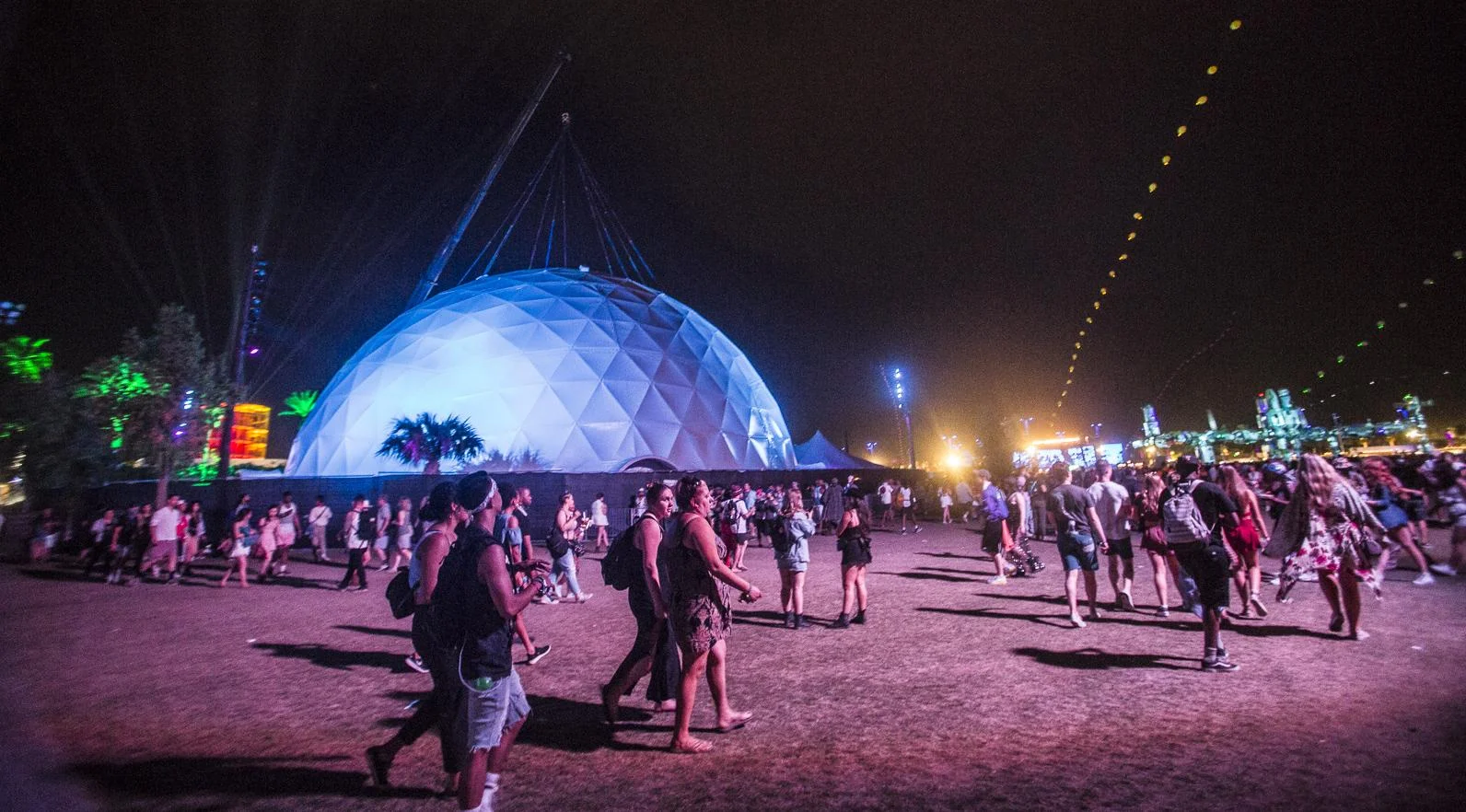
The Antarctic Dome at Coachella
ARTECHOUSE
This summer, I’ve had the fantastic opportunity to create an exhibition in the digital art gallery Artechouse in Washington D.C. Usually being branded as an interactive gallery, we chose a more immersive approach. Apart from 8 VR stations that could be used to watch all my Virtual Reality work, the centerpiece of the exhibit was a 270° projection screen, for which I created a 21-minute film.
People would be able to sit in beanbags in order to immerse themselves in the fractal worlds.
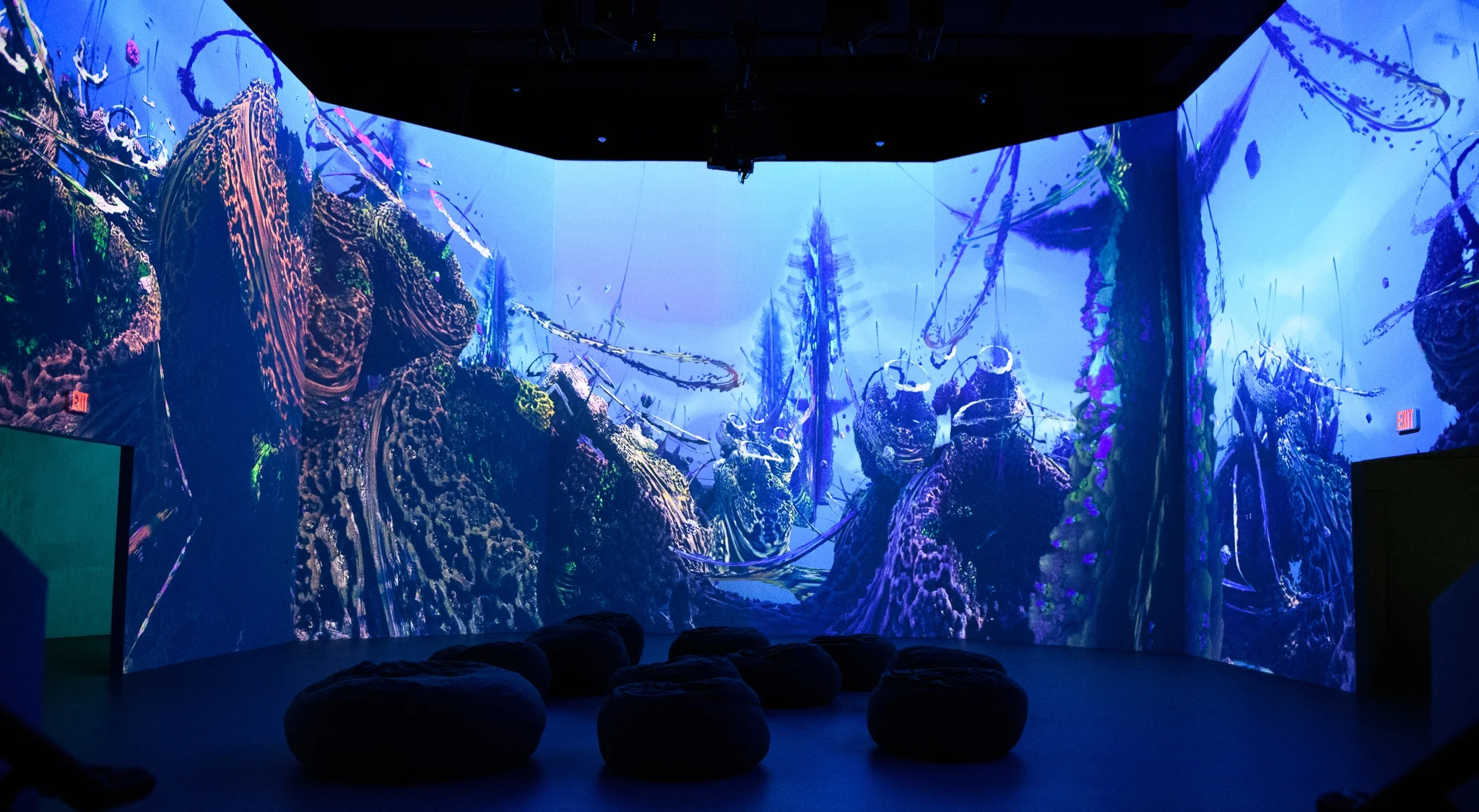
The Fractal Worlds exhibition in Artechouse, Washington DC
After receiving many positive reactions from visitors, I was convinced that this large-screen immersive format works well, which is why I have been focusing on Fulldome for my latest film, A Strange Travelogue.
FULLDOME
What is the Fulldome format exactly?
Imagine completely immersing yourself in fractal space. There’s shapes and formulas around you, 360 degrees. Like in VR.
Now imagine cutting that space in half, and you’re left with a dome, that encompasses 180 degrees of your vision. Usually in a dome theater, this dome fills the roof and the walls, leaving only the floor unprojected. When sitting in a chair or beanbag, looking up, you’ll have the sensation of actually being in this massive space between the fractals.
Isn’t this the same as VR? If VR is 360 degrees, and Fulldome is only 180, why not render for VR?
VR has two major disadvantages. One is that the resolution isn’t that high, so many of the fractal detail gets lost. Fulldome goes as high as you like. The other is that VR is always a solitary experience that can’t really be enjoyed together.
For me, dome theaters are magical temples – movie theaters dedicated to astronomy, science and art. What more could you ask for?
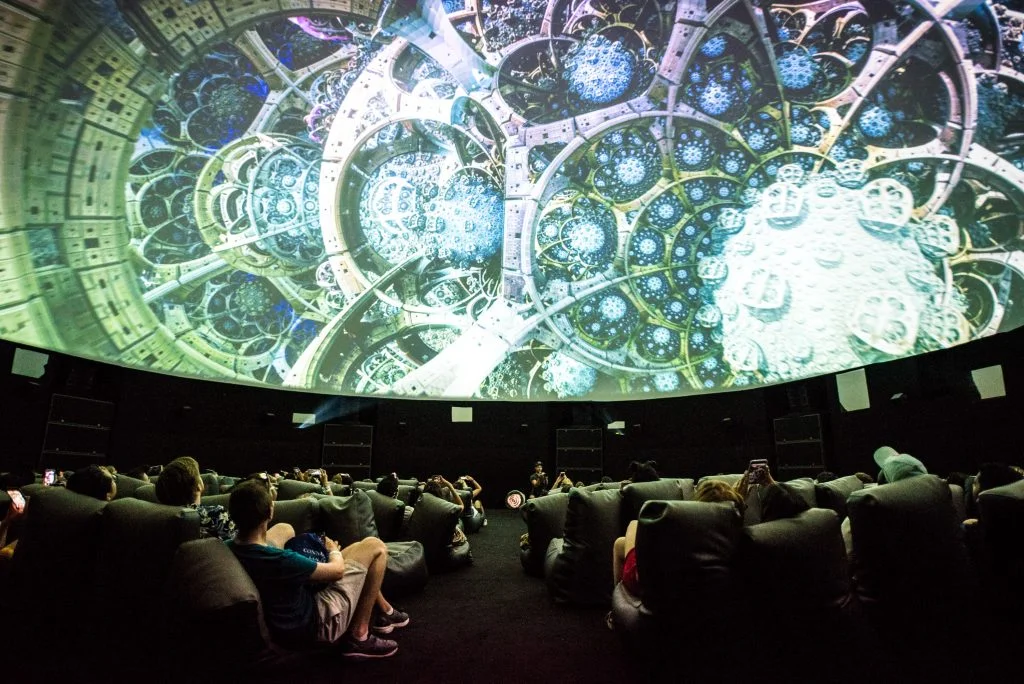
A still from my work at the Antarctic dome at Coachella, sponsored by HP
This isn’t the first time I’ve worked with the format. In 2015, the SAT in Montreal contacted me if I was interested in re-rendering my VR film The Cryogenian in Fulldome. Also, earlier this year, I collaborated with Infinity Marketing and artists such as Beeple and Teun van der Zalm on a Fulldome piece at the Coachella Arts and Music festival.
A STRANGE TRAVELOGUE
My new film isn’t fully finished, as I want to change scenes here and there, and the music has yet to be composed. I’m talking to David Levy for this. He created the music for “Fraktaal” and the exhibition “Fractal Worlds” in DC. Yet I’ve organized several pre-screenings in Moscow, LA and Miami.
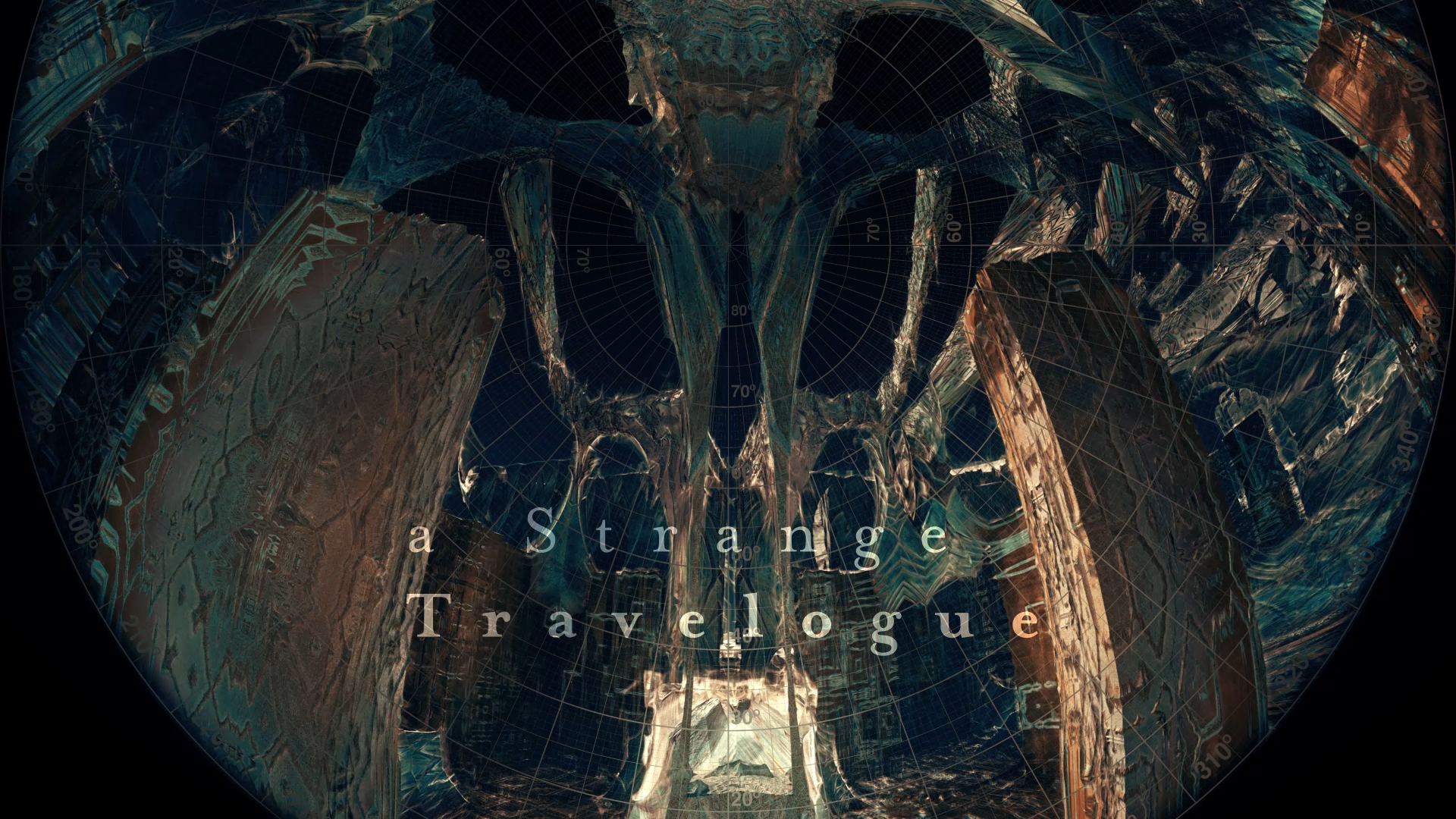
Current poster from my new Fulldome Film
Since it’s the first time I’m creating a Fulldome-only film, I’m still searching for the perfect timing and pacing. I hope to perfect this in future versions of the film, and future dome films.
Julius Horsthuis

Fractal Art Isn't Random or Artificial Intelligence
This is the comparison I make when I talk about fractal art. It’s an art, no question about it, but the comparison should be with the photographer, not the painter. Just like the photographer for National Geographic, we are explorers. We explore vast mathematical landscapes that aren’t of our own making, but we may be called pioneers, visiting places that no human has yet gazed upon. This is exactly what the most fulfilling part of the creative process feels like. Exploring, in ultimate wonder, wondering what’s behind that ledge, or what happens when we change the Minimum Radius, or go into Julia mode.
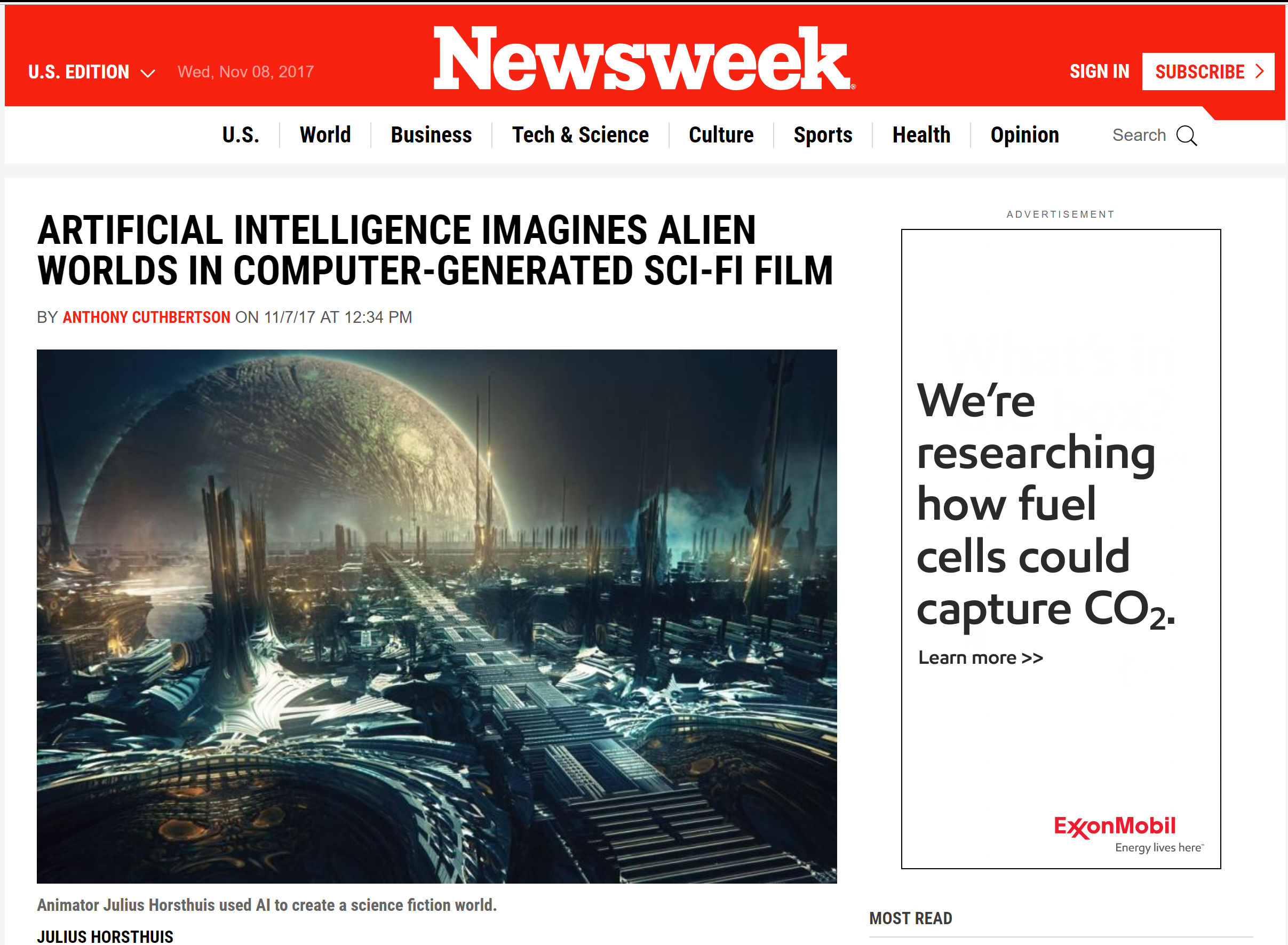
The Newsweek article
This is of course dead wrong. There has been no artificial intelligence involved at all in the making of this film, unlike my recent work ‘Recurrence’. But catchy headlines are good for views, and indeed, views have been racking up faster on this fractal than any of my previous work.
However, the mistake is not completely illogical. I’ve written about how I’m a ‘lazy animator’ who:
“Using fractals, I can conjure up entire worlds without having to draw or model anything. These shapes hide in the formulas, they exist in a mathematical reality, all I need to do is explore those worlds and make them reveal themselves.”
There’s nothing random about it (because each time the same process would lead to the same result) and there’s no AI involved, no neural networks, no learning, no iterative processes. On the other hand, there’s not much human input either.
No human input? Let me nuance that statement. A human (me) created the animation of the camera, the decision on lighting setups, the compositing – not to mention the music, which was of course laboriously composed by the very talented David Levy, whom I owe much gratitude for boosting this piece deep into the sci-fiosphere.
The short film in question, Fraktaal.
But imagine we would set all those artistic aspects aside for a moment. What’s left is the unimaginable alien world defined by fractal math. Does the fractal artist ‘create’ that? Although this isn’t easy to answer, I'm going to be blunt and say ‘no’.
Let me explain.
Fractal Art Isn't Art
In my work in the VFX industry I hate to use the word artist. Which is why I opted to call myself a VFX designer. VFX artists absolutely exist, but the term artist is applied so broadly that it’s lost its meaning. Roto artists are very skilled craftsmen, but are they artists? Wanna visit the Roto Museum of Modern Keys?
I absolutely do not want to start a discussion of what constitutes art, but I do want to express my opinion that I have problems with the term fractal art. In my experience, artists are people who meticulously hand-paint every detail, are constantly aware of both the small parts and the whole, and who are thoroughly disciplined. A fractal artist doesn’t have to know how to draw details, because she gets all the detail in the world for free. Also, she doesn’t need to be disciplined at all, since the computer does all the work and whatever settings you put in, something superficially amazing looking will come out no matter what.
Do not ever compare a fractal artist to a real artist.
But is this the whole picture? Is this the right comparison to make?
Not all artists draw or paint. Some dance, perform. There are those who use words as shortcuts to the detail of the imagination, yet others wield bulky photographic equipment to instantly capture detail that was there all along, only now it has been framed into a certain light.
This is the comparison I make when I talk about fractal art. It’s an art, no question about it, but the comparison should be with the photographer, not the painter. Just like the photographer for National Geographic, we are explorers. We explore vast mathematical landscapes that aren’t of our own making, but we may be called pioneers, visiting places that no human has yet gazed upon. This is exactly what the most fulfilling part of the creative process feels like. Exploring, in ultimate wonder, wondering what’s behind that ledge, or what happens when we change the Minimum Radius, or go into Julia mode.
The alien cityscape from Fraktaal I visited a long time ago, when I first started with fractals in 2013. I had forgotten about it, until I found an old picture. I had a sudden urge to go back, because now I had new skills under my belt. The place was still there, unchanged, beautifully haunting as before. So I started exploring this realm again.
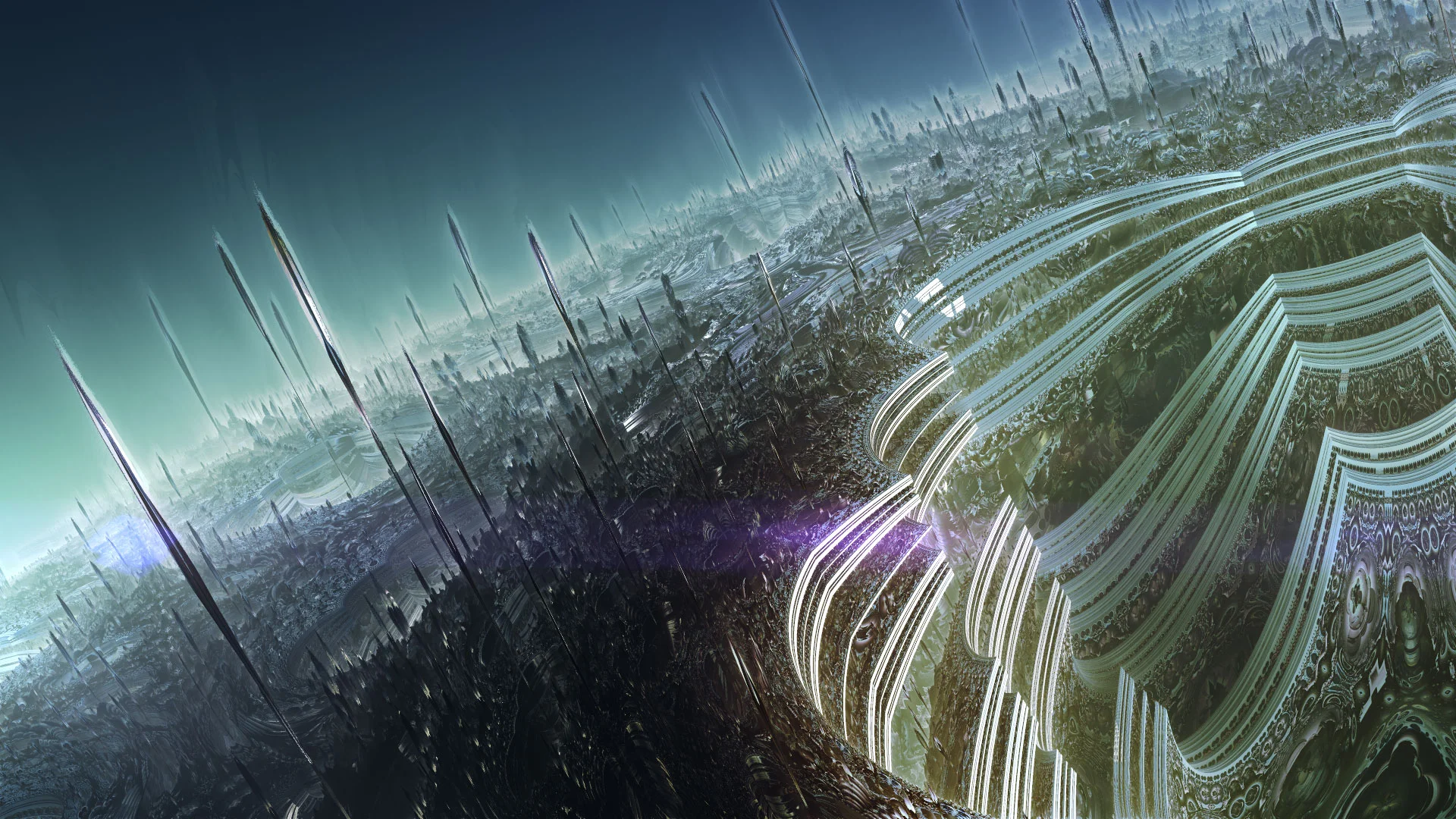
A render from early 2013, which formed the foundation of Fraktaal
And just like the photographer we know when we’ve found the right spot. We then set up our gear, we find the right angle, we set the right light.
This, to me, is what makes fractal art art. It’s not Artificial Intelligence, it’s just simple humans that found a way to explore new dimensions, other places. Travel, without moving.
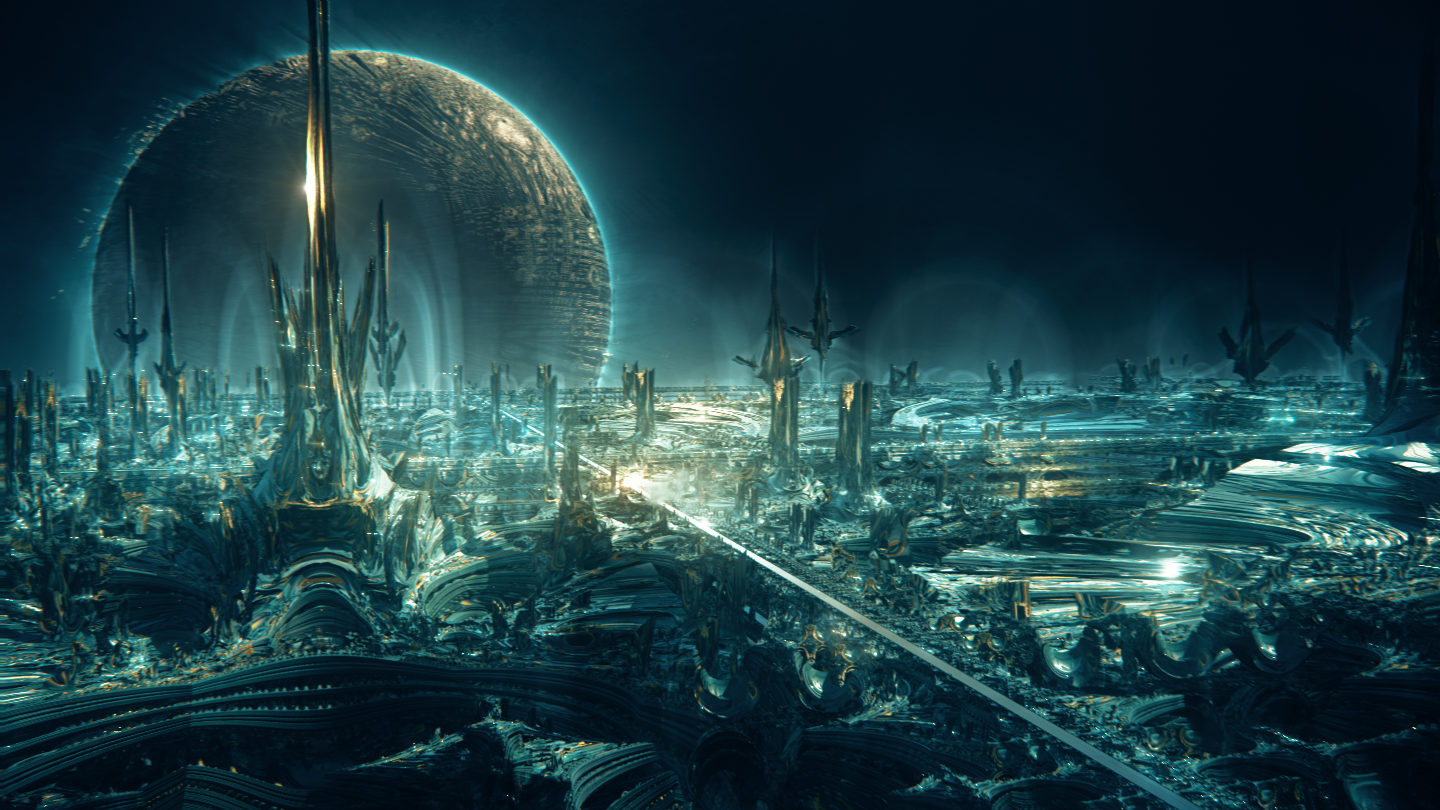
The same place, revisited.
Julius Horsthuis