
Inversive Geometry and Sidestepping
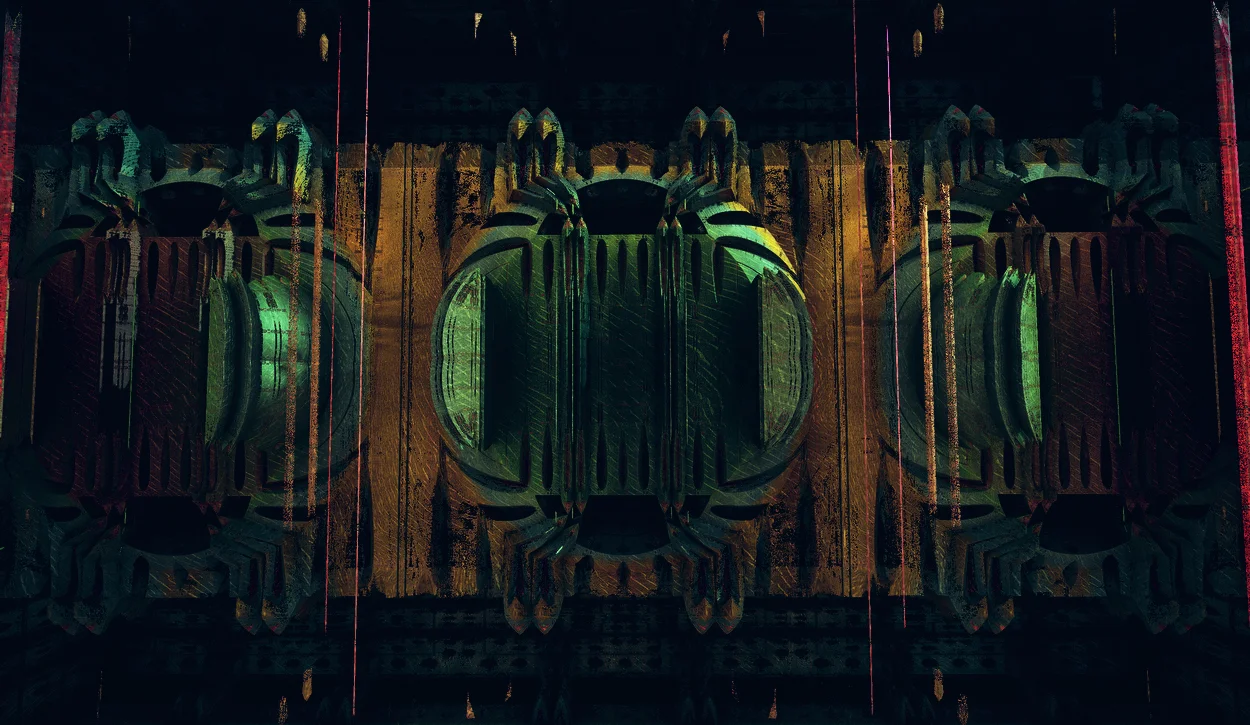
The effect is best described as some mysterious sphere or orb of dark matter or negative energy that moves through the fractal space. When I was rendering some shots for this film, it became clear to me that the orb itself was a mirrored and warped version of the world around it, which I thought was very cool. After doing some research, I found that this effect is called Sphere Inversion, or Inversion in a Sphere, and is a subset of Inversive Geometry.
Sphere Inversion
My latest Fractal Short, Sphere Invasion, is a sort of exercise in a specific Visual ‘Effect’. It happens quite a lot in the fractal realm, but I never really understood what was happening exactly.
The effect is best described as some mysterious sphere or orb of dark matter or negative energy that moves through the fractal space. When I was rendering some shots for this film, it became clear to me that the orb itself was a mirrored and warped version of the world around it, which I thought was very cool. After doing some research, I found that this effect is called Sphere Inversion, or Inversion in a Sphere, and is a subset of Inversive Geometry.
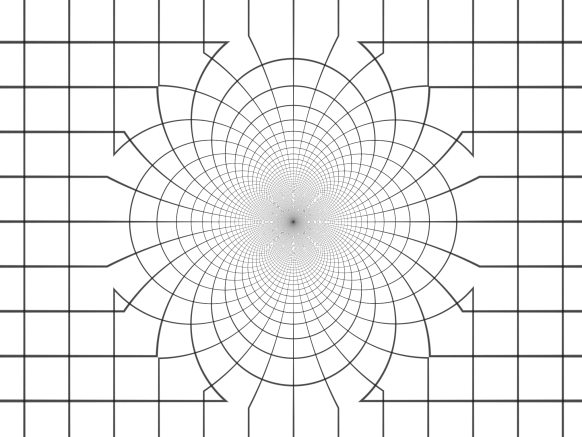
The effect of 2-dimensional inversion in a circle
I see the above pattern everywhere in the fractals, and now I understand it’s just the extended grid that is inversed in a circle. (the circle itself is invisible, as is the sphere in my fractal short, only its inversion shows)
We get the interesting effects only when we start moving this sphere through the space, and it starts bending, and folding everything accordingly. I used the fractals to create a semi-realistic space, for the effect to feel like it’s this uncanny entity from another dimension that’s fucking with our earthly dwellings.
This in turn made me think it would be a cool effect to use in other, non-fractal, Visual Effects. I would love to see a Dr Strange type of character that’s able to bend space conjure up these inversive spheres. It should be relatively easy to accomplish if you have software like Houdini that already has a realistic-looking 3-dimensional environment.
How much cooler would Sphere (1998) be if they found an Inversive Sphere on that underwater spaceship? Although the sphere in that movie doesn’t reflect people, what would your own reflection (or, inversion) look like?
I’ve never seen this effect in any movie, animation or game yet, but perhaps this has already been done before. If I missed something, please let me know in the comments, as I’m very curious.
These ideas really fire me up, and this reminded me of another Visual Effect that I thought of years ago, but has been too wild to make, or even explain. I called this effect ‘Sidestepping’
Sidestepping
Yet, after all these years I’ve still never seen an example of this. In order for me to explain, I ask you to bear with me and to join me to a time where I hadn’t yet discovered Mandelbulb3D.
I was working in Visual Effects, more specifically the software 3DsMAX. This is a professional 3D package that’s very versatile, and lets you create models, scenes, animations, simulations and a whole lot extra.
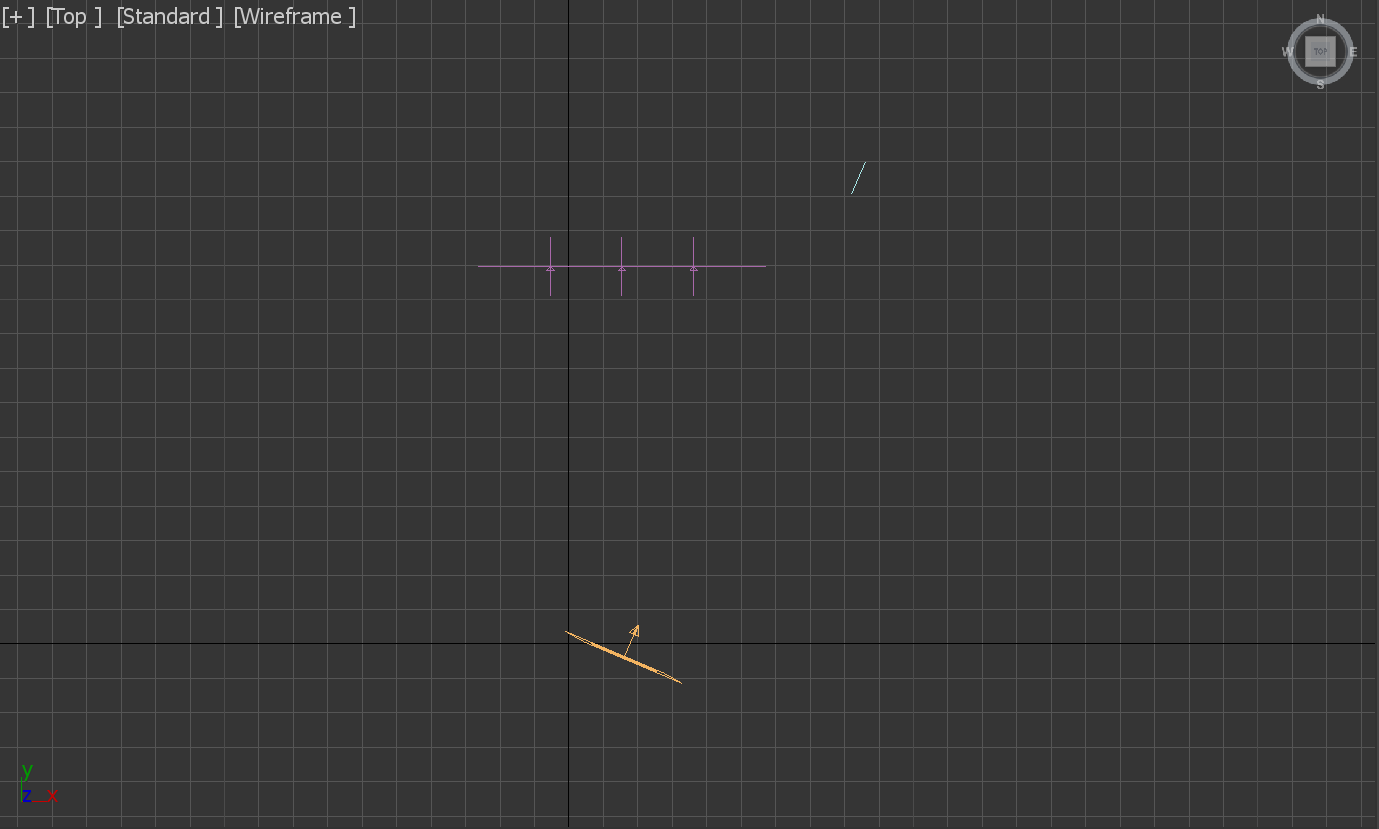
In Visual Effects, we often have to create things like explosions or bullet trails, and we using something called a particle system. A particle system can be thought of as a ‘gun’ that fires particles. It can fire many particles, but for this example we only need a single particle. There’s also a ‘reflector’ in the scene, a plane that will reflect the particle if it hits.
Let’s say that the particle gun fires the particle at the first frame, frame 1. It needs 30 frames to travel through the air before it hits the reflector. At frame 40 it has bounced back a little bit.
The cool thing with the particle system in 3DsMAX is that you can keep the time slider at frame 40, while rotating the gun as if it was rotated at frame 1. So, I can ‘aim’ the particle gun and in real-time see its effect on the path of the particle, including its behavior after it reflected. If I rotate the gun so that its path is no longer blocked by the reflector, the particle will instantaneous jump to the other side of the reflector, because it has now been traveling in a straight line for 40 frames in stead of having been bounced back at frame 30.
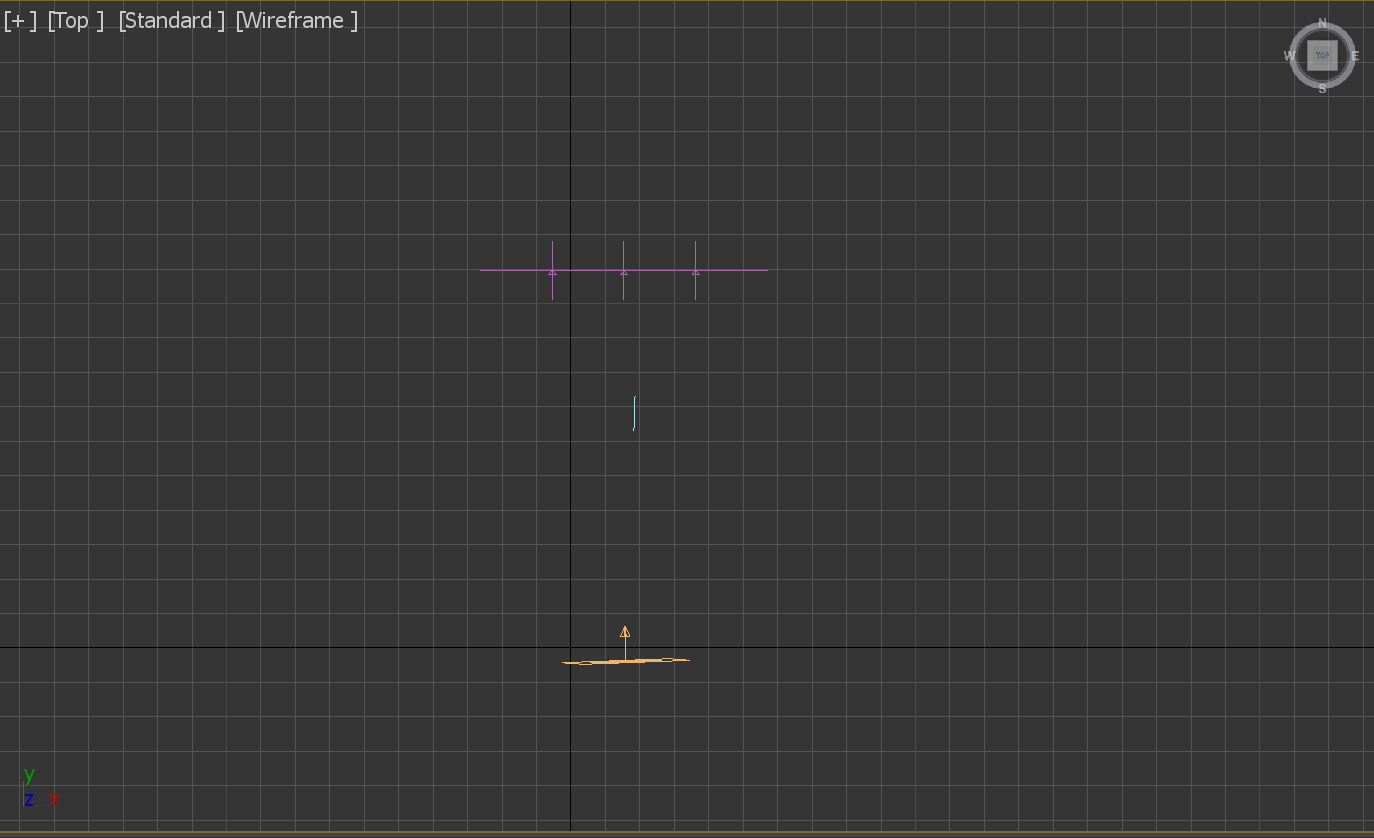
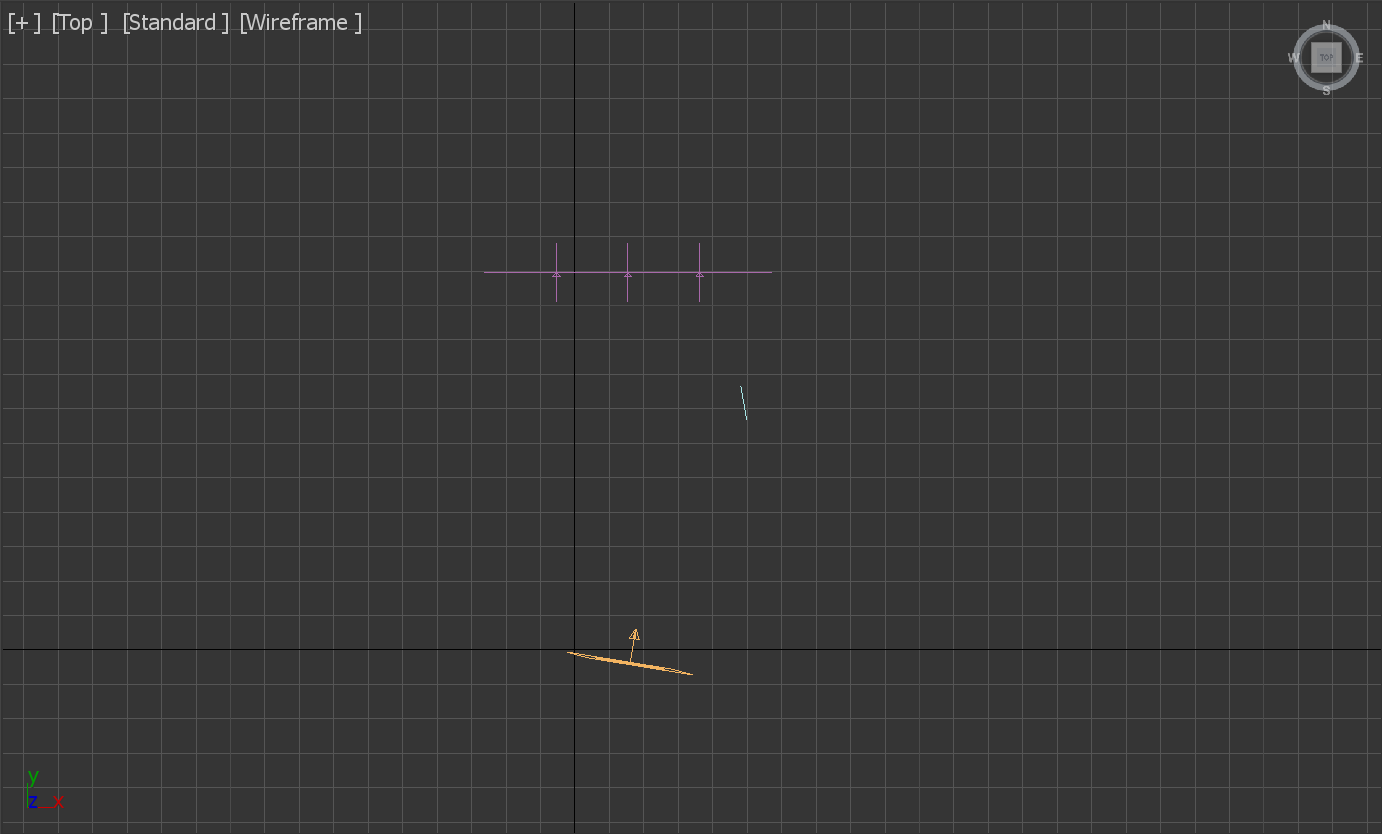
There’s nothing very special with this but let’s see what happens if we take a more realistic scene. Setting the stage for a bad-ass lady with a shotgun and only a single shell. From the moment she pulls the trigger, the shell flies out of the barrel and starts its path of destruction. Imagine it hits the windows, shattering the glass, which flies ever which way. Now we stop the time, (frame 40 in the last example) and see what happens if she’d aimed a little bit more to the right. A different pane of glass is now shattered, while the original one is suddenly unscathed. As she moves further to the right, suddenly none of the glass is hit, and it’s the concrete wall that’s wasted.
We can follow the various possibilities of her one and only shot, to see the effect of each decision she must make. It’s like sidestepping through various timelines. Not moving back or forward in time, but moving to other versions, versions that differ in only a minuscule amount. Although multiple timelines have been done before, I’ve never seen them represented a single continuous shot. A shot consisting of multiple versions of frame 40.
Back in 2010, when I was getting enthusiastic about this, I discovered there’s a simple machine that creates this illusion perfectly, and it’s called the Time Fountain.
It’s a simple contraption consisting of a pump that drips water droplets and a stroboscope that’s synced with the rate of dripping. If the sync is perfect, it creates the illusion of the droplets being frozen in mid-air. But when you then start manipulating the droplets, you can see the effects later down their path in real time. It’s truly unique, and although I don’t own a time fountain, I had spent many times with my stroboscope at the bathroom sink in order to experience this amazing effect first hand.
Look at 1:00 to see the effect I’m talking about.
Back to the Visual Effect. I imagined the coolest looking implementation of this would be with explosions, rockets, and other simulated effects like debris and fire/smoke. Simulations where very hard to do, because although you only need frame 40, for each frame, you need to run the entire simulation.
And because chaos theory is a thing, small increments in the beginning of the simulation can have large differences later down the line, and when playing all the frames 40 in a row, you can see its erratic behavior.
These are old low-quality renders and animatics from around 2011 I created to illustrate the effect.
After I discovered fractals, I haven’t really looked back at this idea. I was sure someone else had probably thought of this too, and I would see some kind of implementation someday, somewhere. Yet almost a decade has passed and I’m still not aware of this effect ever been used somewhere.
Finally, This is a scene from the movie script I wrote where the main character SARA sidesteps in order to escape certain death.
INT. ARCHIVES SIXTH FLOOR / GAME - DAYA large space with EMPTY SERVER CABINETS. A massive GUARD runs at her screaming with a KNIFE, but she shoots him down with her SHOTGUN from about five meters. Almost simultaneously a SECOND GUARD appears from her side, and shoots her in the chest from less than a meter away.FREEZE TIME - Guard 1 hangs LETHALLY WOUNDED in MID AIR, as Sara - HIT by the second guard - SIDESTEPS. As she starts to move her shotgun away from the first guard, towards the second, we see the TRAIL OF DESTRUCTION shift. As it leaves the first guard, he is back on his feet and the trail and its impact move towards the second guard.The moment the bullet trail has reached the second guard, the situation changes so that he is hanging wounded in mid-air, and Sara is NOT HIT. TIME back to NORMAL. Guard 2 hits the ground dead, while Guard 1 continues to RUN towards Sara. She manages to incapacitate him with the butt of her gun.
Spaced Out or Stretched Out- VR storytelling ideas
I've decided to share some excerpts from a piece I'm writing on VR (virtual reality) storytelling. These are thoughts and ideas that I's like to experiment with, improve upon or throw away if they don't work. If you have any additional ideas or comments about mine, I invite you to write them down in the comments section
I've decided to share some excerpts from a piece I'm writing on VR (virtual reality) storytelling. These are thoughts and ideas that I'd like to experiment with, improve upon or throw away if they don't work. If you have any additional ideas or comments about mine, I invite you to write them down in the comments section.
Discarding events
In screenwriting, one learns that scenes must turn. If, at the end of the scene nothing has changed much in respect to the beginning, the scene should be thrown away. This is at least what I learned from Robert McKee's book 'Story: Style, Structure, Substance, and the Principles of Screenwriting'. McKee proceeds to explain that scenes can turn through either action or revelation. A character can do something that changes the dynamics of the scene, or something can be revealed to him or the audience, that puts everything in a different perspective.
It would be an interesting experiment to discard the action-device and rely solely on revelation. This is useful in VR because of the following.
The nature of 360 degrees is such that you can look anywhere you want at any given time. If you want the audience to look in a specific direction you could use a bag of tricks in order to increase the likelihood that he looks in the right direction, but this creates all sorts of problems, and I suspect the viewing experience would become very forced.
Never I want the viewer to have the idea he may have missed something because he wasn't looking the right way. This is why crucial story elements should never be events - moments in time and space - that you can miss. They are either only in time - but not tied to a place, or they are in the space, but spread out over time. This will put the viewer at ease, without him worrying that he misses out.
Therefor scenes will not turn through action, but only through revelation - as events must be either time OR space, but never both. I imagine that creating a story that is forced to adhere to these principles must create something compelling and original. The following are examples of events that are spaced out or stretched out:
Imagine we're in a frozen-time scenario. Time is non-existent, only through our (pre-directed) point of view. Moving through space, we can reveal something that was previously hidden, for instance discovering a person we didn't expect to be there. We should give the viewer time to make this discovery - but when he does, the scene has turned, climaxed, etc and the story propels forward. The next example is more metaphoric (or suitable for fractals). We could be in a tunnel that feels small, confined, and end up in a large space. Here the turn could be from claustrophobic to agoraphobic. We can go from horizontal caverns (sense of being lost) to vertical (fear of falling), etc.
Events that only exist in time may be less useful, but I can imagine it to occur from time to time. If we are to use voice over, or literal dialogue, what is being said can turn a scene regardless of where you're looking. Changes in lighting or color can be obvious from all angles and have enough impact to be immediately on the leading edge of your consciousness.
On the brink of two hemispheres
If the story demands some traditional scenes, how do we show them? I've always imagined it would feel a little amateurish to put a 360 camera in the middle of a room (set?) to record some actors playing. Without editing, interesting camera angles and lenses, even without any place to put your lights - how can you shoot something beautiful?
I don't want to create something where we are 'in the middle of the action' I'd still would want to be an observer, albeit one that can observe a hell of a lot more then one that watches a screen. When faced with these issues, interesting techniques come to mind, like split screen. We could continually be at two places at once, on the brink of two hemispheres. This makes production easier, as lights and sound equipment can be placed in the blind corner, and this heightens the feeling that we are not 'actually present' - we are in the virtual world - spying on the real world.
These ideas, especially the last one, are mostly applicable to a screenplay I'm writing, in which the protagonist, a young woman, thinks she is a human - flesh and blood, but actually only exists in the virtual world. She can see the world through cameras, computers, etc. and can easily be at two places at once.
Wouldn't it be great if the audience would experience what it's like to be virtual?