
Hardware and Rendering for Mandelbulb3D
I often get asked questions about how long it took to render the animation, or what kind of computer I have. I often forgo answering, partly because it's not an easy question to answer. But in this post I will try and answer them as best I can.
I often get asked questions about how long it took to render the animation, or what kind of computer I have. I often forgo answering, partly because it's not an easy question to answer. But in this post I will try and answer them as best I can.
How long does a typical render take? Well, I render on multiple machines (render farm), and the machines don't all have the same specs. Also, I don't always render the entire animation in one continuous session. I can only use the render farm when no 'real' work is rendering, so I have to manage the renders in all the down-time. This hopping on and off and machines with various specs make it hard to put a number on render time. Typically, my animations render between 5 and 30 minutes per frame, and I usually render about 2500 frames for a fly-through animation. The animations that are divided in 'scenes' usually have about 100 frames per scene, so that's usually less then a continuous fly-through.
Remember that I create in-between frames in After Effects. So the 100 frames that I render get multiplied to 500 using frame interpolation. This practice saves an incredible amount of render time.
So altogether it usually takes several days, or even weeks to render something on the farm.
So what kind of computer do I have? Well, some people assume some crazy GPU configuration, but I must stress that the current generation of Mandelbulb3D fractals do not make any use of GPU. It's CPU only, and the reason is that fractals use double precision whereas GPU only uses single precision. The coordinates are therefor not precise enough to create all the cool endless zooms in the fractal space. So GPU real-time fractals can be done, but you can only zoom in to a certain extent. I have seen some examples of this in VR - and I should think that in a few years on, something pretty amazing should be possible in real time.
But for now, it's all CPU, which means that the only thing you should be concerned about when tuning your Mandelbulb3D beast is CPU clock cycles. The more the better, more virtual cores, more physical cores. As it's multi threaded, it will pretty much consume 99% CPU an any PC. I don't know about the L1 L2 caches, but I imagine they won't make much difference. Memory is not going to be an issue. The program is 32-bit so it can't use more then 4 GB of RAM. A lot of people seem to think that more RAM will speed up the rendering, but it won't.
Perhaps somebody could find the sweet spot in the pricing of a PC with as many CPU cycles for the lowest amount of $$$, taking into account the cost of the motherboard you would need for the CPU and some cheap graphics card and RAM.
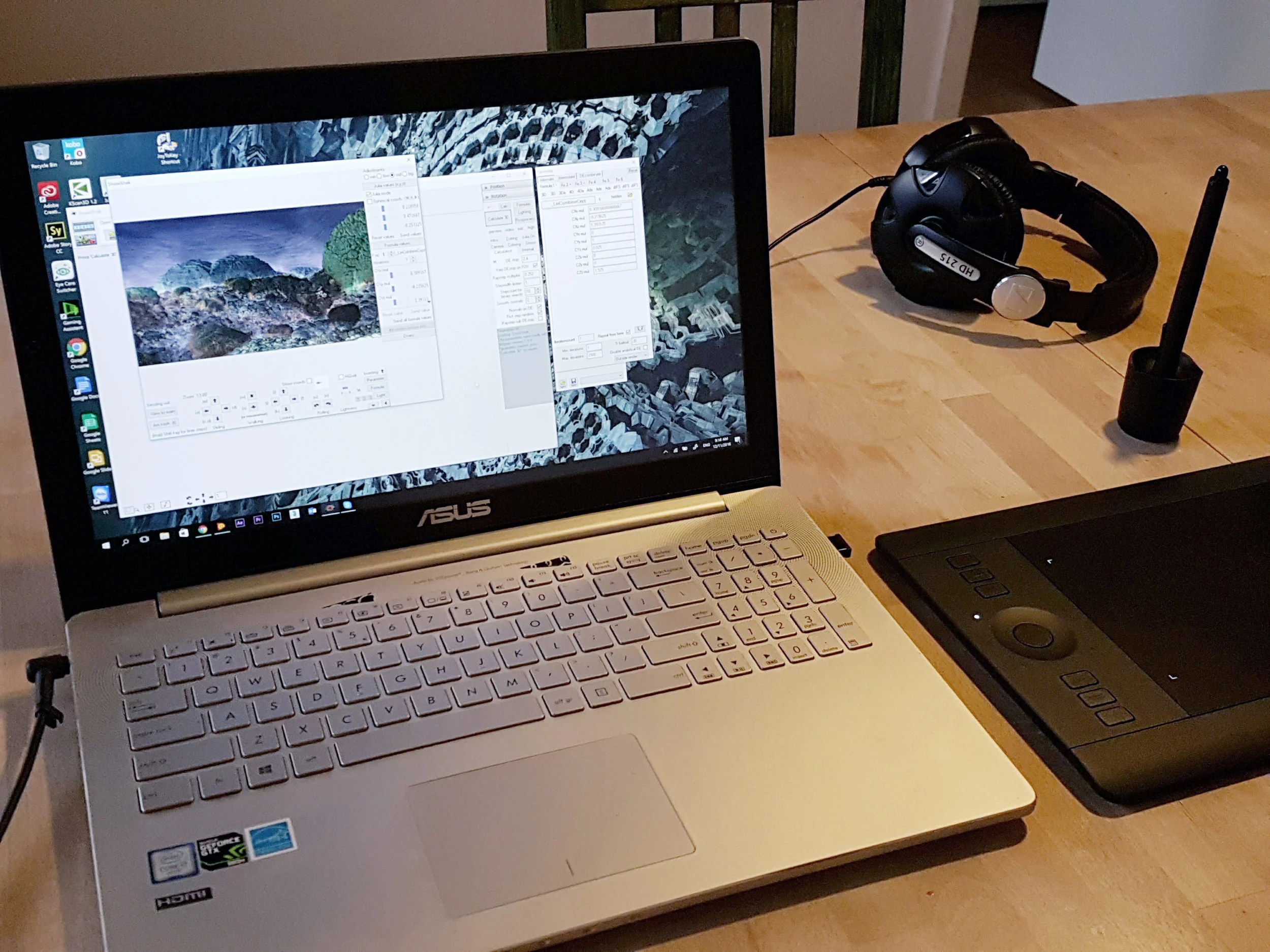
I've recently bought an ASUS Zenbook laptop, which I use for Mandelbulb3D and After Effects. I wouldn't use it to render animations, but I do create high-resolution stills on it, and I generally use it to create the fractals in MB3D in the first place.
I hope that these insights into the hardware side has proven useful for some people, looking for their own setups. And if I've made any errors, or omitted important information you think I should include, please let me know in the comments section.
Happy rendering.
True Stereoscopy
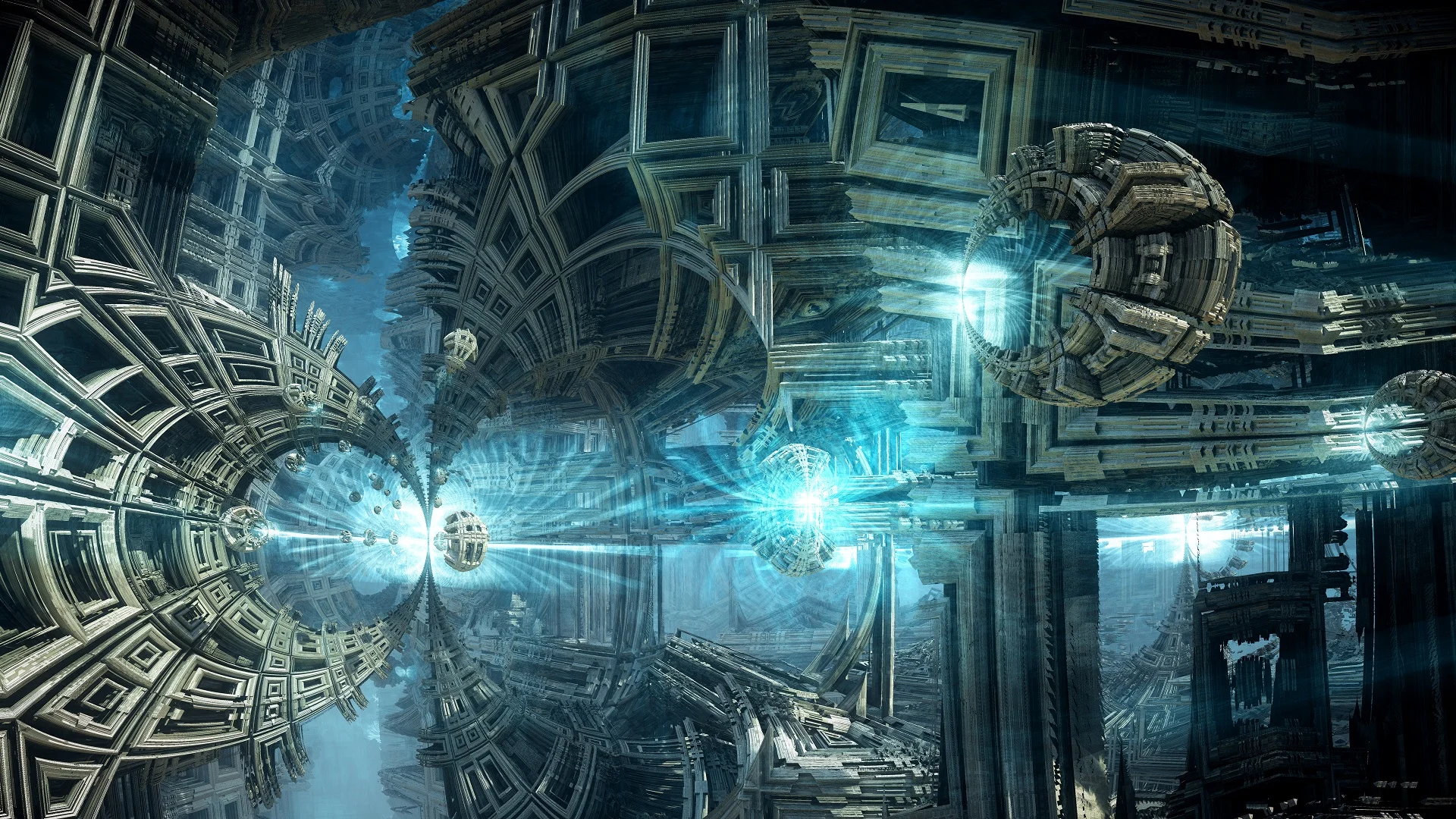
I've decided to render a true stereoscopic fractal flythrough - although it isn't 360 degrees. You can't look back, only forward, as it's a 180 degrees render. Still, it's as immersive as the other VR stuff, with the added benefit of being truly stereoscopic.
Although I don't think it's necessary to have 3D for 360 films, it is something a lot of people have asked for, for obvious reasons. I don't want to go into the technical details explaining what the issues are rendering 3D for 360 it suffices to say that it itsn't a walk in the park.
I've decided to render a true stereoscopic fractal flythrough - although it isn't 360 degrees. You can't look back, only forward, as it's a 180 degrees render. Still, it's as immersive as the other VR stuff, with the added benefit of being truly stereoscopic. The piece called "From Nothing" was also in stereo, but I faked the effect by offsetting the frame using the Z-Buffer, creating a faux 3d- effect not unlike badly converted 3D movies that were shot in 2D.
Dynamic Fog
It works really well, and the true stereo adds a lot of depth. Also I used dynamic fog to create transparent layers - something that true stereo excels at and cannot be faked or converted. In this picture, the blue glowing energy lines are what I call Dynamic Fog.
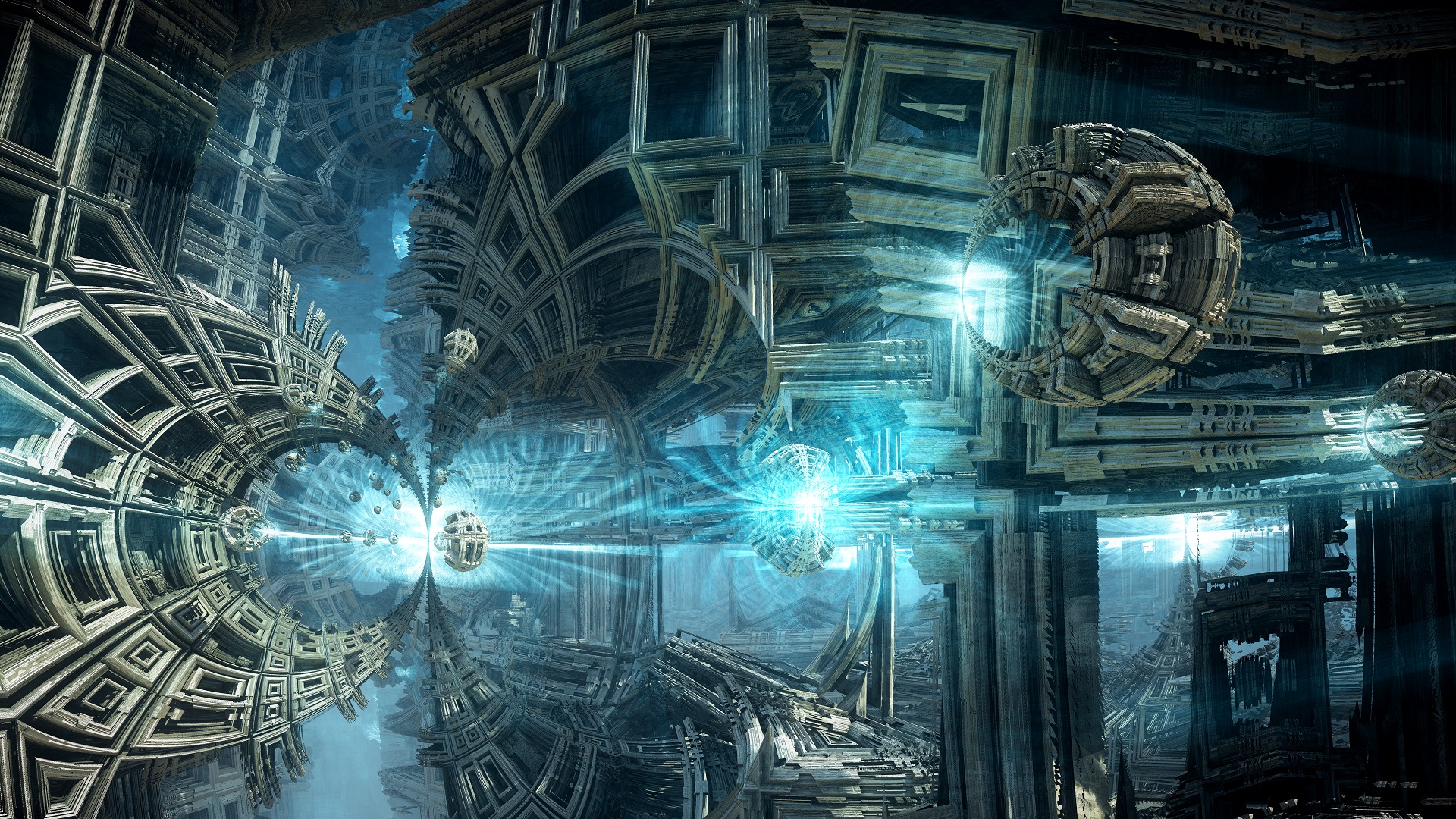
Dynamic Fog is a really cool feature of Mandelbulb3D in that it can create a volumetric effect based on the fractal formula. Some parts of the mathematical volume that aren't visible from the geometry can be made visible through the fog.
Most of the time the fog was gathering at the surface of the fractal, like fog hugging a mountain, giving usually an eerie, ghost-like, or electron microscope effect, not always something that I was looking for. Only recently I figured out how to control the location where the fog gathers, and even animate it. (In the 3D navigator, under Drivers, the 'Dyn Fog on its' and 'R Bailout' sliders) Although in this example the fog has overstepping artifacts and doesn't look as good as I hoped it did in 3D, I still believe there's a tremendous coolness to it.
Alice
In a fractal world, you can zoom in infinitely. In order to keep the very large and the very small manageable, MB3D keeps scaling everything all the time, depending on how close you are to an object. This is necessary for fractals, as you want to be able to get closer to the surface while expanding the detail.
Although I haven't used the effect much in this particular animation, and it sort of just happens, I can imagine how cool it would be to use it more pronounced; and have a fractal the size of a dollhouse just one meter in front of you scale to the size of a city. We would feel like Alice as she shrinks in order to fit through the little door in that famous book.
As I write this, the stereoscopic film is rendering, and it will be a while until it's done. Also I hope that there aren't too many overstepping artifacts, as this formula isn't very stable. I imagine that this works well for other types of immersive films though, as you don't constantly feel the idea you're missing out on what's happening behind you. Just sit back and enjoy the ride.
Ice Cave rendering and VR
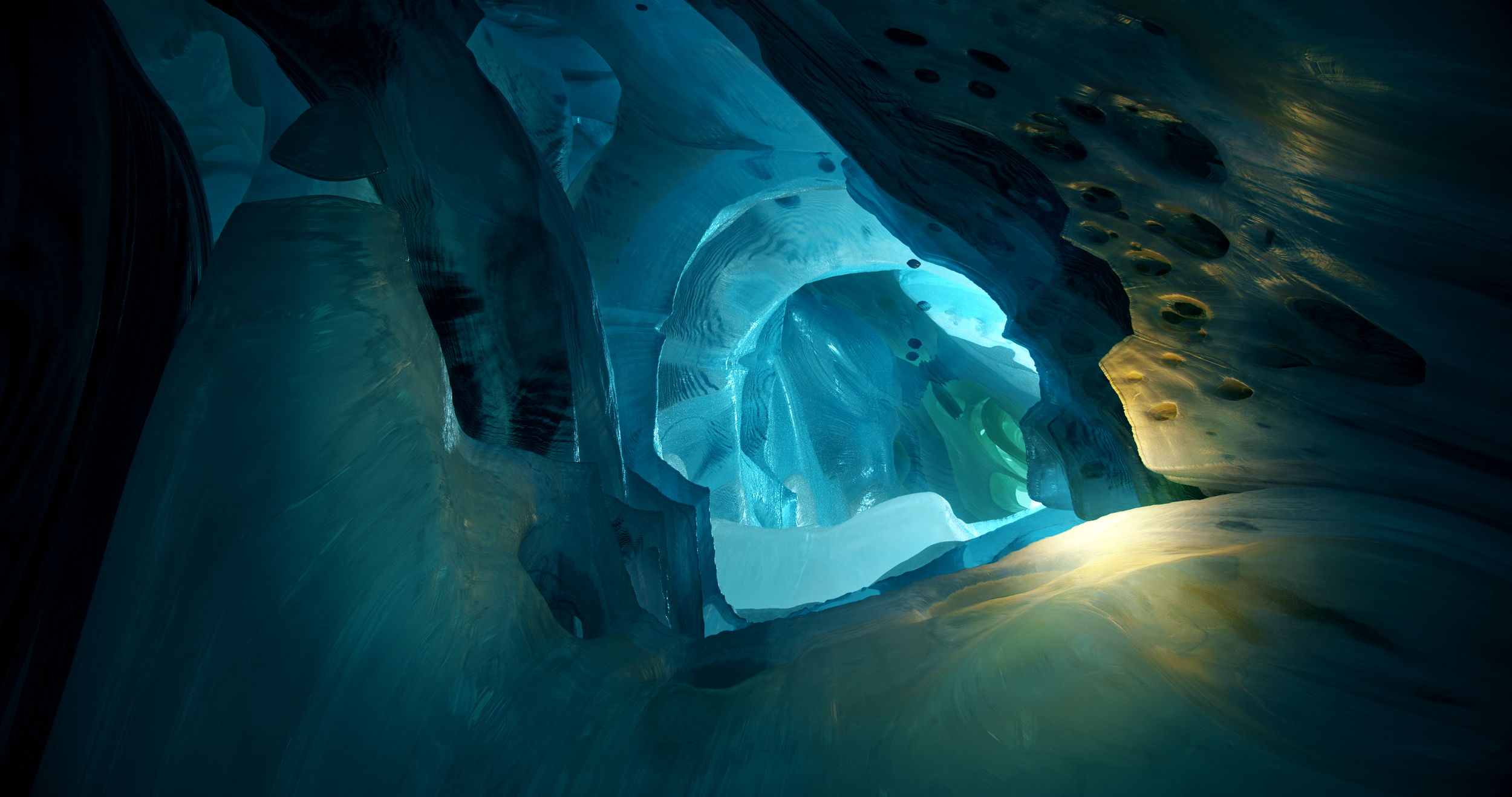
I'm currently doing a couple of 'Ice Cave' renders, and an animation is in the making. I'm not sure if it's going to be any good, because rendering refractive materials is not only extremely slow, but also prone to a lot of unwanted artifacts. But let's put the problems aside for a moment.
I'm going to use the Ice Cave examples to explain something about fractals that I've been thinking about for a while. I'll try to not to get too technical, and anybody with a mild interest in rendering or computer graphics should be able to follow it.
I'm currently doing a couple of 'Ice Cave' renders, and an animation is in the making. I'm not sure if it's going to be any good, because rendering refractive materials is not only extremely slow, but also prone to a lot of unwanted artifacts. But let's put the problems aside for a moment.
I'm going to use the Ice Cave examples to explain something about fractals that I've been thinking about for a while. I'll try to not to get too technical, and anybody with a mild interest in rendering or computer graphics should be able to follow it.
In CG, there's usually a difference between the shape of the object, and its texture. The shape is modeled in some software like digital clay, and then (after the object has been UV unwrapped) the texture is painted on. Now I'm oversimplifying this - in actual fact programs like Z-brush with their abilities to export high-res displacement maps make this distinction a little more fuzzy, but it's still pretty much true.
Take the example of a log of wood. The overall shape is being sculpted, and then a wood texture is applied. In real life though, shape and texture aren't distinct at all. The wood texture consists of little strands of material that make up the whole. To appreciate this connection, consider how the direction of the wood splinters indicate the direction of the tree as a whole.
Unfortunately, I'm not able to model a photo-realistic tree in Mandelbulb3d. But if I was, I wouldn't need to texture it, since the texture would emerge by the sheer fact that in stead of being a solid object, the fractal piece of wood would consist of thousand little wood splinters, giving the appearance of wood. Although usually you only see the outer layer, most fractals are infinitely complex layered objects like onions.

You can see this sub-surface property well in the Ice Cave example. This particular Mandelbulb formula is smooth and round, but it has detail in its surface, as well as holes. This is perfect for the scattering of light in a realistic way inside an object. I'd say I really like the (painterly) texture of this image, but there is no texture. There's only form.
I'm not saying that Mandelbulb3D is the best software for creating realistic ice or sub-surface materials (it isn't), but if this technique would somehow be improved in the future, the processes of modeling and texturing could change completely. In stead of recreating the appearance of a natural object, you would digitally recreate the process that created it. This is already feasible with simple objects like crystal, rock or ice. It would be harder to do for plants and extremely hard to do for animals and humans. But it would unlock an entirely new (semi-photorealistic) realm to render and explore.

I'm sure that some steps have been taken into this direction by clever programmers, and if you know about some cool tool that does this, please let me know in the comments.
VR
I'm considering rendering a VR version of the Ice Caves, although I'd have to think about where the hell I'm going to find enough render power to make that happen. VR is an extremely awesome way to experience fractals, and if you haven't tried it I really recommend trying to get your hand on one of the many VR devices that are coming out this year. There is a great team working on a cross-platform app that you can install on any of the devices (IOS, Android, Oculus, Vive, GearVR) in order to download and watch all my work in the best possible resolution. You should hear more about this when it will release.