
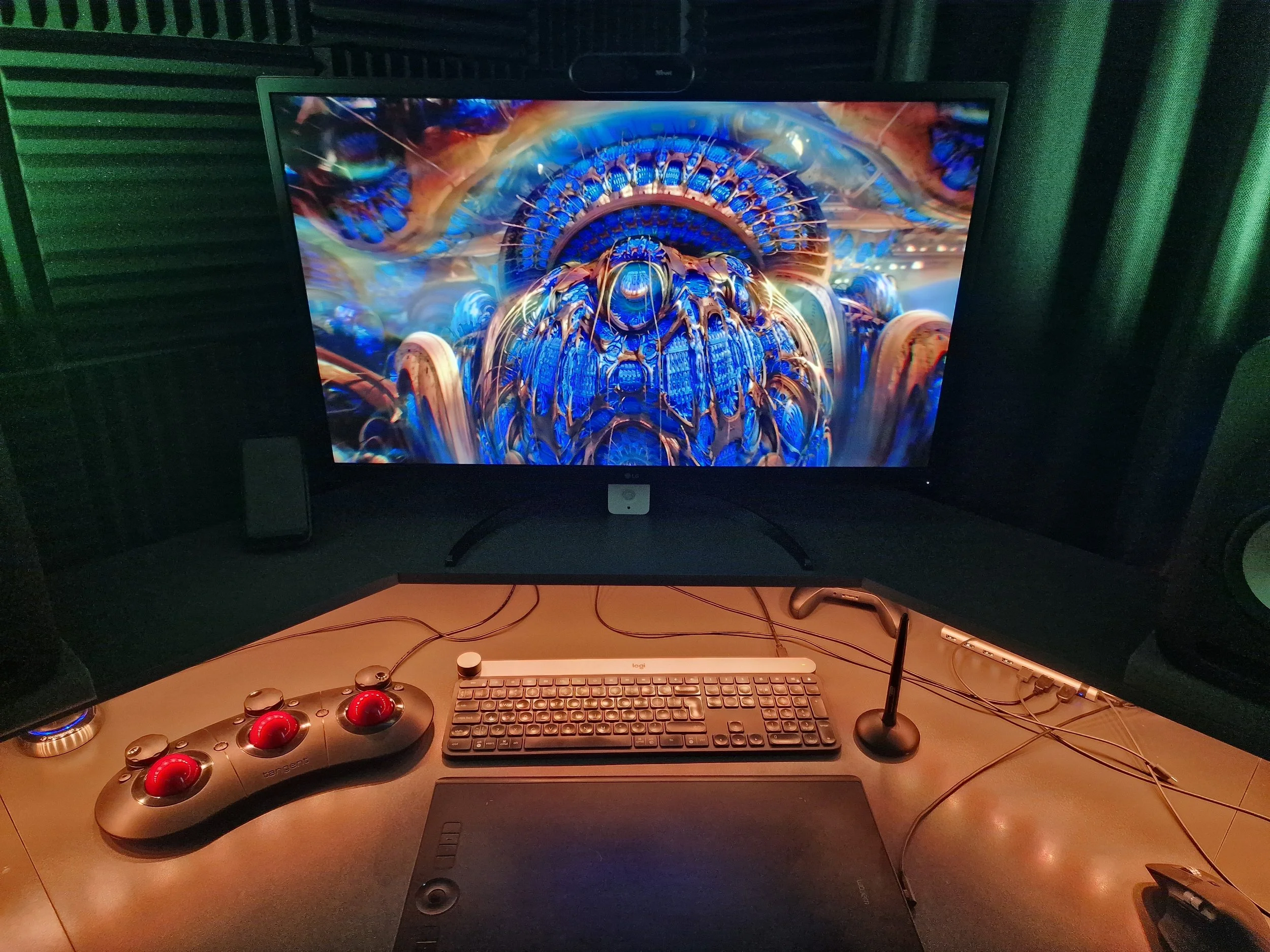
10 Fractalicious years
Today, December 30th 2023, a decade has passed since I published my first Fractal film on the internet. And what a decade it has been!
Today, December 30th 2023, a decade has passed since I published my first Fractal film on the internet. And what a decade it has been!
First of all, the community response has been overwhelming, warm and extremely encouraging. This has been the primary motivation for me to keep going into the depths in stead of staying at the surface. This meant that four years in I decided to quit my day job at a VFX house and for the last six of those years I’ve had the opportunity to live and breathe fractal art.
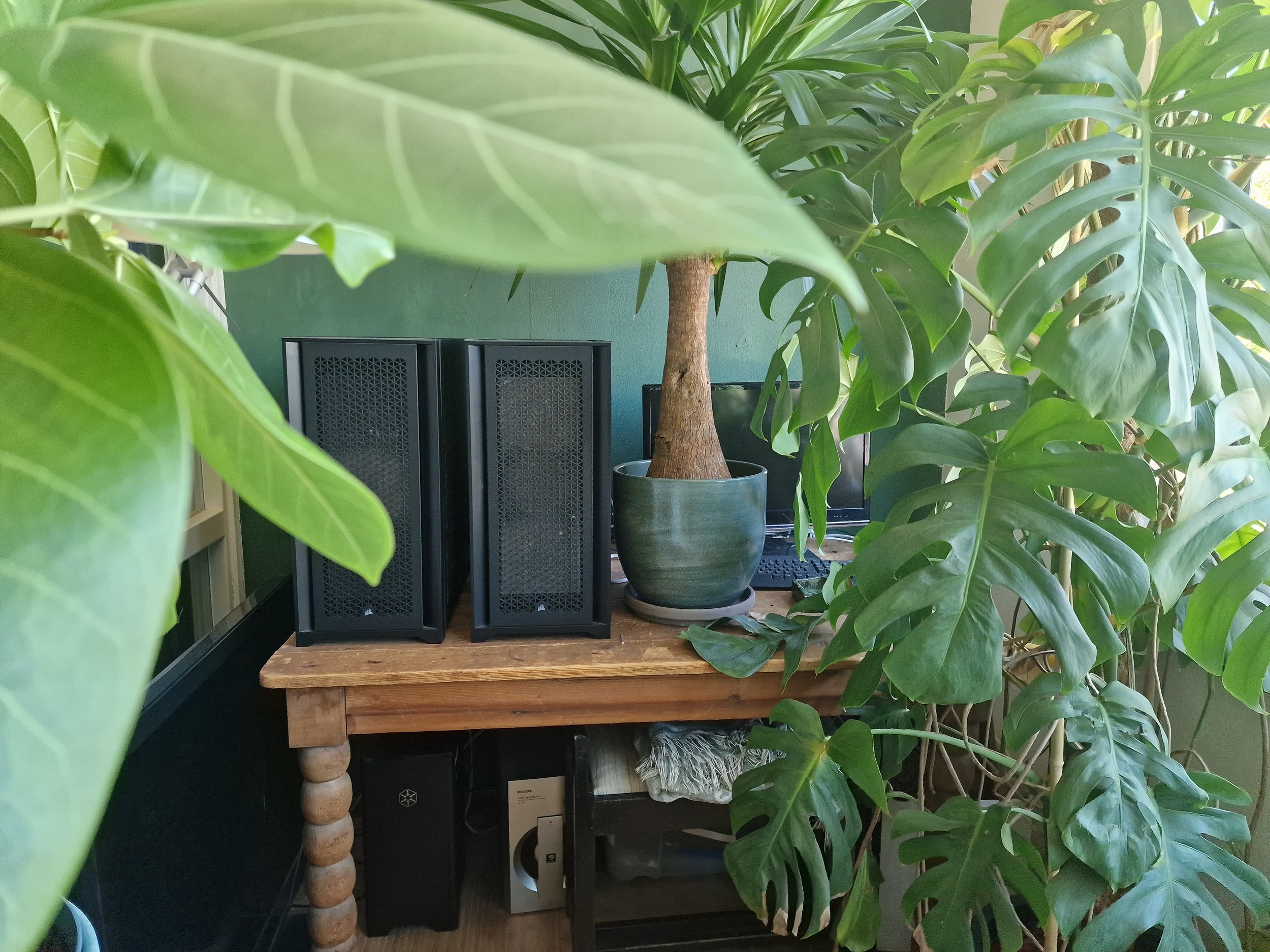
Creating fractals has always been a delicate dance between artistic intuition and technological abiliy. Fractals take a notoriously long time to render, and this is especially true the higher the resolutions, the more immersive and lengthy the experiences become. So, In order to maintain my addiction, I had to accrue a not-so-modest army of CPU cores heating my Amsterdam apartment both in summer and winter time.
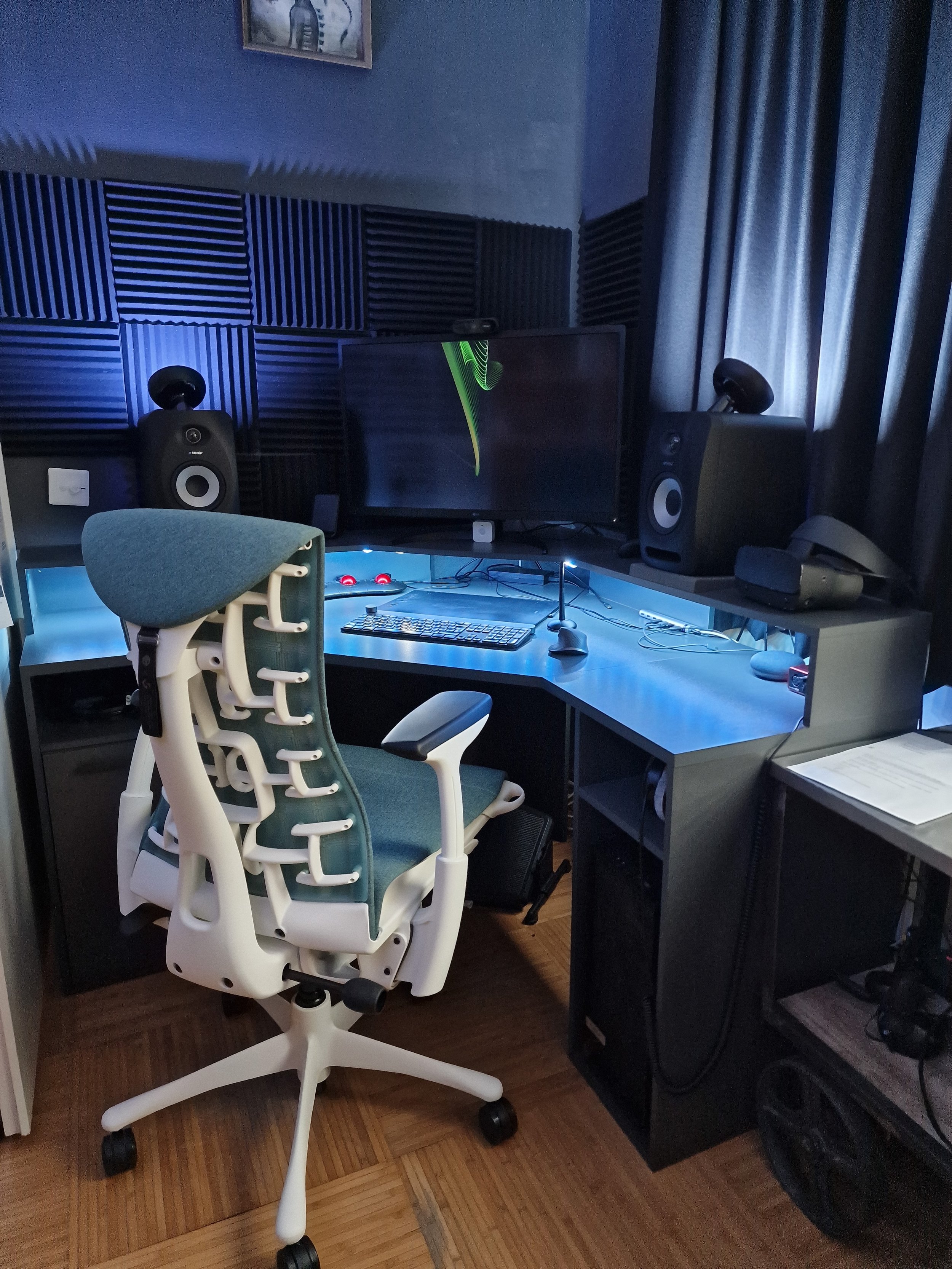
Recognizing that this was ultimately untenable, all the while encouraged from all you amazing followers around the world to explore ever more immersive worlds, I decided to start a proper studio that saw the light in October of this year. Right in the center of Amsterdam, next to the Central Station is a lovely studio / atelier that is now 50% a fractal exploration place. (the other 50% is by Wildvreemd, a foundation by Steye Hallema that does amazingly creative things with smartphones, VR storytelling and other tech-related experiences.)
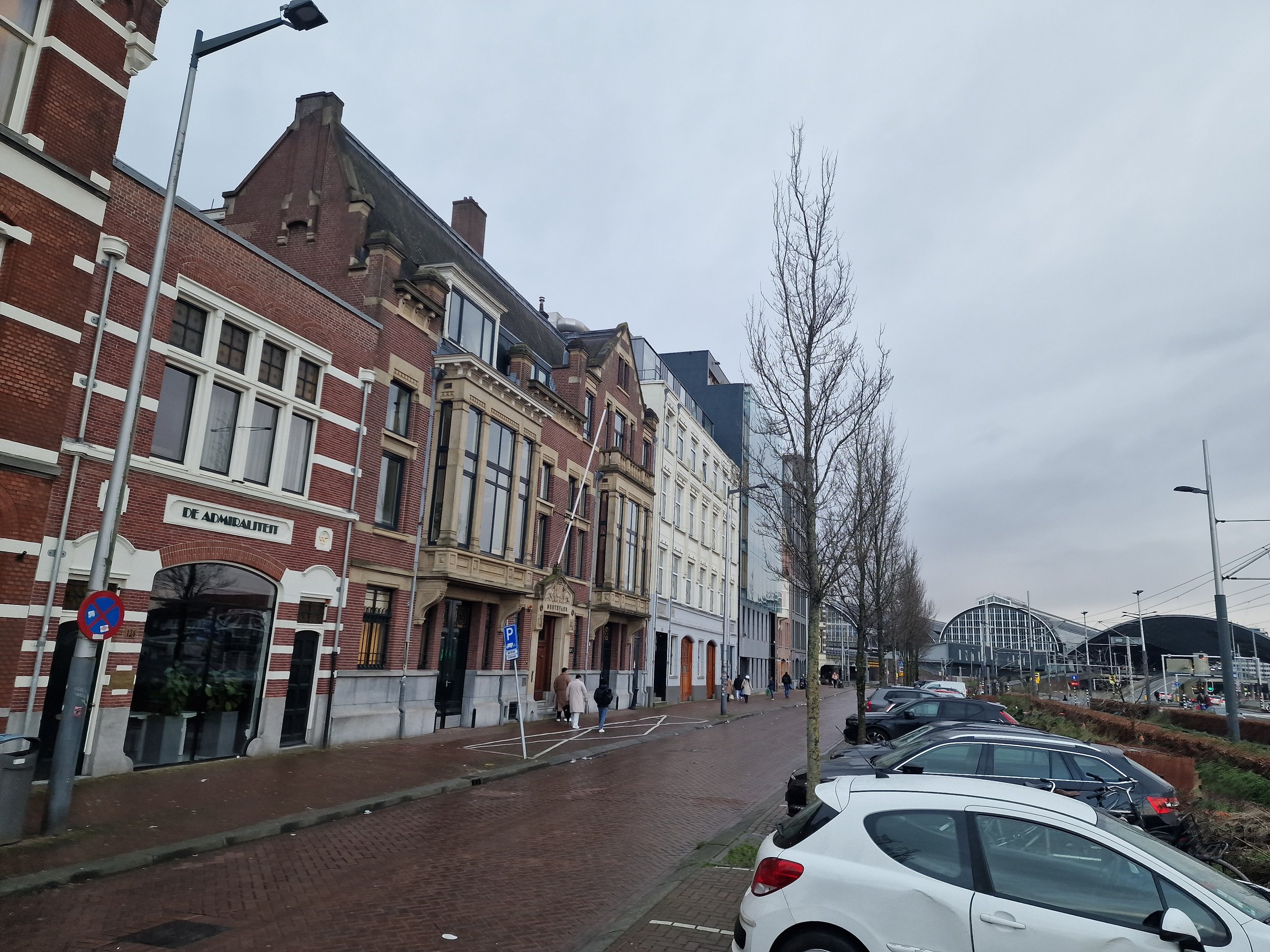
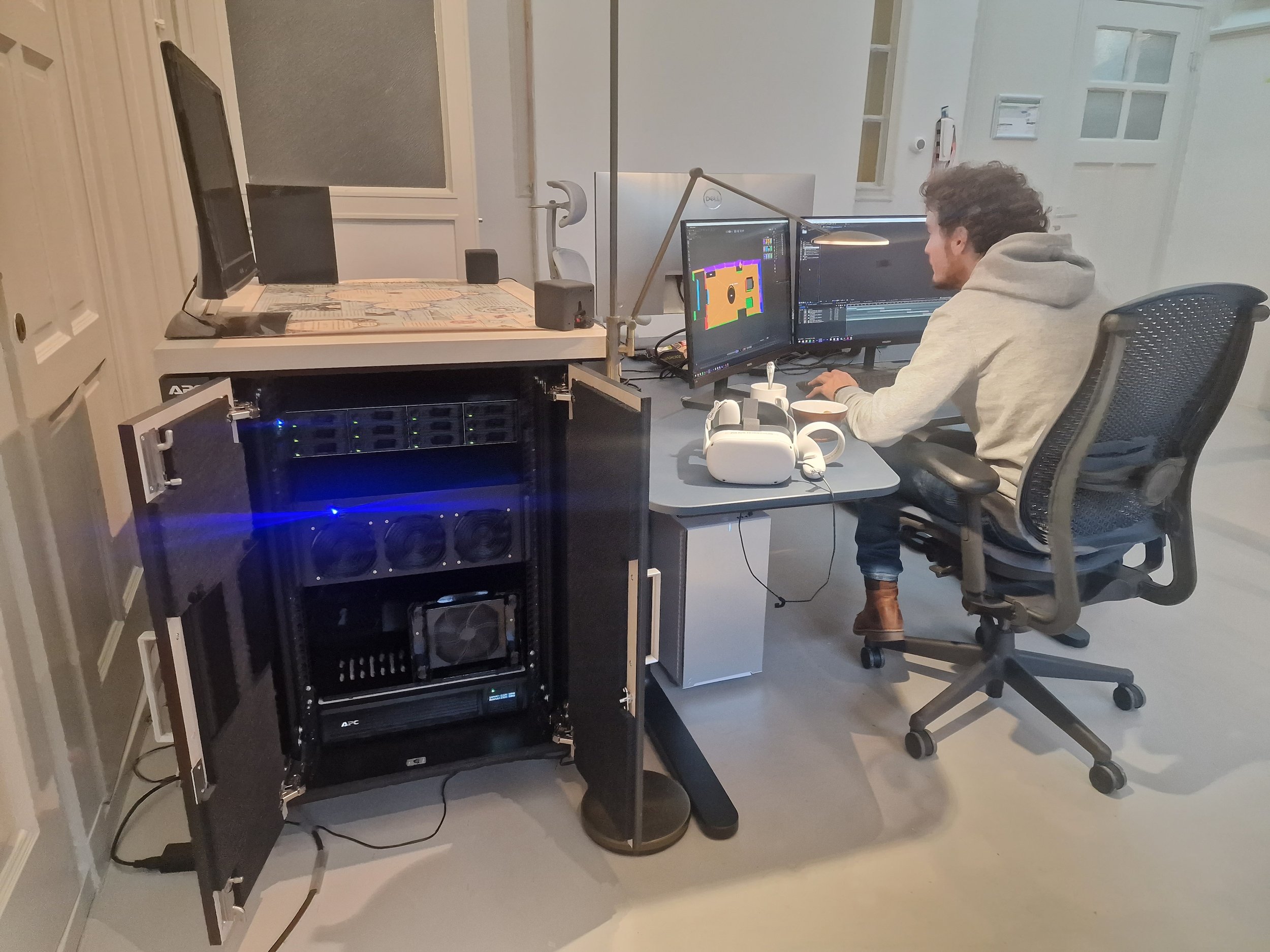
The aim of the fractal studio is simply to be able to streamline the creation of fractals so that more thought can be given to the higher order concepts. What more stories can we tell with fractals, or shouldn’t we want to tell any stories with fractals and simply treat them as visual music? These questions are hard to answer if we don’t try, experiment, fail and learn. To help me answer these I asked Simeon in ‘t Veld to join the team. Simeon and I have worked together on VFX jobs in the past, on VJ shows at Boom festival and he’s an expert of all things fractal, film and visual. The studio will also provide some room to expand in terms of people and/or technology if, for instance, Vegas calls and wants their brand new sphere filled with fractaliciousness. (the heat would’ve probably burnt my apartment down)
Another angle to the studio would be to explore more ways to interact with fractals. At the moment I’m using Mandelbulb3D almost exclusively as a source for multi-dimensional recursive mathematics, but this doesn’t always have to be. It has been heart-warming to see so many people embrace fractal art while it’s simultaneously true that there are still many people today who’ve never seen any 3d fractals and are baffled by the worlds they produce. This means there’s so much room for us to grow, as Machina Infinitum has shown by creating fractal plugins that allow you to explore fractals in real time, as well as allowing for modern, quality rendering.
Since I’m trained to think like a cameraman or director real-time has never been my focus, but I have to admit it opens up many interesting possibilities.
Perhaps the studio could facilitate more of these explorations in the future. In particular, Desmond Germans who collaborated with me on the VR album Recombination (still available for the Quest 2 & 3!) is currently looking into creating a 3d fractal explorer that utilizes VR technology and the latest in CPU and GPU rendering to eventually alleviate and overcome the friction that is increasingly holding Mandelbulb3D back from soaring into the second quarter of the 21st century.
For the immediate future the focus is on creating immersive experiences. This can be for spaces such as ARTECHOUSE or NXT museum, domes like Omniversum and SAT, or VR. My particular enthusiasm at the moment is aimed at high resolution LED walls, which just look absolutely great and allow not only for extremely sharp images, but also smooth (HFR) and new color palettes (HDR)
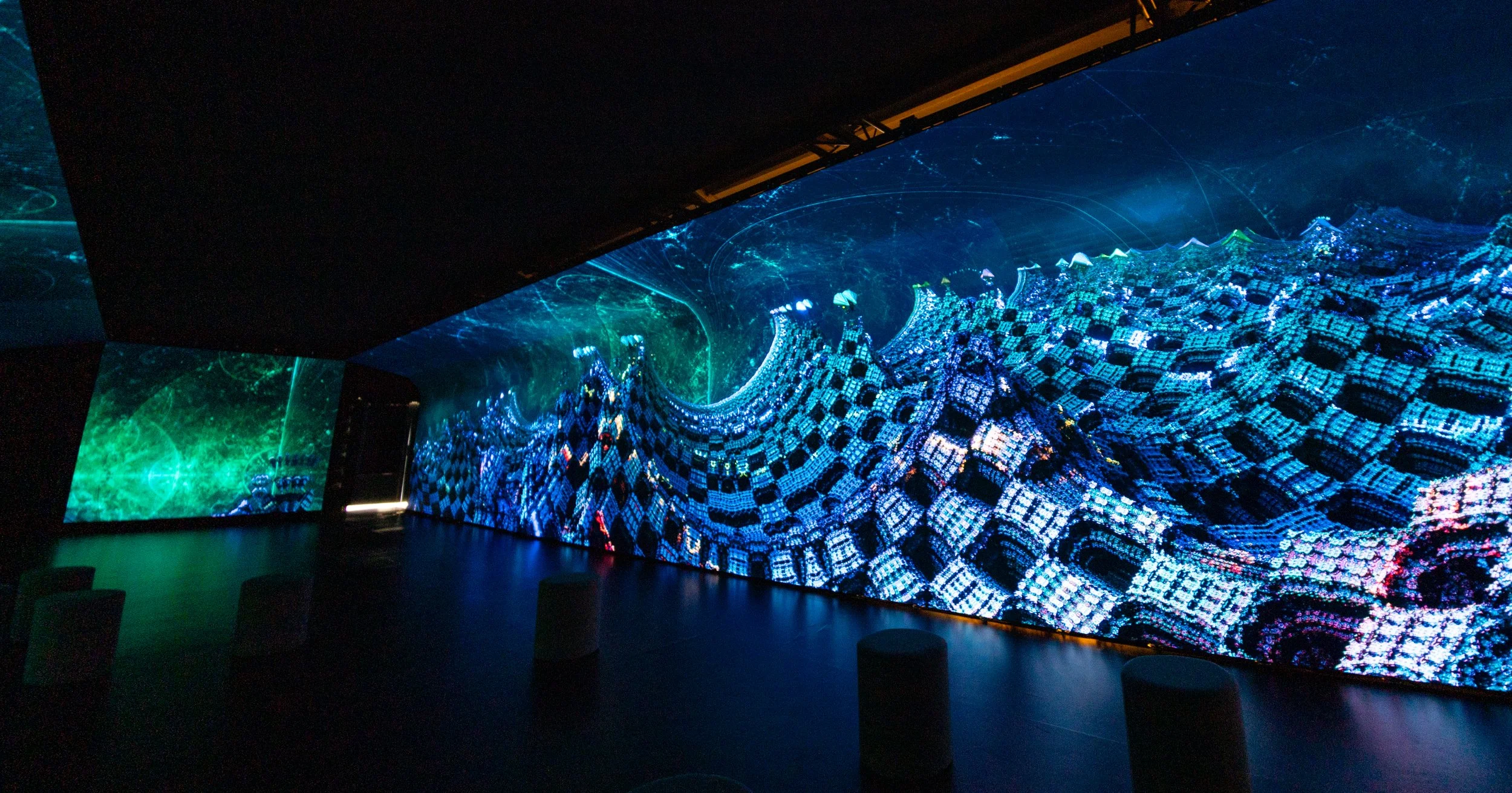
Recursive Reflections in Hangar Y in Meudon, France. An example of high-res LED technology.
On December 30th, 2013, I pressed ‘publish’ on Geiger’s Nightmare, without knowing what that would set in motion.
A few months before that moment my colleague, talented 3D artist Lars Snelders, had found and downloaded Mandelbulb3D for me after I expressed my interest in 3d fractals. I suddenly had the urge to create a short mini-film of it, and I used the music of my father, Maurice Horsthuis, who’s been a composer for most of his life. (now he’s a painter!) His orchestral piece for Der Kübelreiter was perfect for showing the hidden cinematic properties of this über-digital artform.
If you don’t have any followers on any social media and you publish something for the first time, not much happens. I had to spend a lot of time posting my mini film on Vimeo to forums, blogs and other places in the hope that it would get noticed. Without a community, we fail. Facebook, for all its faults, has no doubt been the kindest to fractal art and the community Mandelbulb Maniacs in particular has stood out as a place of vital encouragement.
The past decade has been the most wonderful and humbling of my life. The people I’ve met, places I’ve been both physically and virtually, and the privilege to be able to make a living out of my passion. All of you, all of it. Thank you for all of the support. Thank you if you pressed ‘like’ on Vimeo in 2014 or if you came along at a later stage. Thank you all for believing in art that doesn’t have to make a statement or have meaning. Art that just is. Complex or simple, colorful or black&white, static or volatile, but always structured, always stylish.
Like visual music.
Have a wonderful 2024!
Julius Horsthuis
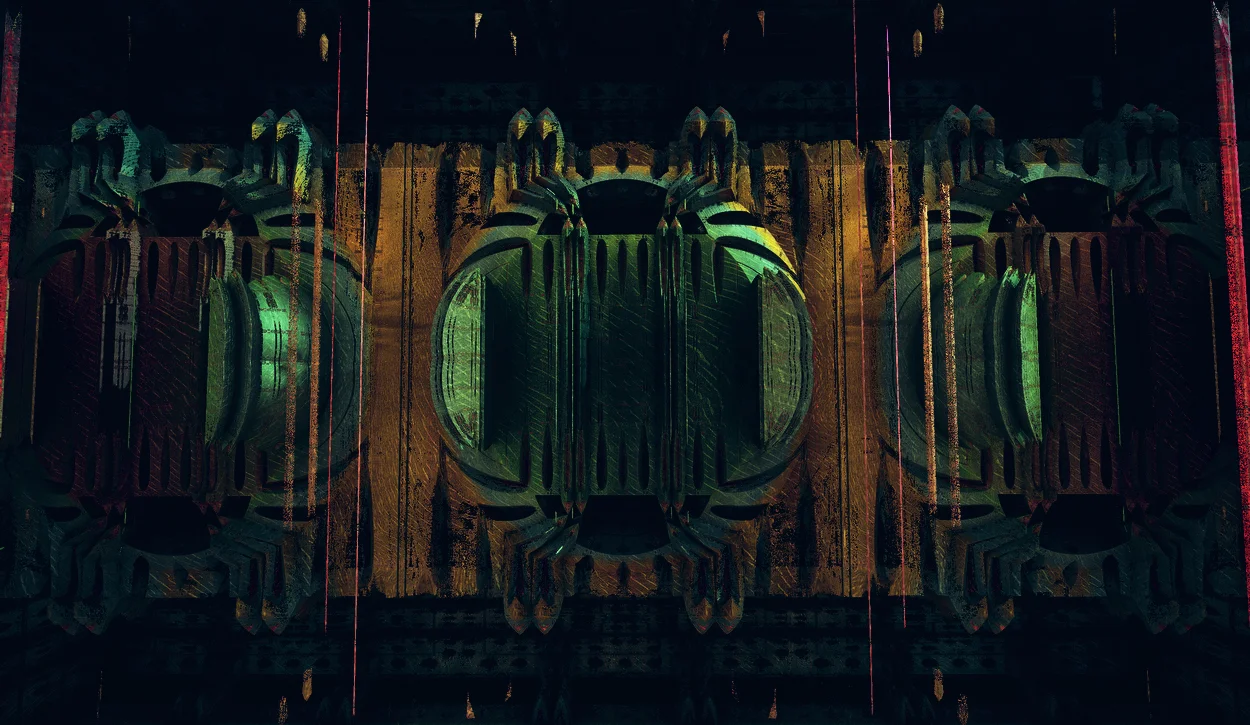
Inversive Geometry and Sidestepping
The effect is best described as some mysterious sphere or orb of dark matter or negative energy that moves through the fractal space. When I was rendering some shots for this film, it became clear to me that the orb itself was a mirrored and warped version of the world around it, which I thought was very cool. After doing some research, I found that this effect is called Sphere Inversion, or Inversion in a Sphere, and is a subset of Inversive Geometry.
Sphere Inversion
My latest Fractal Short, Sphere Invasion, is a sort of exercise in a specific Visual ‘Effect’. It happens quite a lot in the fractal realm, but I never really understood what was happening exactly.
The effect is best described as some mysterious sphere or orb of dark matter or negative energy that moves through the fractal space. When I was rendering some shots for this film, it became clear to me that the orb itself was a mirrored and warped version of the world around it, which I thought was very cool. After doing some research, I found that this effect is called Sphere Inversion, or Inversion in a Sphere, and is a subset of Inversive Geometry.
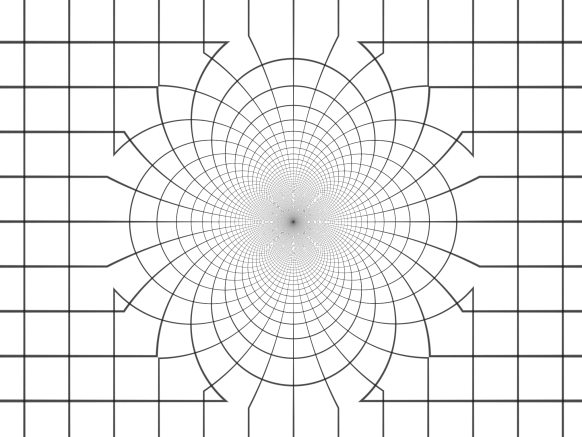
The effect of 2-dimensional inversion in a circle
I see the above pattern everywhere in the fractals, and now I understand it’s just the extended grid that is inversed in a circle. (the circle itself is invisible, as is the sphere in my fractal short, only its inversion shows)
We get the interesting effects only when we start moving this sphere through the space, and it starts bending, and folding everything accordingly. I used the fractals to create a semi-realistic space, for the effect to feel like it’s this uncanny entity from another dimension that’s fucking with our earthly dwellings.
This in turn made me think it would be a cool effect to use in other, non-fractal, Visual Effects. I would love to see a Dr Strange type of character that’s able to bend space conjure up these inversive spheres. It should be relatively easy to accomplish if you have software like Houdini that already has a realistic-looking 3-dimensional environment.
How much cooler would Sphere (1998) be if they found an Inversive Sphere on that underwater spaceship? Although the sphere in that movie doesn’t reflect people, what would your own reflection (or, inversion) look like?
I’ve never seen this effect in any movie, animation or game yet, but perhaps this has already been done before. If I missed something, please let me know in the comments, as I’m very curious.
These ideas really fire me up, and this reminded me of another Visual Effect that I thought of years ago, but has been too wild to make, or even explain. I called this effect ‘Sidestepping’
Sidestepping
Yet, after all these years I’ve still never seen an example of this. In order for me to explain, I ask you to bear with me and to join me to a time where I hadn’t yet discovered Mandelbulb3D.
I was working in Visual Effects, more specifically the software 3DsMAX. This is a professional 3D package that’s very versatile, and lets you create models, scenes, animations, simulations and a whole lot extra.
In Visual Effects, we often have to create things like explosions or bullet trails, and we using something called a particle system. A particle system can be thought of as a ‘gun’ that fires particles. It can fire many particles, but for this example we only need a single particle. There’s also a ‘reflector’ in the scene, a plane that will reflect the particle if it hits.
Let’s say that the particle gun fires the particle at the first frame, frame 1. It needs 30 frames to travel through the air before it hits the reflector. At frame 40 it has bounced back a little bit.
The cool thing with the particle system in 3DsMAX is that you can keep the time slider at frame 40, while rotating the gun as if it was rotated at frame 1. So, I can ‘aim’ the particle gun and in real-time see its effect on the path of the particle, including its behavior after it reflected. If I rotate the gun so that its path is no longer blocked by the reflector, the particle will instantaneous jump to the other side of the reflector, because it has now been traveling in a straight line for 40 frames in stead of having been bounced back at frame 30.
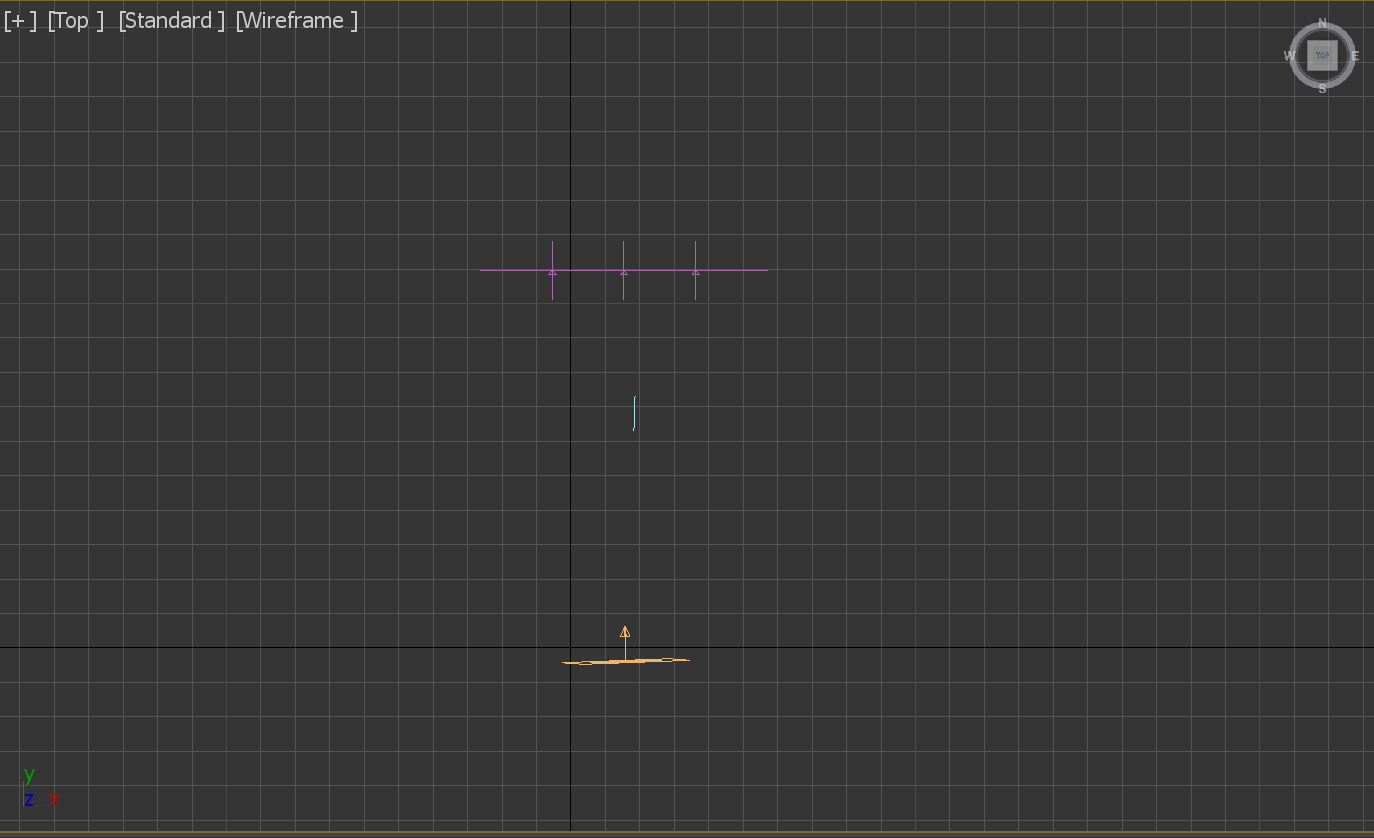
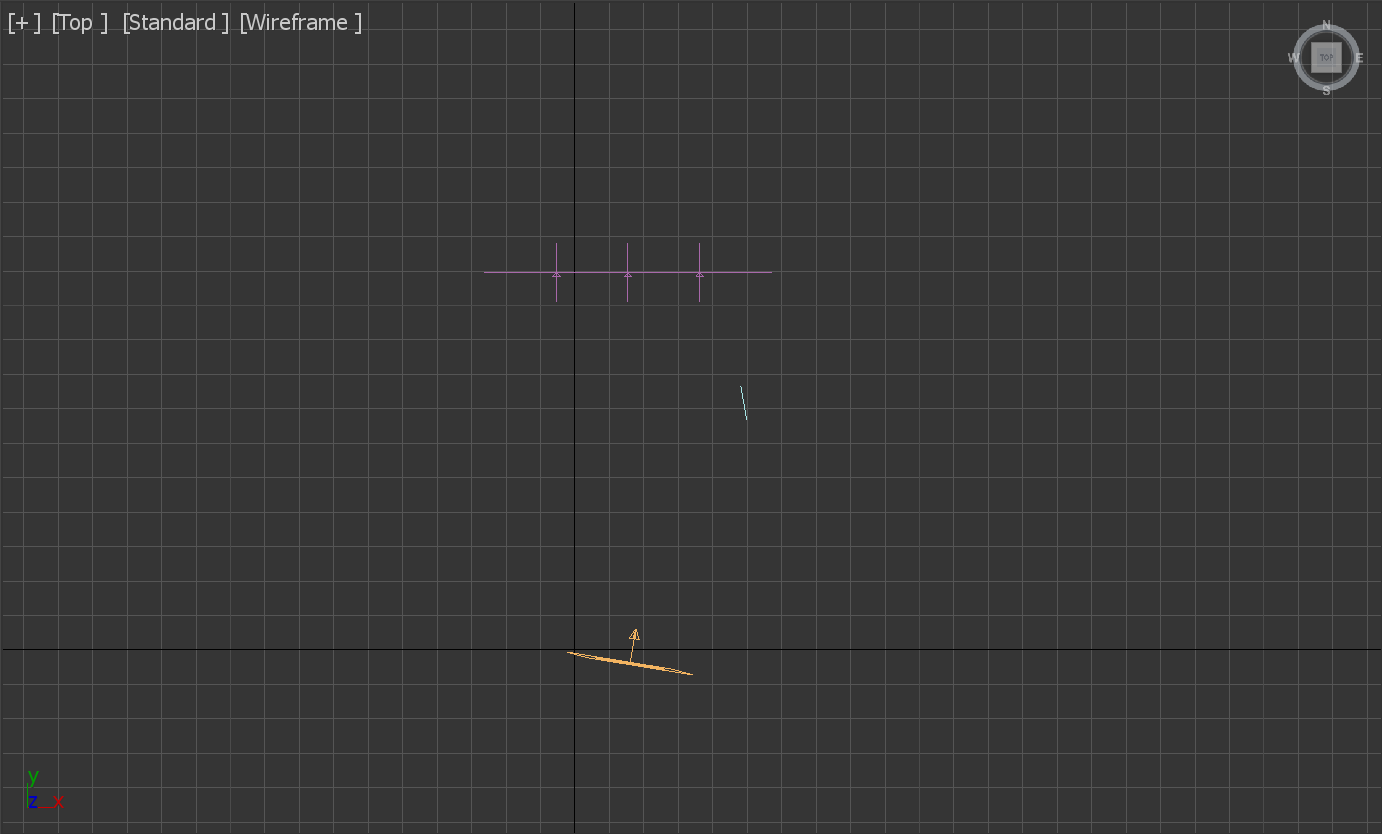
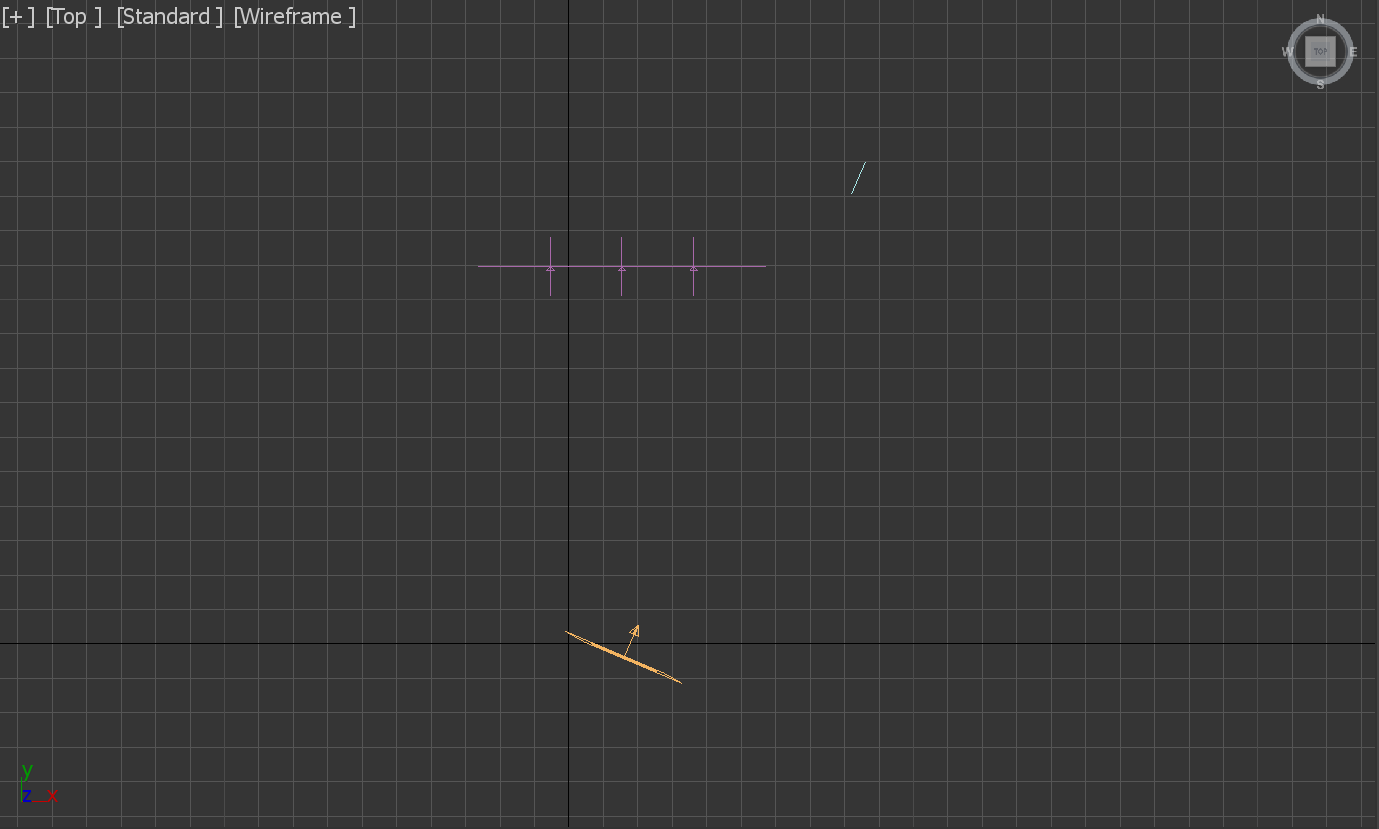
There’s nothing very special with this but let’s see what happens if we take a more realistic scene. Setting the stage for a bad-ass lady with a shotgun and only a single shell. From the moment she pulls the trigger, the shell flies out of the barrel and starts its path of destruction. Imagine it hits the windows, shattering the glass, which flies ever which way. Now we stop the time, (frame 40 in the last example) and see what happens if she’d aimed a little bit more to the right. A different pane of glass is now shattered, while the original one is suddenly unscathed. As she moves further to the right, suddenly none of the glass is hit, and it’s the concrete wall that’s wasted.
We can follow the various possibilities of her one and only shot, to see the effect of each decision she must make. It’s like sidestepping through various timelines. Not moving back or forward in time, but moving to other versions, versions that differ in only a minuscule amount. Although multiple timelines have been done before, I’ve never seen them represented a single continuous shot. A shot consisting of multiple versions of frame 40.
Back in 2010, when I was getting enthusiastic about this, I discovered there’s a simple machine that creates this illusion perfectly, and it’s called the Time Fountain.
It’s a simple contraption consisting of a pump that drips water droplets and a stroboscope that’s synced with the rate of dripping. If the sync is perfect, it creates the illusion of the droplets being frozen in mid-air. But when you then start manipulating the droplets, you can see the effects later down their path in real time. It’s truly unique, and although I don’t own a time fountain, I had spent many times with my stroboscope at the bathroom sink in order to experience this amazing effect first hand.
Look at 1:00 to see the effect I’m talking about.
Back to the Visual Effect. I imagined the coolest looking implementation of this would be with explosions, rockets, and other simulated effects like debris and fire/smoke. Simulations where very hard to do, because although you only need frame 40, for each frame, you need to run the entire simulation.
And because chaos theory is a thing, small increments in the beginning of the simulation can have large differences later down the line, and when playing all the frames 40 in a row, you can see its erratic behavior.
These are old low-quality renders and animatics from around 2011 I created to illustrate the effect.
After I discovered fractals, I haven’t really looked back at this idea. I was sure someone else had probably thought of this too, and I would see some kind of implementation someday, somewhere. Yet almost a decade has passed and I’m still not aware of this effect ever been used somewhere.
Finally, This is a scene from the movie script I wrote where the main character SARA sidesteps in order to escape certain death.
INT. ARCHIVES SIXTH FLOOR / GAME - DAYA large space with EMPTY SERVER CABINETS. A massive GUARD runs at her screaming with a KNIFE, but she shoots him down with her SHOTGUN from about five meters. Almost simultaneously a SECOND GUARD appears from her side, and shoots her in the chest from less than a meter away.FREEZE TIME - Guard 1 hangs LETHALLY WOUNDED in MID AIR, as Sara - HIT by the second guard - SIDESTEPS. As she starts to move her shotgun away from the first guard, towards the second, we see the TRAIL OF DESTRUCTION shift. As it leaves the first guard, he is back on his feet and the trail and its impact move towards the second guard.The moment the bullet trail has reached the second guard, the situation changes so that he is hanging wounded in mid-air, and Sara is NOT HIT. TIME back to NORMAL. Guard 2 hits the ground dead, while Guard 1 continues to RUN towards Sara. She manages to incapacitate him with the butt of her gun.
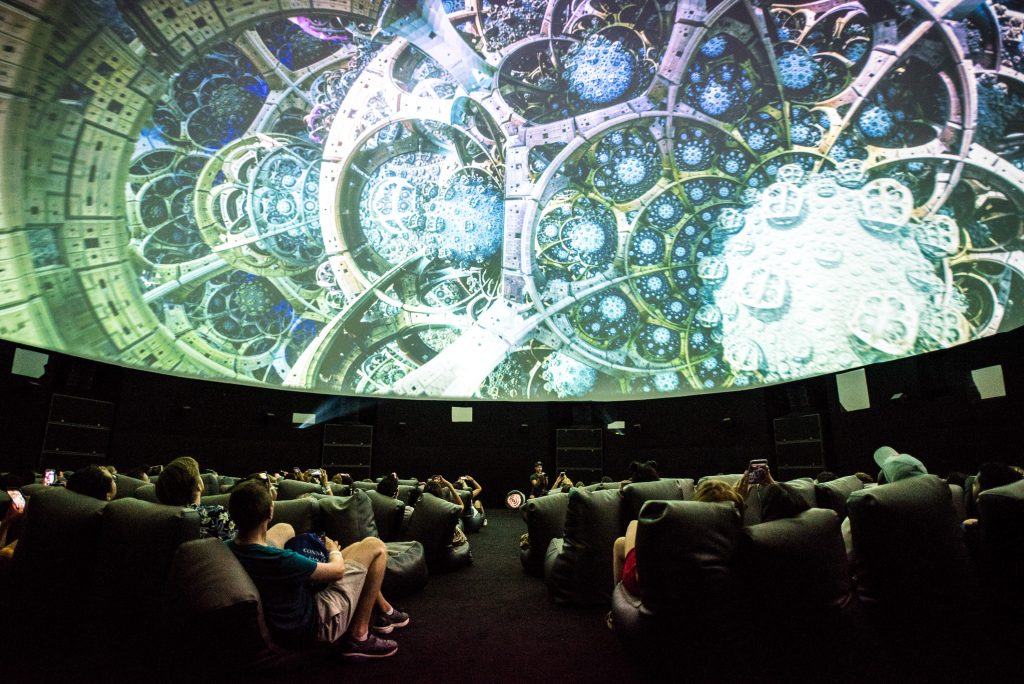
Art Galleries and Fulldome Fractals
For me, dome theaters are magical temples – movie theaters dedicated to astronomy, science and art. What more could you ask for?
Artists are always searching for ways how to best showcase their work. Or, let me rephrase that, for a format that provides the best fit for one’s art.
For me, I think I’ve found that perfect fit in the Fulldome format.
For those unfamiliar with the term, it related to the immersive format usually associated with Planetariums and similar Dome theaters.
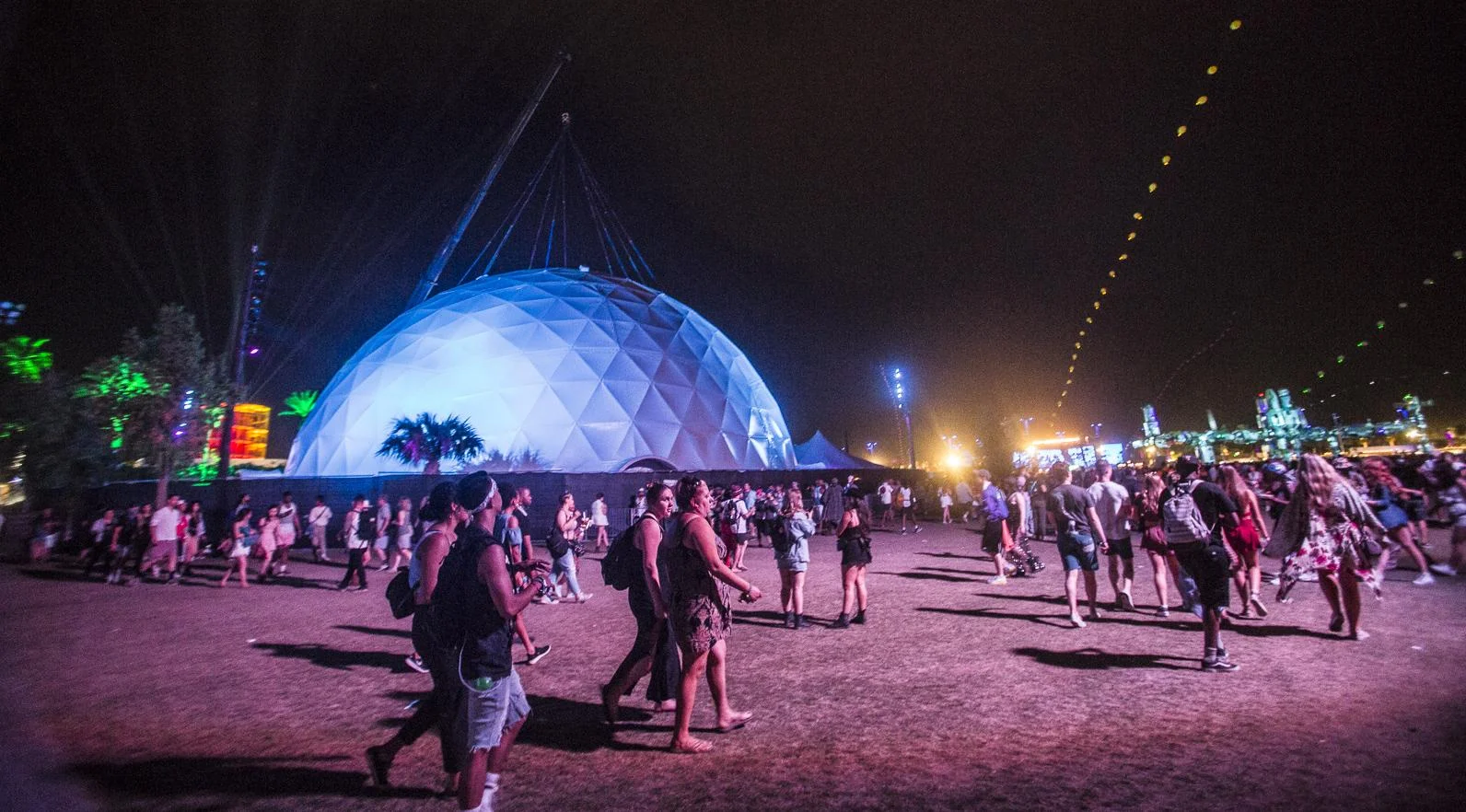
The Antarctic Dome at Coachella
ARTECHOUSE
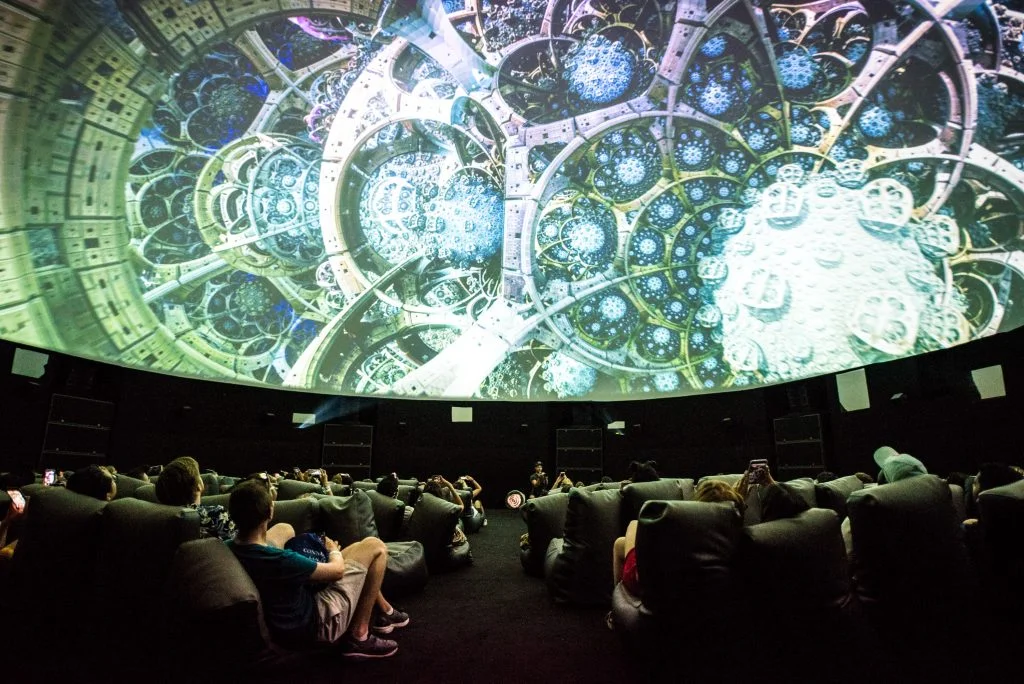
This summer, I’ve had the fantastic opportunity to create an exhibition in the digital art gallery Artechouse in Washington D.C. Usually being branded as an interactive gallery, we chose a more immersive approach. Apart from 8 VR stations that could be used to watch all my Virtual Reality work, the centerpiece of the exhibit was a 270° projection screen, for which I created a 21-minute film.
People would be able to sit in beanbags in order to immerse themselves in the fractal worlds.
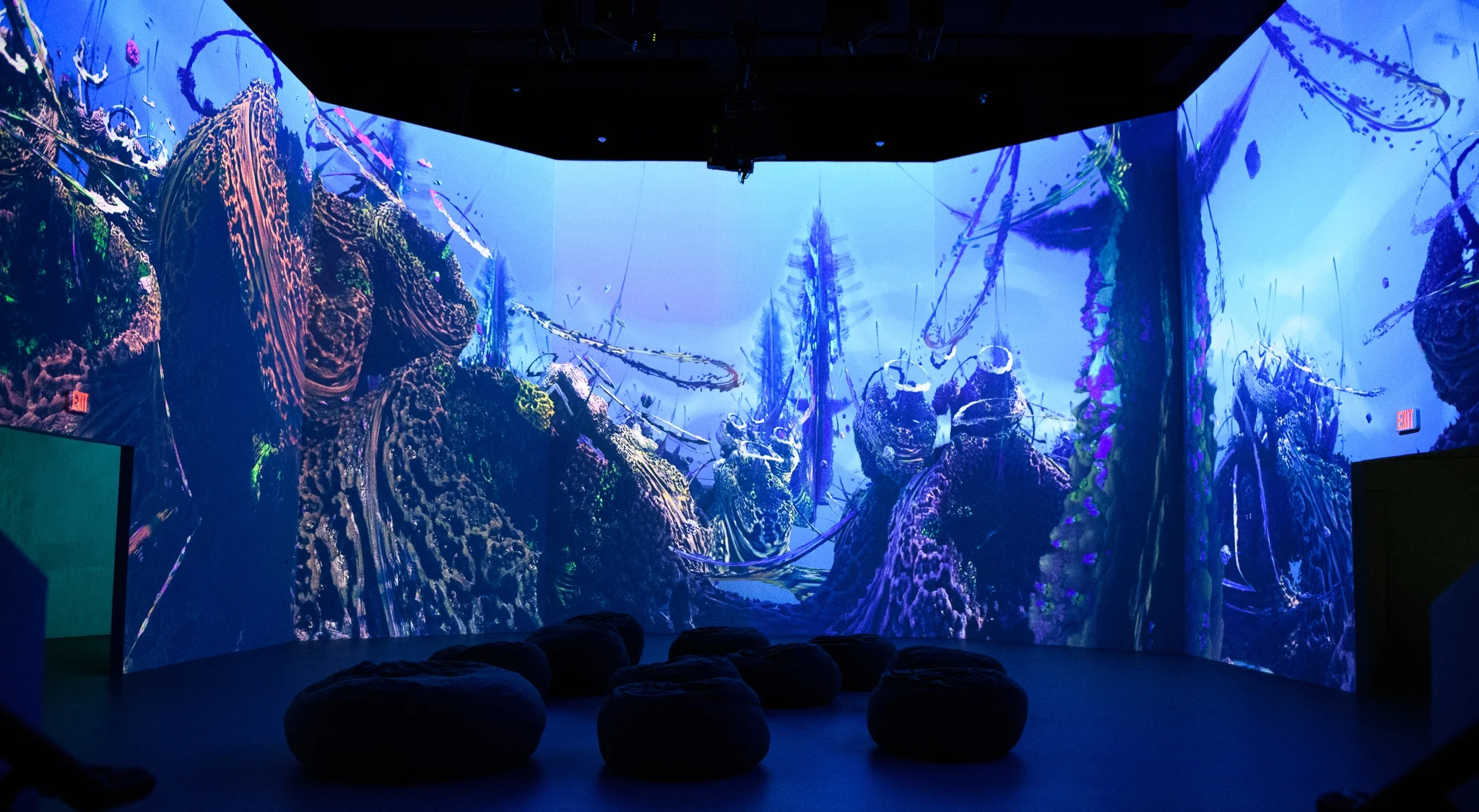
The Fractal Worlds exhibition in Artechouse, Washington DC
After receiving many positive reactions from visitors, I was convinced that this large-screen immersive format works well, which is why I have been focusing on Fulldome for my latest film, A Strange Travelogue.
FULLDOME
What is the Fulldome format exactly?
Imagine completely immersing yourself in fractal space. There’s shapes and formulas around you, 360 degrees. Like in VR.
Now imagine cutting that space in half, and you’re left with a dome, that encompasses 180 degrees of your vision. Usually in a dome theater, this dome fills the roof and the walls, leaving only the floor unprojected. When sitting in a chair or beanbag, looking up, you’ll have the sensation of actually being in this massive space between the fractals.
Isn’t this the same as VR? If VR is 360 degrees, and Fulldome is only 180, why not render for VR?
VR has two major disadvantages. One is that the resolution isn’t that high, so many of the fractal detail gets lost. Fulldome goes as high as you like. The other is that VR is always a solitary experience that can’t really be enjoyed together.
For me, dome theaters are magical temples – movie theaters dedicated to astronomy, science and art. What more could you ask for?
A still from my work at the Antarctic dome at Coachella, sponsored by HP
This isn’t the first time I’ve worked with the format. In 2015, the SAT in Montreal contacted me if I was interested in re-rendering my VR film The Cryogenian in Fulldome. Also, earlier this year, I collaborated with Infinity Marketing and artists such as Beeple and Teun van der Zalm on a Fulldome piece at the Coachella Arts and Music festival.
A STRANGE TRAVELOGUE
My new film isn’t fully finished, as I want to change scenes here and there, and the music has yet to be composed. I’m talking to David Levy for this. He created the music for “Fraktaal” and the exhibition “Fractal Worlds” in DC. Yet I’ve organized several pre-screenings in Moscow, LA and Miami.
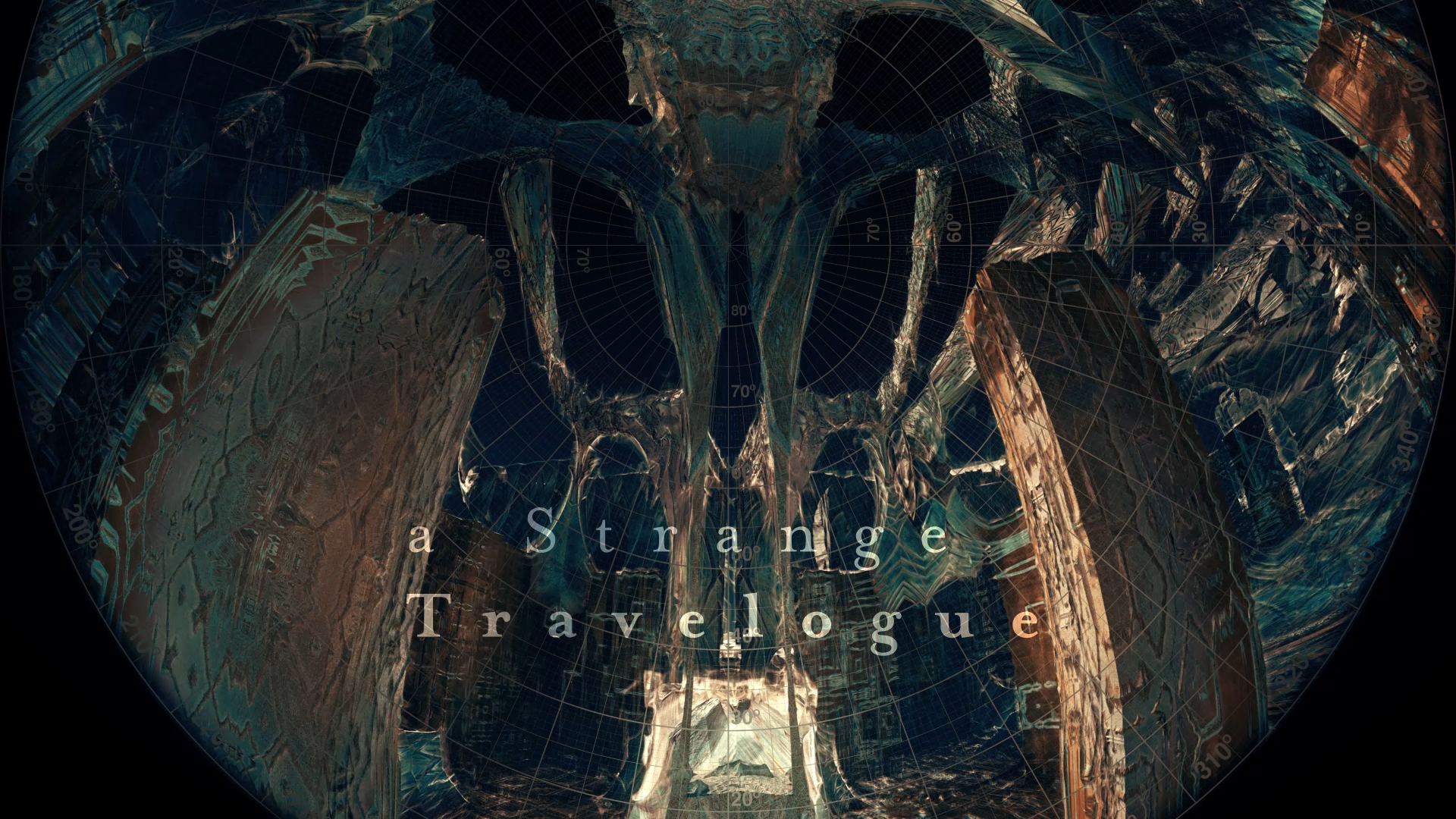
Current poster from my new Fulldome Film
Since it’s the first time I’m creating a Fulldome-only film, I’m still searching for the perfect timing and pacing. I hope to perfect this in future versions of the film, and future dome films.
Julius Horsthuis
The End of an Era
Up until today I have always called myself VFX designer and Fractal Artist. After tomorrow, I will drop the first part of that title.
Up until today I have always called myself VFX designer and Fractal Artist. After tomorrow, I will drop the first part of that title.
In my early twenties, I was working in film for several years, but quickly realized I would never be able to create what I wanted to do with the budgets that I could lay my hand on. I started out in the VFX industry because I felt it was another way to create worlds. Instead of having to build expensive film sets, I could create digital film sets myself, for only a fraction of the costs.
Tomorrow morning, I will go to my work at Hectic Electric for the last day as an employee. A place I have called home for a very long time, a place that helped me grow. The place where I rendered my very first fractal.
Back in 2004, when my life was working on film sets and VJ-ing, I met an unlikely and colorful character. Joe Broadbent was a talented creative director from the UK. He worked for a motion graphics company in Rotterdam and saw something in me. We agreed to work together, and he quickly taught me all the tricks in the 3d software 3Ds MAX.
He was quite direct but extremely eloquent – two traits that make for perfect critique. Looking at your own work though someone else’s eyes – seeing what’s wrong with a picture and why, is very valuable. Communicating ideas internally and to clients is another thing he excelled at. Although we haven’t worked together for about 6 years, I see him as my primary mentor.
He founded Carbon Media back in 2006, which was incorporated by Hectic Electric in ’09.
I feel I don’t need 3D Studio MAX anymore, as fractals have become my primary way to create worlds now, and I have decided to take the leap and see if it’s possible to make a living as a Fractal Artist. Realizing this is somewhat of a gamble: the software I use is not in development anymore and starting to become pretty outdated. And I haven’t yet seen anything new on the horizon that does what Mandelbulb3D does. I’m not worried about the future though. I want to keep exploring worlds, and the amount of encouragement I’ve had from many of you has been a blessing for me.
I will miss many things from my job as VFX designer, such as working on films as a VFX supervisor – something that I was very fortunate to have been asked to do. Most notably the Dutch fantasy road movie Koning van Katoren. But also, the internationally acclaimed drama Manchester by the Sea.
But more than that I will miss the people I have spent so many hours of my life with. The company’s founder, Marc Kubbinga of course, whom I owe so much gratitude for the many opportunities he’s given me. We will keep working close together in the future I'm sure.
But most significantly, I’ve had the immense pleasure to call two people my friends and colleagues for a period of no less than eleven years: Guido van Rijbroek and Lars Snelders, two extremely talented designers/models. Guido has always had a keen eye for anything to do with graphic design, and the variety of fresh styles that he seems to pull out of nowhere has commanded nothing but respect. Lars was my 3D buddy for a long time. We both worked in 3Ds MAX, and where I started looking at fractals, Lars focused on simulation software such as FumeFX and RealFlow. He’s a wizard with fire and smoke simulations, but mainly known for his exquisite water simulations.
Guys, it’s been an honor to work with you and be a part of the solid and diverse skillset that we collectively developed together.
After I go home tomorrow evening, and close the door of that beautiful studio on the canals behind me, what shall I do?
Like I mentioned, I plan to focus on fractal art entirely.
Fulldome shows, VR films, festival exhibitions are pretty cool things to work on. But I will also take on other work: for ad agencies who have the balls to use fractals to sell a product – (car commercial on a fractal planet anyone?)
I really don’t know what the future of fractal art looks like, but if it looks like anything, I wouldn’t want to miss it for the world.
Julius Horsthuis
Fractal Art Isn't Random or Artificial Intelligence
This is the comparison I make when I talk about fractal art. It’s an art, no question about it, but the comparison should be with the photographer, not the painter. Just like the photographer for National Geographic, we are explorers. We explore vast mathematical landscapes that aren’t of our own making, but we may be called pioneers, visiting places that no human has yet gazed upon. This is exactly what the most fulfilling part of the creative process feels like. Exploring, in ultimate wonder, wondering what’s behind that ledge, or what happens when we change the Minimum Radius, or go into Julia mode.
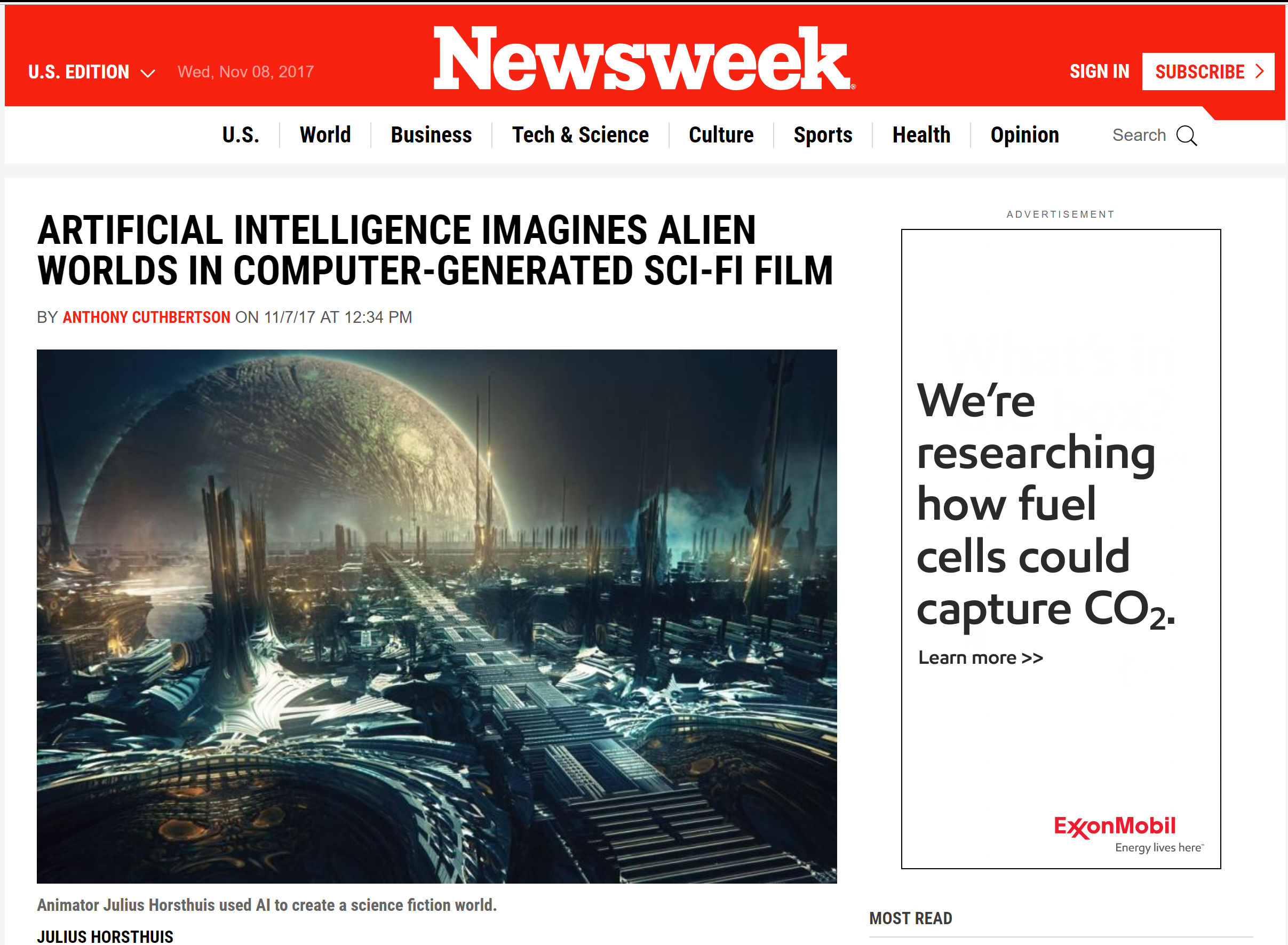
The Newsweek article
This is of course dead wrong. There has been no artificial intelligence involved at all in the making of this film, unlike my recent work ‘Recurrence’. But catchy headlines are good for views, and indeed, views have been racking up faster on this fractal than any of my previous work.
However, the mistake is not completely illogical. I’ve written about how I’m a ‘lazy animator’ who:
“Using fractals, I can conjure up entire worlds without having to draw or model anything. These shapes hide in the formulas, they exist in a mathematical reality, all I need to do is explore those worlds and make them reveal themselves.”
There’s nothing random about it (because each time the same process would lead to the same result) and there’s no AI involved, no neural networks, no learning, no iterative processes. On the other hand, there’s not much human input either.
No human input? Let me nuance that statement. A human (me) created the animation of the camera, the decision on lighting setups, the compositing – not to mention the music, which was of course laboriously composed by the very talented David Levy, whom I owe much gratitude for boosting this piece deep into the sci-fiosphere.
The short film in question, Fraktaal.
But imagine we would set all those artistic aspects aside for a moment. What’s left is the unimaginable alien world defined by fractal math. Does the fractal artist ‘create’ that? Although this isn’t easy to answer, I'm going to be blunt and say ‘no’.
Let me explain.
Fractal Art Isn't Art
In my work in the VFX industry I hate to use the word artist. Which is why I opted to call myself a VFX designer. VFX artists absolutely exist, but the term artist is applied so broadly that it’s lost its meaning. Roto artists are very skilled craftsmen, but are they artists? Wanna visit the Roto Museum of Modern Keys?
I absolutely do not want to start a discussion of what constitutes art, but I do want to express my opinion that I have problems with the term fractal art. In my experience, artists are people who meticulously hand-paint every detail, are constantly aware of both the small parts and the whole, and who are thoroughly disciplined. A fractal artist doesn’t have to know how to draw details, because she gets all the detail in the world for free. Also, she doesn’t need to be disciplined at all, since the computer does all the work and whatever settings you put in, something superficially amazing looking will come out no matter what.
Do not ever compare a fractal artist to a real artist.
But is this the whole picture? Is this the right comparison to make?
Not all artists draw or paint. Some dance, perform. There are those who use words as shortcuts to the detail of the imagination, yet others wield bulky photographic equipment to instantly capture detail that was there all along, only now it has been framed into a certain light.
This is the comparison I make when I talk about fractal art. It’s an art, no question about it, but the comparison should be with the photographer, not the painter. Just like the photographer for National Geographic, we are explorers. We explore vast mathematical landscapes that aren’t of our own making, but we may be called pioneers, visiting places that no human has yet gazed upon. This is exactly what the most fulfilling part of the creative process feels like. Exploring, in ultimate wonder, wondering what’s behind that ledge, or what happens when we change the Minimum Radius, or go into Julia mode.
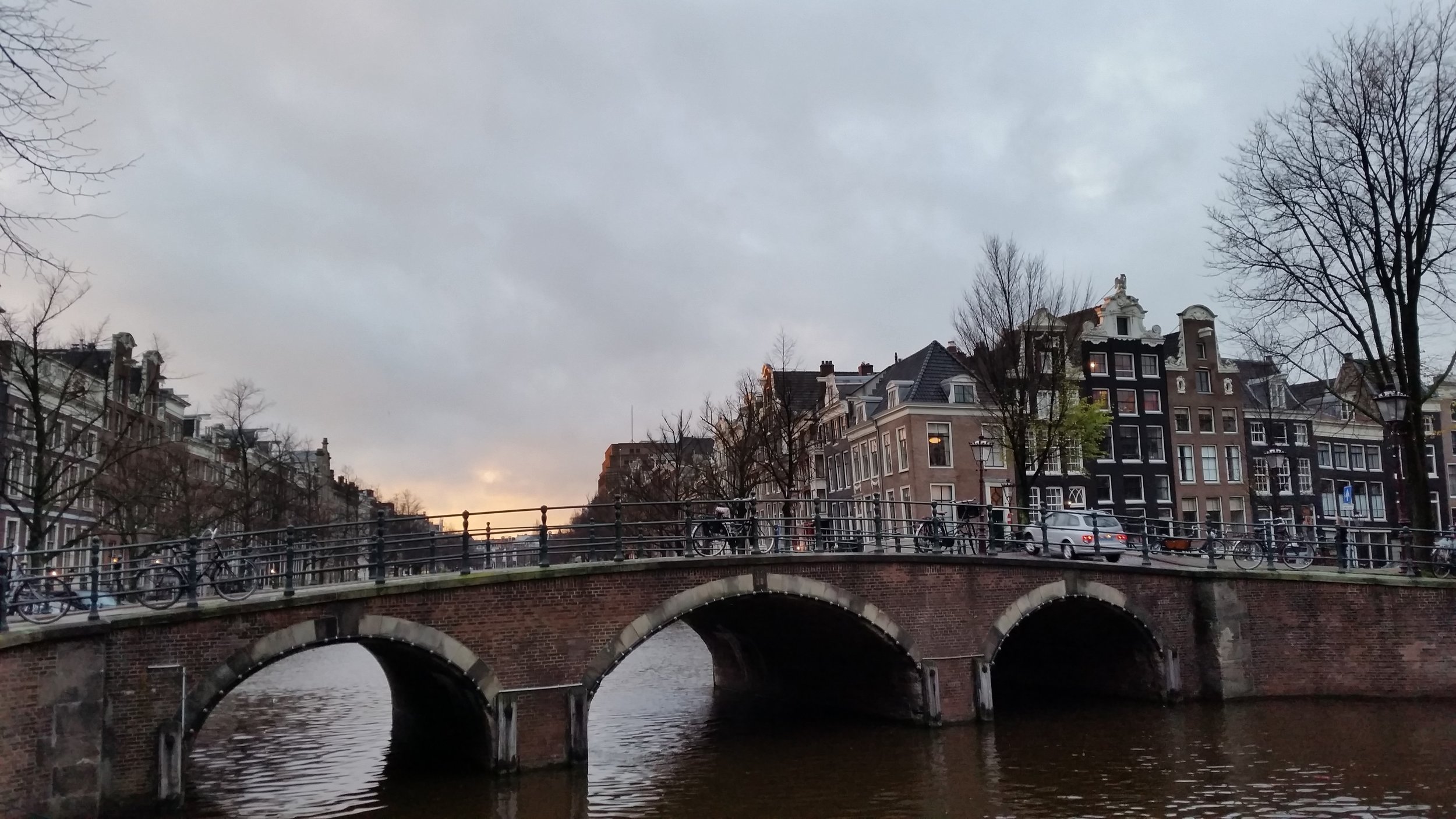
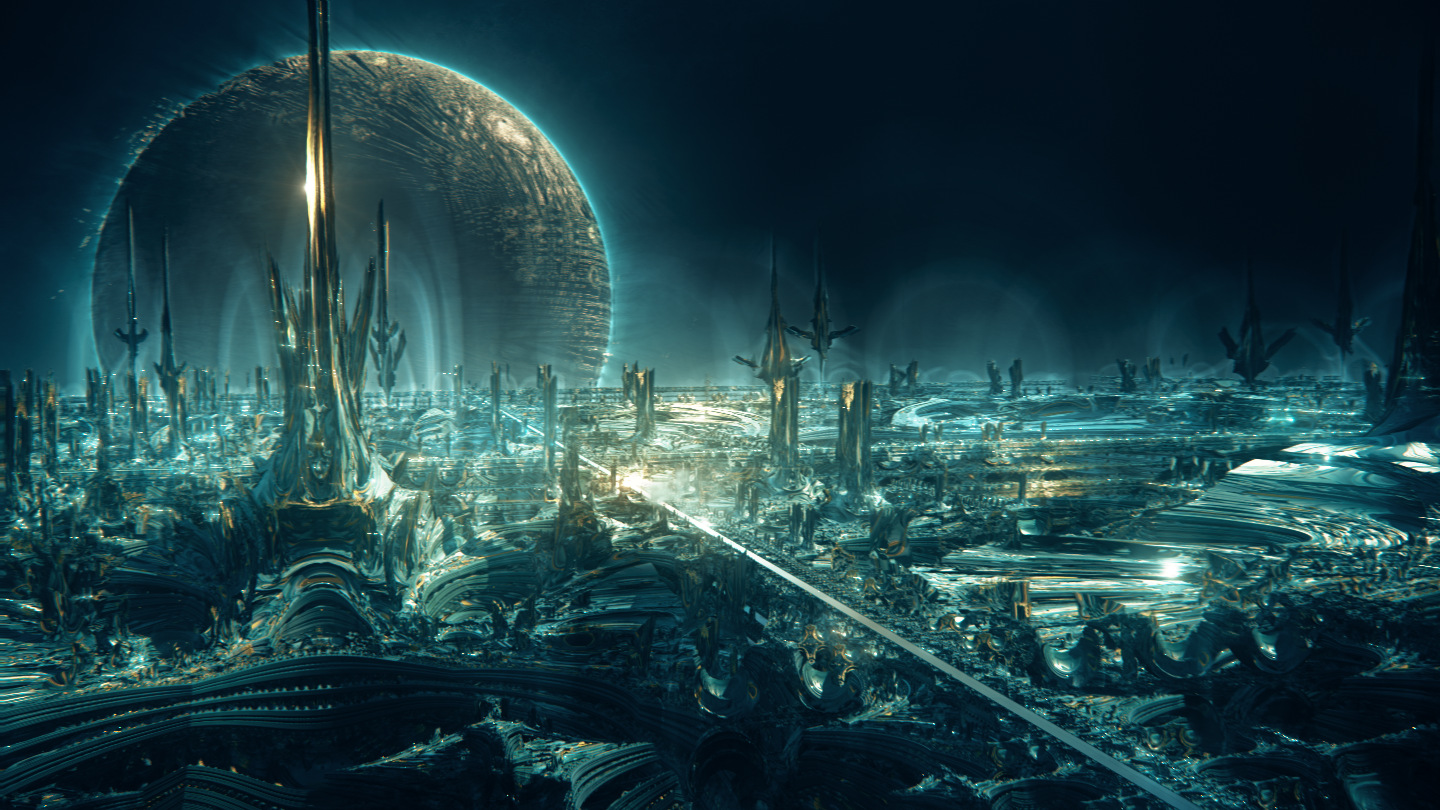
The alien cityscape from Fraktaal I visited a long time ago, when I first started with fractals in 2013. I had forgotten about it, until I found an old picture. I had a sudden urge to go back, because now I had new skills under my belt. The place was still there, unchanged, beautifully haunting as before. So I started exploring this realm again.
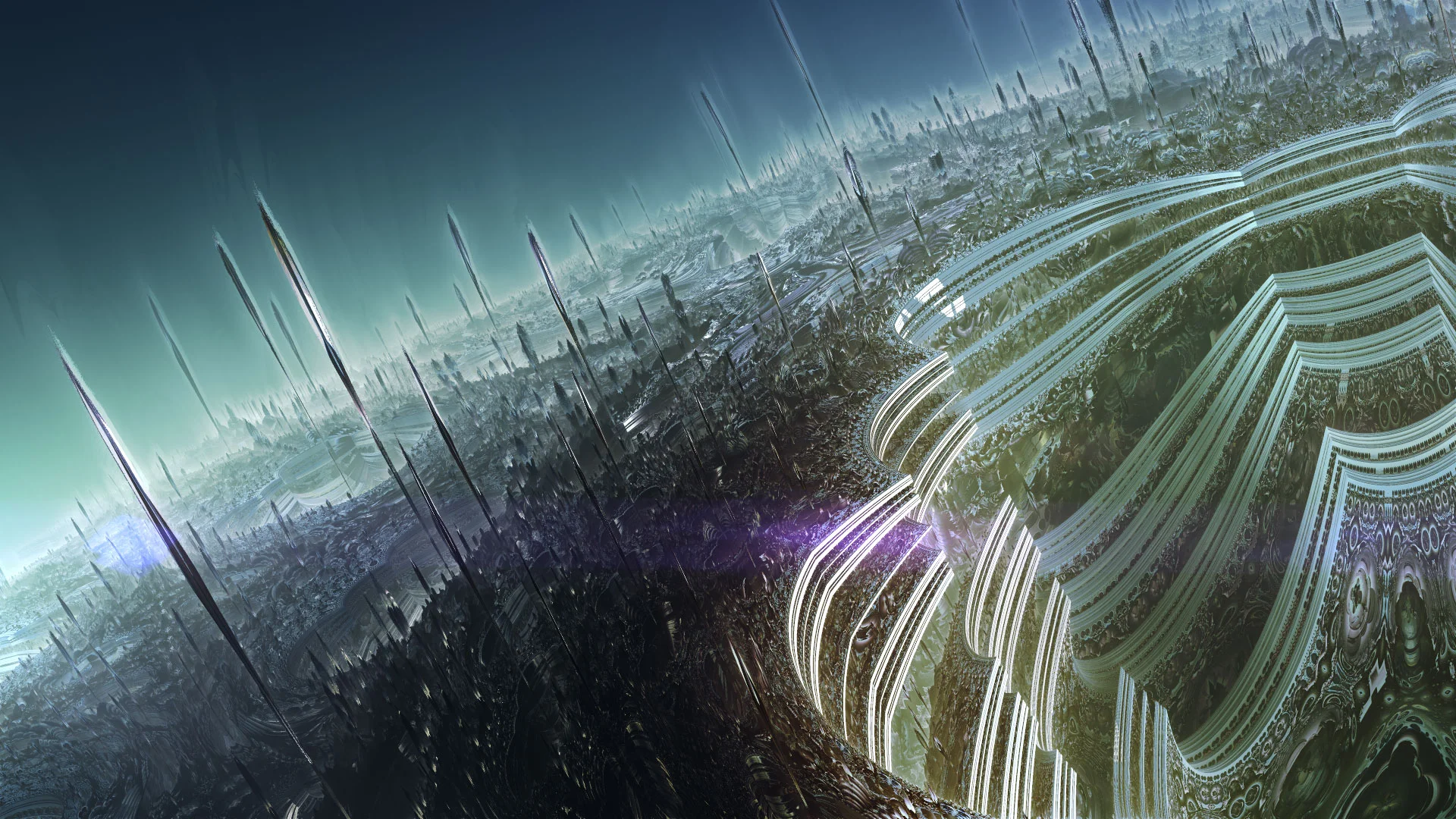
A render from early 2013, which formed the foundation of Fraktaal
And just like the photographer we know when we’ve found the right spot. We then set up our gear, we find the right angle, we set the right light.
This, to me, is what makes fractal art art. It’s not Artificial Intelligence, it’s just simple humans that found a way to explore new dimensions, other places. Travel, without moving.
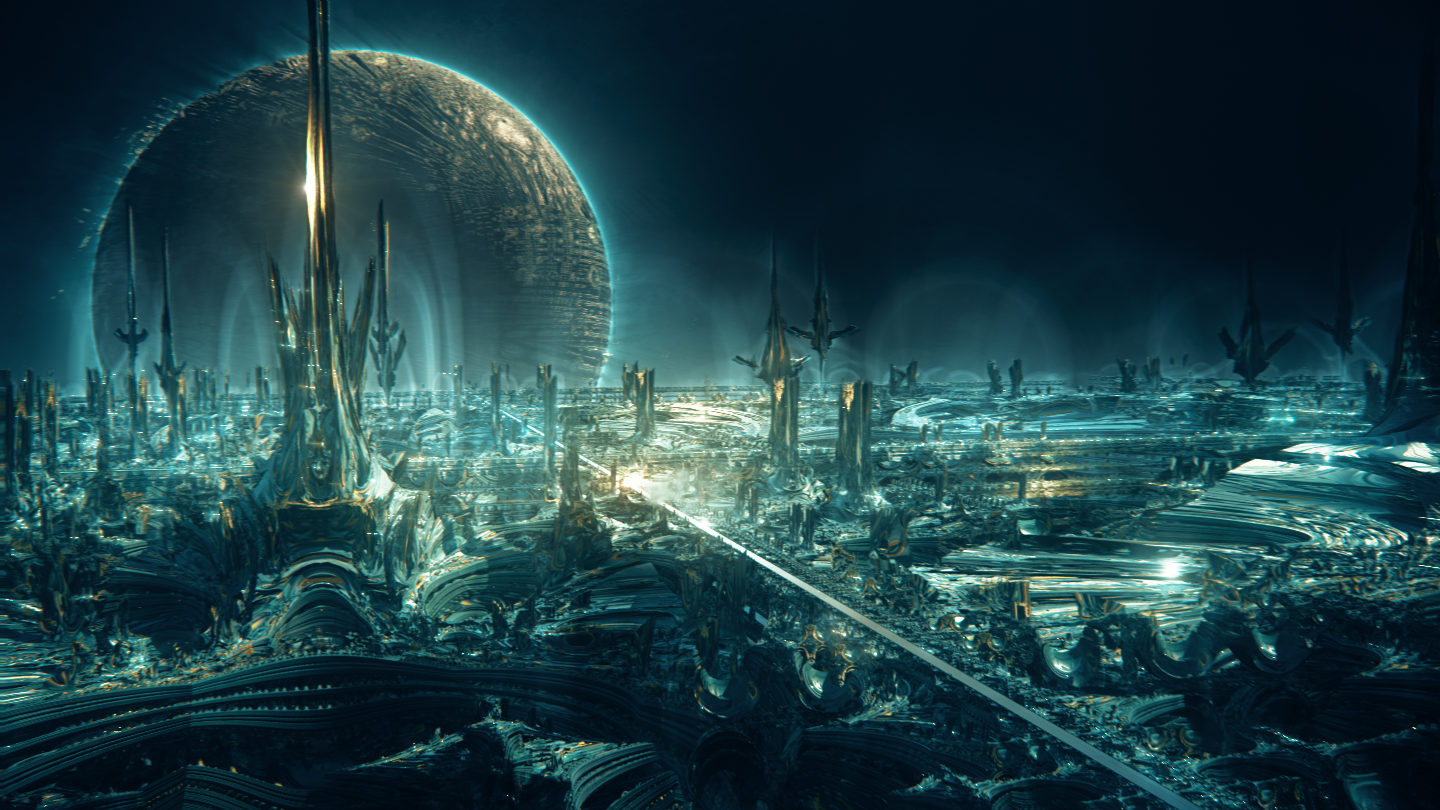
The same place, revisited.
Julius Horsthuis
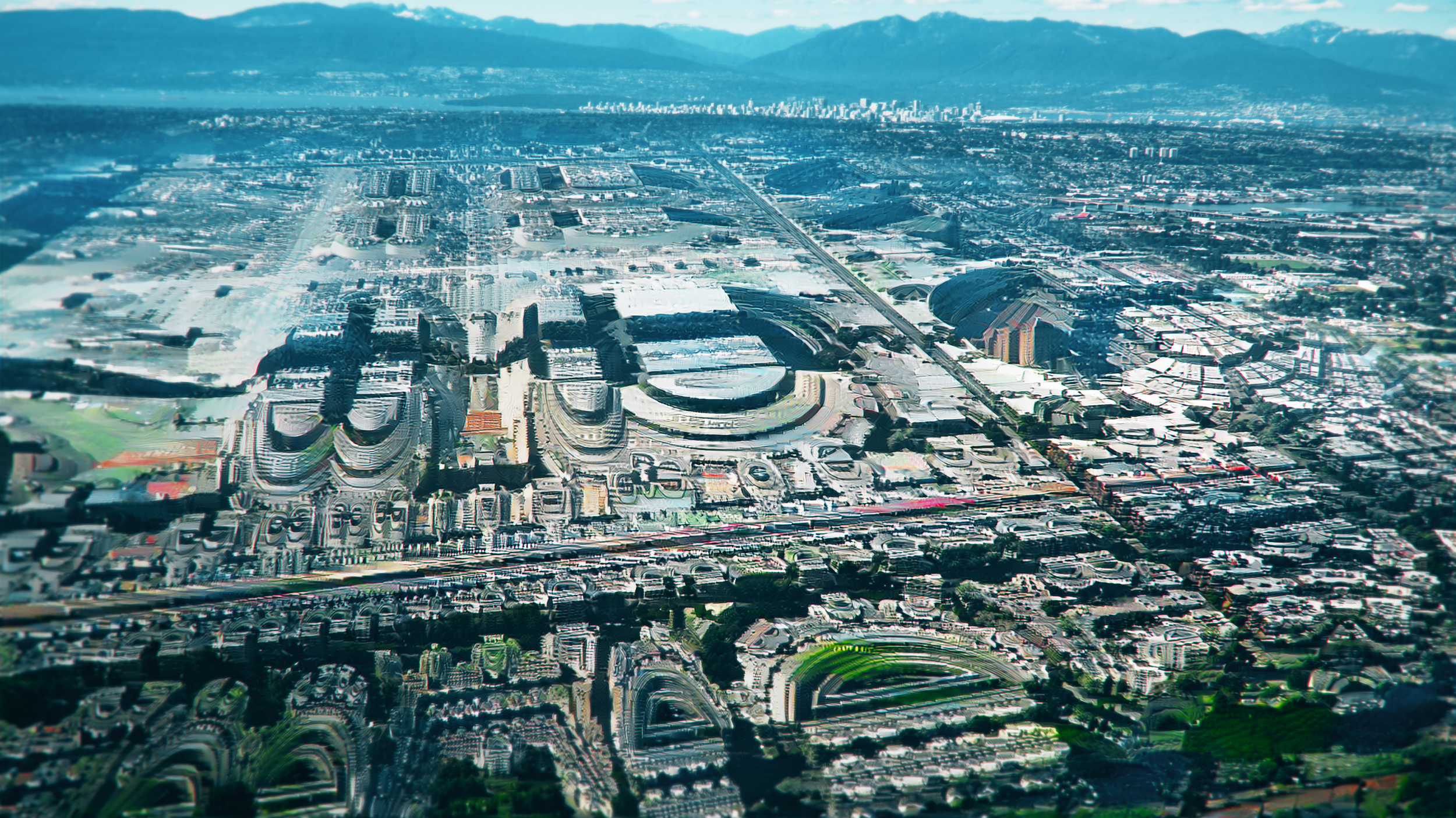
Neural Style Transfer for Matte Painting and Fractal Art
The rapid advent of neural networks in the field of computer graphics have opened some interesting possibilities. Most examples of Deep Neural Style transfer I have seen focus on applying painterly styles to pictures or videos. I’ve seen plenty interesting results, but I cannot stomach to see yet another ‘Starry Night’ styled picture. Therefor I wanted to focus on a few other uses beyond the glorified Instagram filters.
The rapid advent of neural networks in the field of computer graphics have opened some interesting possibilities. Most examples of Deep Neural Style transfer I have seen focus on applying painterly styles to pictures or videos. I’ve seen plenty interesting results, but I cannot stomach to see yet another ‘Starry Night’ styled picture. Therefor I wanted to focus on a few other uses beyond the glorified Instagram filters.
Matte Painting
Using a real photograph as a style picture could be a very handy tool for the digital matte painter. The detail-hungry matte painter frequently clone stamps or cuts/pastes from photographic reference to create the realistic detail their client expects.
Neural Style transfer seems to offer an amazing opportunity here. You can mock up the basic geometry with any tool, either 2d or 3d and apply the photorealistic style to the image. While the result is far from perfect, it offers a great foundation to improve with other photoshop techniques. The examples below are examples of what you could do with Mandelbulb3D as a base, with photo-styles applied.
click on the images for full screen, and use the arrows to switch from source to result.
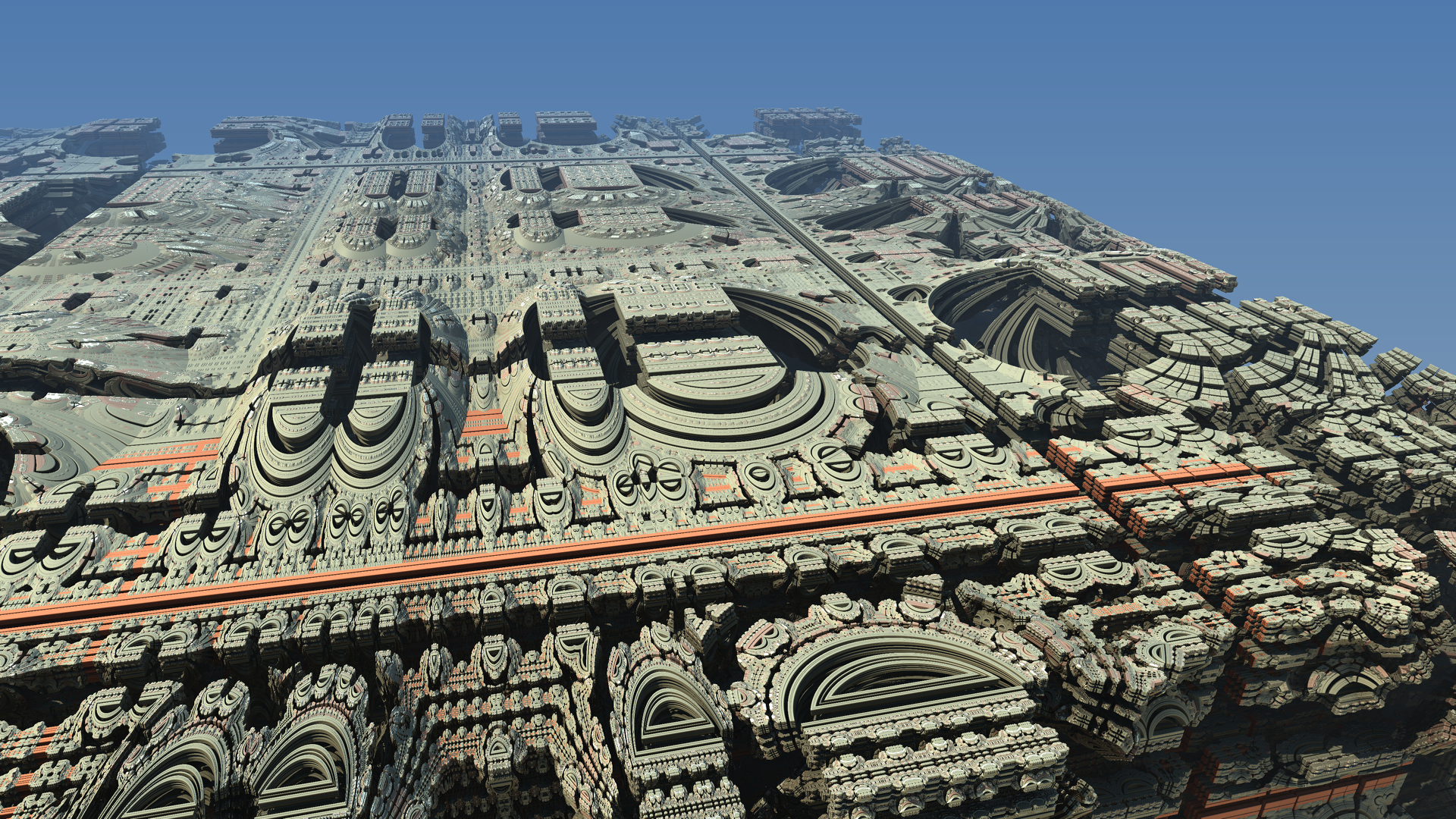
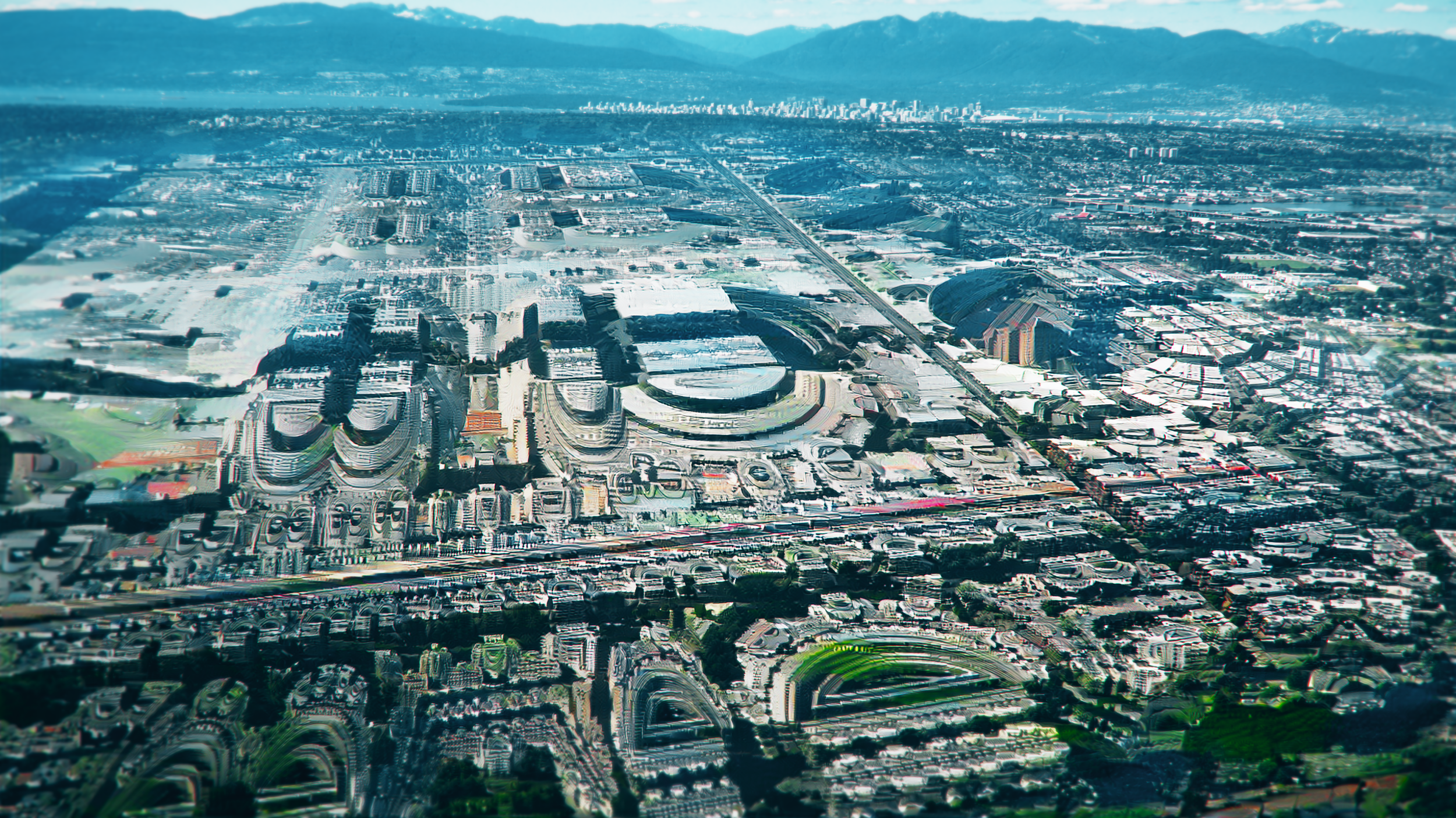
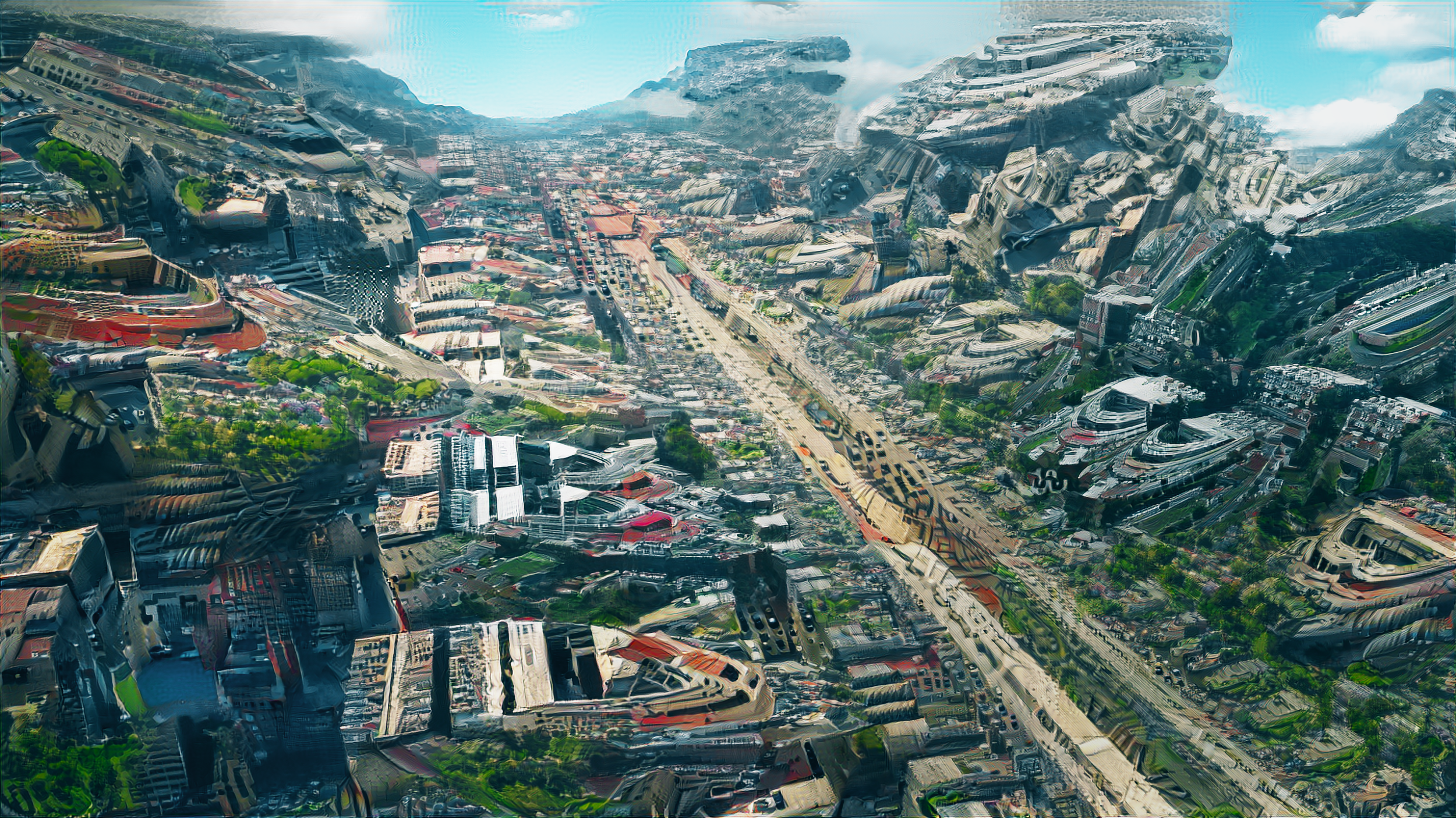

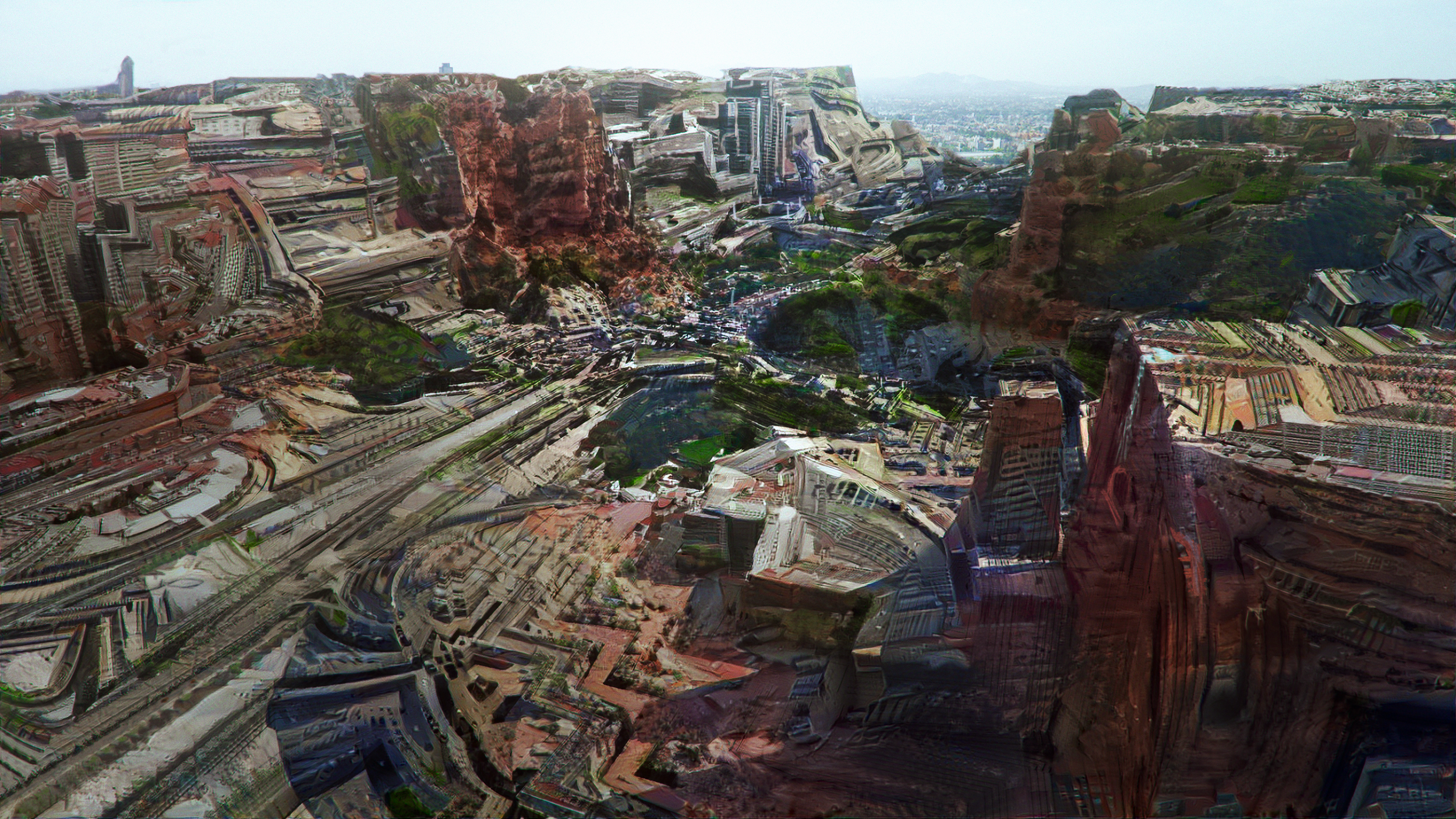

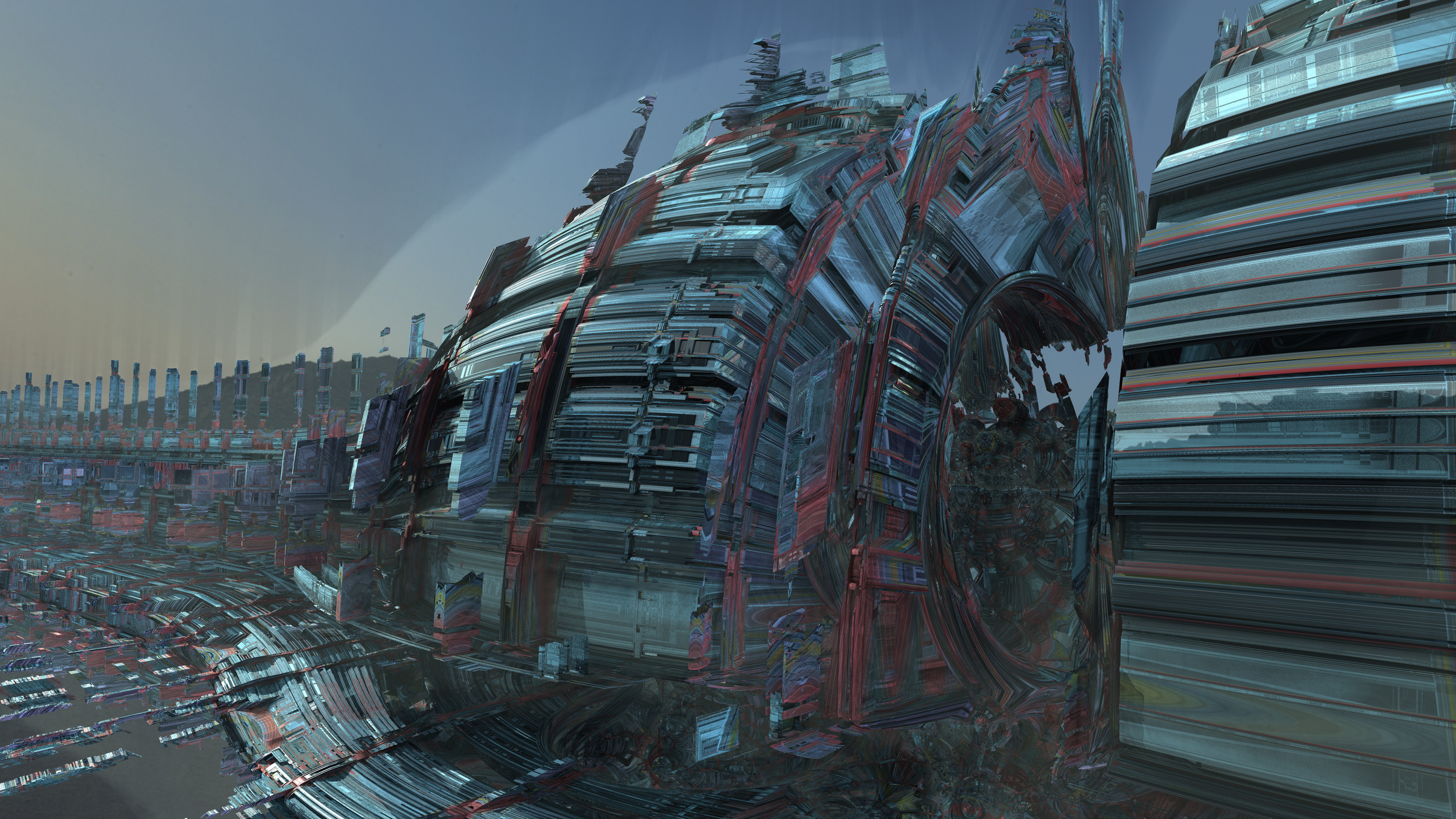
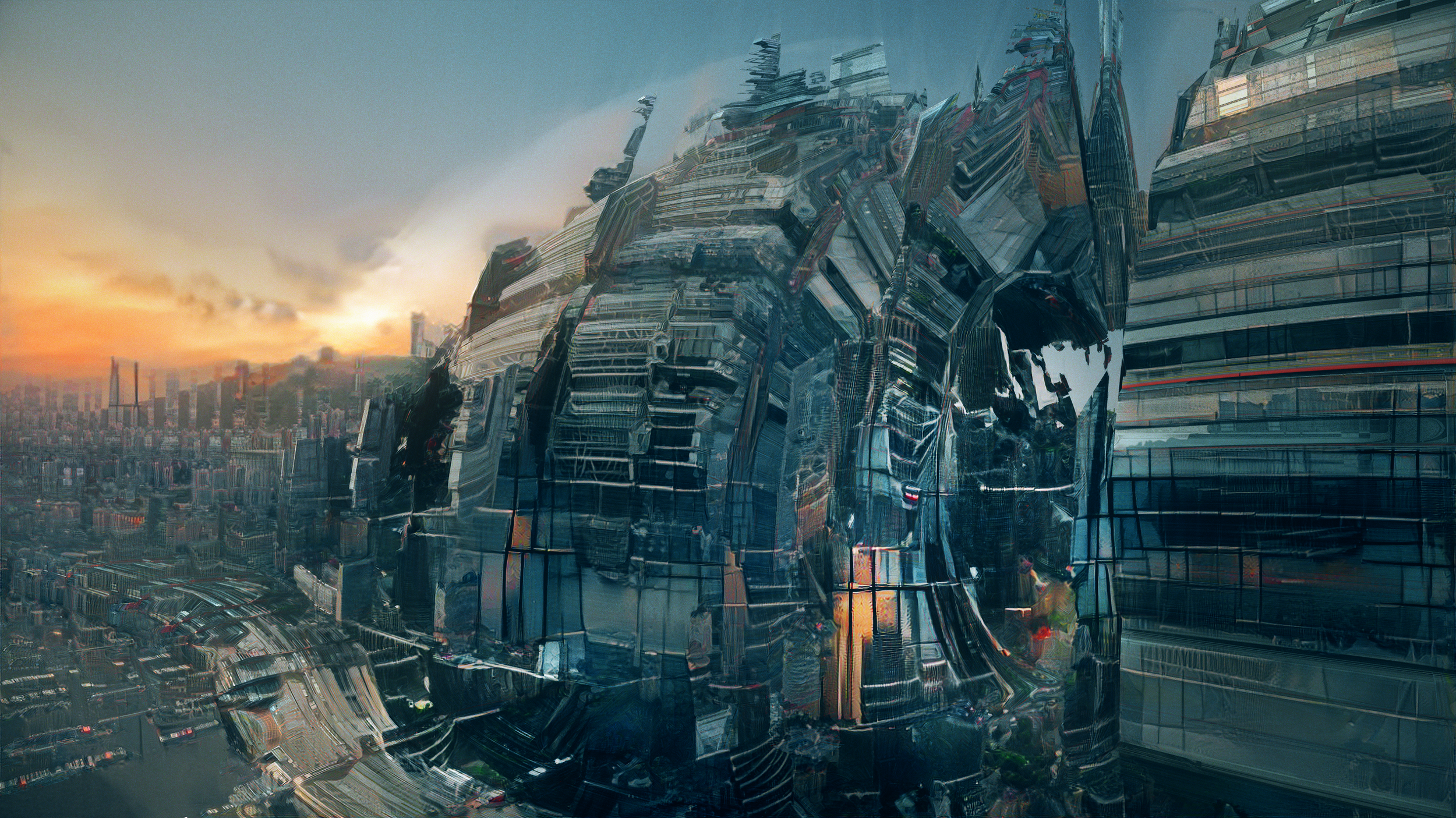
You might wonder what I used as style images in above examples. For some, I used multiple and blended them, but basically I don't have the copyright, so can't publish. Just do a Google image search for 'Nature' or 'City' - that kind of stuff. I also used the technique that I talked about in my last blog post - a Google Similar Image search on the fractal source image.
How does Neural Style Transfer work?
If you do not understand how neural style transfer works, I’ll try to offer some insight. I will give you the usual disclaimer that I don’t really understand how it works under the hood. Instead, I will offer a more intuitive understanding of the process.
Deep learning is the active operator. Deep because the algorithm has many layers, and Learning because it improves over time.
Think of the many layers as a hierarchy in a large company. Every single person can only do so much, and at the bottom of the ladder a person has little insight and little power. One layer up the people manage the people at the bottom, and they have some insight and more interesting strategies apply. This continues to be true all the way to the top, where the individual person is not per se a smarter person, but their decisions set off a much more complex cascade of actions They have many strategies to choose from as their operations are much more delicate.
In the style transfer program, the bottom layers only operate on the pixel level, which won’t create anything interesting at all. But keep adding layers (my understanding is that the algorithm I use contains 19) and at the top we get a larger-scale artificial ‘understanding’ of the image.
So what’s the image that the algorithm ‘understands’? What happens next is still magical to me, but both the source image and the style image are interpreted in this way, and a random algorithm is tried to match one to the other. The first random try won’t result in anything useful, so the computer measures how big this ‘error’ is and tries another one that will decrease this error. This continuously decreasing of the error is the ‘learning’ part. After a few hundred or thousands of iterations, this error is sufficiently low, and behold – style transfer has taken place.
Fractal Art with Neural Style
Apart from the (somewhat trippy) matte painting examples above, there are of course many more options. One of them is to apply a style to an infinite fractal zoom, as I did in my latest Fractal short, Recurrence. A clever Optical Flow system ensures that there’s stability over time, but at the same time the scale of the style will keep looking similar, just as with a fractal. Unfortunately, it did take an extremely long time to process this video, and I hope that in the future faster techniques will be made available.
Where's the software?
Finally you may wonder how you can do this Style Transfer yourself. There are a couple of websites, such as deepart.io that offer the service. If you want to do it yourself, be prepared for a lot of work - you need to install a lot of code before it will work.
I used this implementation by Cameron Smith, which gave me the best result and flexibility. It also supports video.
I believe that these techniques have the future, so artist-friendly implementations for these things will hopefully come soon. I for one would definitely be willing to pay for such visual wonder.
Julius Horsthuis
Neural Networks interpreting Fractals
There's something intensely satisfying about peering into a machine's mind.
For me, one of the most amazing things about fractals is that at first glance they seem to resemble something from real life, but at closer inspection this appears an illusion. With the advent of Google's Deep Dream and many other Neural Networks I thought it was an interesting experiment to see how AI would interpret a fractal picture. I've done two simple tests to see where this could go.
First, I gave a couple of fractal images to Google's similar image search algorithm, to see what Google would think is on the picture.
So I uploaded this image of a pure fractal:

What would Google 'think' is on this picture? Some similar images came up, not surprisingly most where buildings, churches and such:

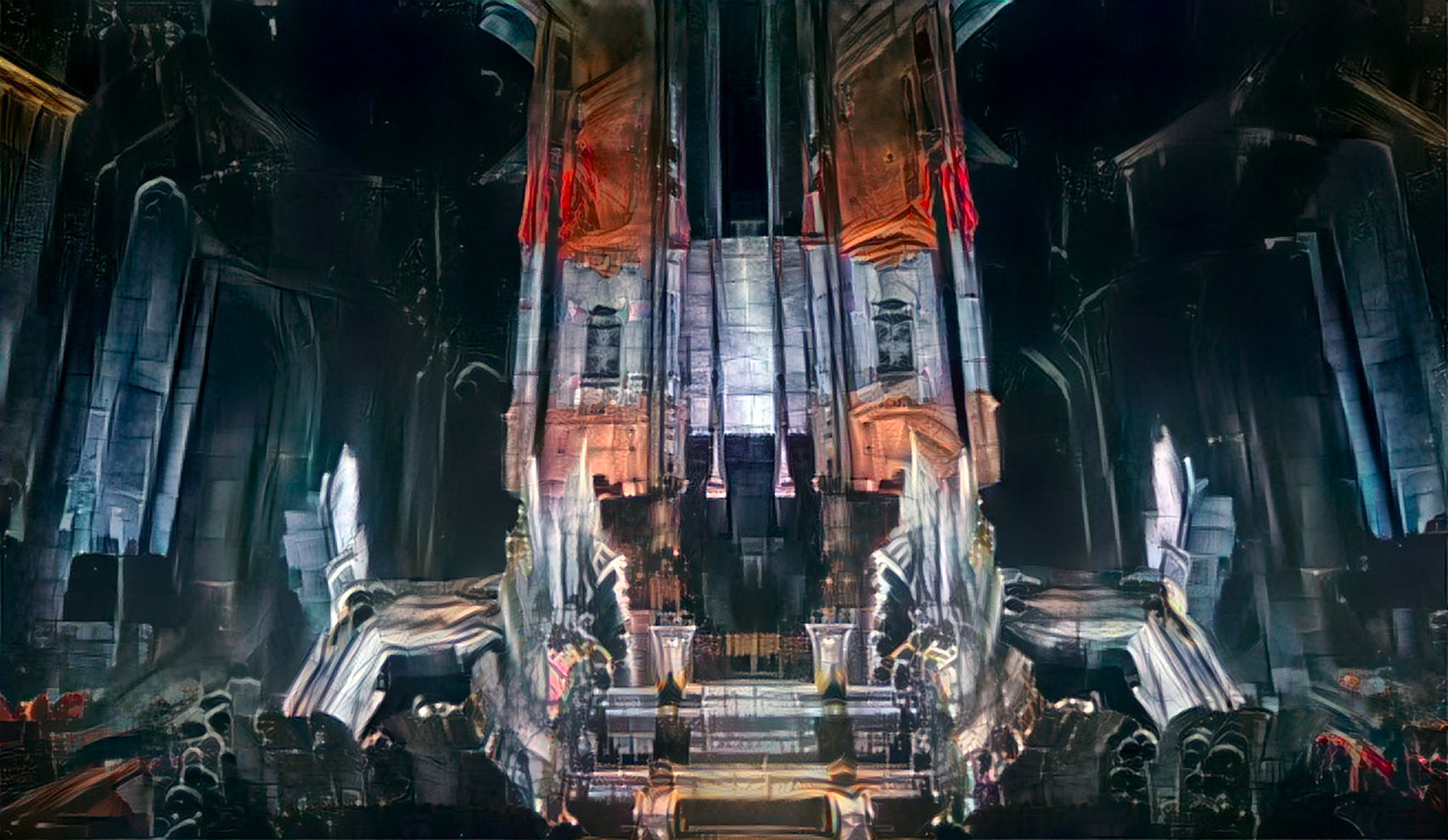
With DeepArt you can transform any image into a 'style' using a base picture and a style picture. I used the fractal image as the base image, and the church as a style image to render this:

Here are some other examples, all made from a base image and a style image based on its 'similar images' result:


Another algorithm that uses deep learning colors in black and white pictures. Its algorithm has learned the best way to do this based on thousands of real images, so it can determine the difference between a sky which is supposed to be blue and a tree that is green.
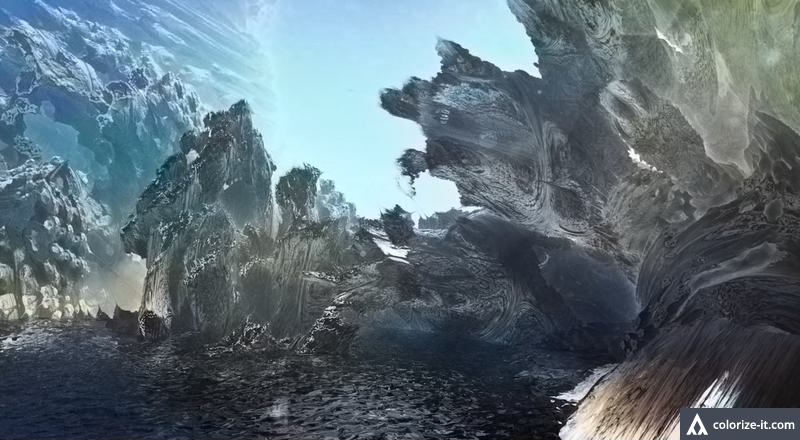
Feeding it fractals in order to see what it would 'think' it needed to color it gave some interesting results. I made sure each image was black and white when I gave it to the algorithm. Most just got back completely sepia, which gave it still a beautiful, old look. Here's some of the most interesting results:
All processed using demos.algorithmia.com/colorize-photos/




Although all this technology is still very young, it's absolutely apparent to me that these techniques will start to play an extremely large role in creating and interpreting art, and this is very exciting to me.
There's something intensely satisfying about peering into a machine's mind.
Live Visuals
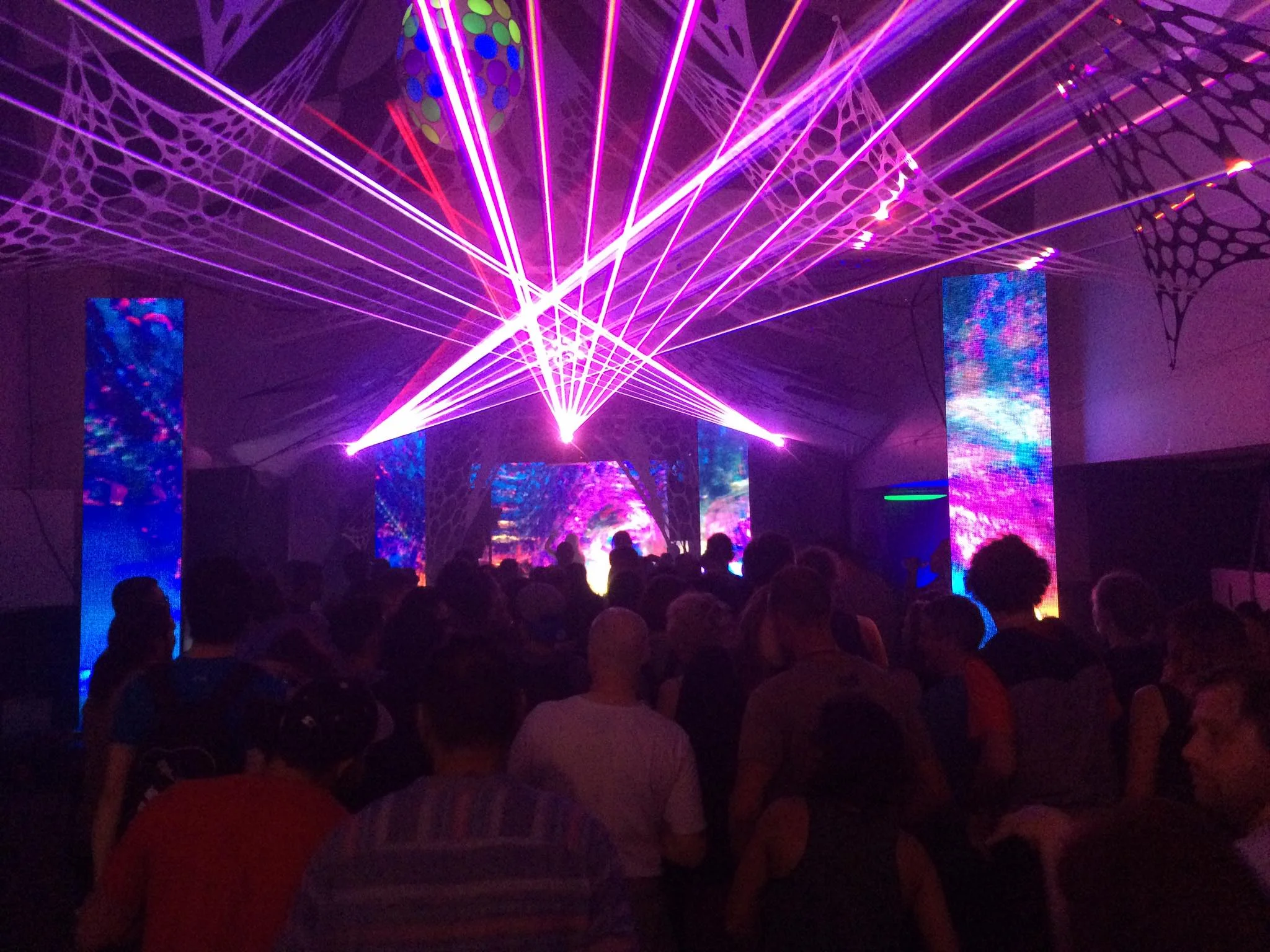
I am mixing clips from a vast repertoire of all my own fractal work -plus a lot of unreleased material – long colorful fly-throughs that work great on large screens, morphing alien worlds that make those on the dance-floor feel like they are on a journey – keeping in tune with the ebb and flow of the music.
In my early twenties, I used to call myself VJ for a while. Armed with two DVD players and a Panasonic MX-50 I used to frequent semi-large venues in Amsterdam, mixing together some funky visuals for the clubbers of those days. Mandelbulb3D hadn’t been invented yet, so I relied on 3D Studio MAX to create tunnels, kaleidoscopic colors, and jumping mushrooms. At age 23, I won the ‘best VJ’ award from the Twix Talent Room. But somewhere around the year 2005 my interests shifted to other endeavors and I let the VJ-ing slide.
Until now. Just last weekend I had my renaissance as a live visual artist – by being invited for the Shattered Barriers event in London. The psychedelic trance music went very well with my fractal artwork. It was incredibly fun and this is definitely something that I will want to be doing more of.
Which is why I’m writing this blog post. If you’re an event organizer, and want to book me as a live visual artist, now you can. Don’t worry – I’m not using DVD players and an MX-50 anymore, but obviously have got the latest hardware and software.
I am mixing clips from a vast repertoire of all my own fractal work -plus a lot of unreleased material – long colorful fly-throughs that work great on large screens, morphing alien worlds that make those on the dance-floor feel like they are on a journey – keeping in tune with the ebb and flow of the music.

Hardware and Rendering for Mandelbulb3D
I often get asked questions about how long it took to render the animation, or what kind of computer I have. I often forgo answering, partly because it's not an easy question to answer. But in this post I will try and answer them as best I can.
I often get asked questions about how long it took to render the animation, or what kind of computer I have. I often forgo answering, partly because it's not an easy question to answer. But in this post I will try and answer them as best I can.
How long does a typical render take? Well, I render on multiple machines (render farm), and the machines don't all have the same specs. Also, I don't always render the entire animation in one continuous session. I can only use the render farm when no 'real' work is rendering, so I have to manage the renders in all the down-time. This hopping on and off and machines with various specs make it hard to put a number on render time. Typically, my animations render between 5 and 30 minutes per frame, and I usually render about 2500 frames for a fly-through animation. The animations that are divided in 'scenes' usually have about 100 frames per scene, so that's usually less then a continuous fly-through.
Remember that I create in-between frames in After Effects. So the 100 frames that I render get multiplied to 500 using frame interpolation. This practice saves an incredible amount of render time.
So altogether it usually takes several days, or even weeks to render something on the farm.
So what kind of computer do I have? Well, some people assume some crazy GPU configuration, but I must stress that the current generation of Mandelbulb3D fractals do not make any use of GPU. It's CPU only, and the reason is that fractals use double precision whereas GPU only uses single precision. The coordinates are therefor not precise enough to create all the cool endless zooms in the fractal space. So GPU real-time fractals can be done, but you can only zoom in to a certain extent. I have seen some examples of this in VR - and I should think that in a few years on, something pretty amazing should be possible in real time.
But for now, it's all CPU, which means that the only thing you should be concerned about when tuning your Mandelbulb3D beast is CPU clock cycles. The more the better, more virtual cores, more physical cores. As it's multi threaded, it will pretty much consume 99% CPU an any PC. I don't know about the L1 L2 caches, but I imagine they won't make much difference. Memory is not going to be an issue. The program is 32-bit so it can't use more then 4 GB of RAM. A lot of people seem to think that more RAM will speed up the rendering, but it won't.
Perhaps somebody could find the sweet spot in the pricing of a PC with as many CPU cycles for the lowest amount of $$$, taking into account the cost of the motherboard you would need for the CPU and some cheap graphics card and RAM.
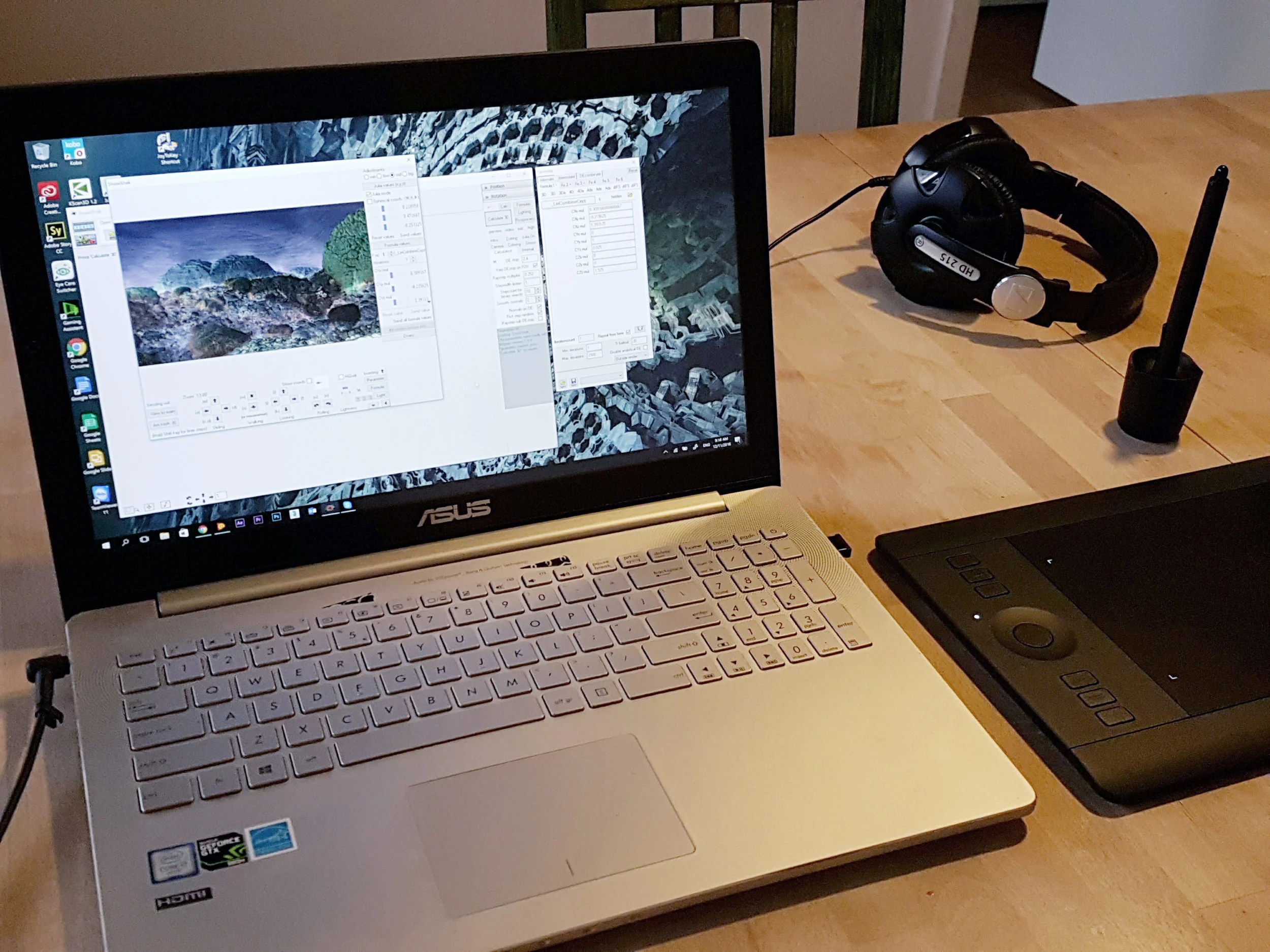
I've recently bought an ASUS Zenbook laptop, which I use for Mandelbulb3D and After Effects. I wouldn't use it to render animations, but I do create high-resolution stills on it, and I generally use it to create the fractals in MB3D in the first place.
I hope that these insights into the hardware side has proven useful for some people, looking for their own setups. And if I've made any errors, or omitted important information you think I should include, please let me know in the comments section.
Happy rendering.
True Stereoscopy
I've decided to render a true stereoscopic fractal flythrough - although it isn't 360 degrees. You can't look back, only forward, as it's a 180 degrees render. Still, it's as immersive as the other VR stuff, with the added benefit of being truly stereoscopic.
Although I don't think it's necessary to have 3D for 360 films, it is something a lot of people have asked for, for obvious reasons. I don't want to go into the technical details explaining what the issues are rendering 3D for 360 it suffices to say that it itsn't a walk in the park.
I've decided to render a true stereoscopic fractal flythrough - although it isn't 360 degrees. You can't look back, only forward, as it's a 180 degrees render. Still, it's as immersive as the other VR stuff, with the added benefit of being truly stereoscopic. The piece called "From Nothing" was also in stereo, but I faked the effect by offsetting the frame using the Z-Buffer, creating a faux 3d- effect not unlike badly converted 3D movies that were shot in 2D.
Dynamic Fog
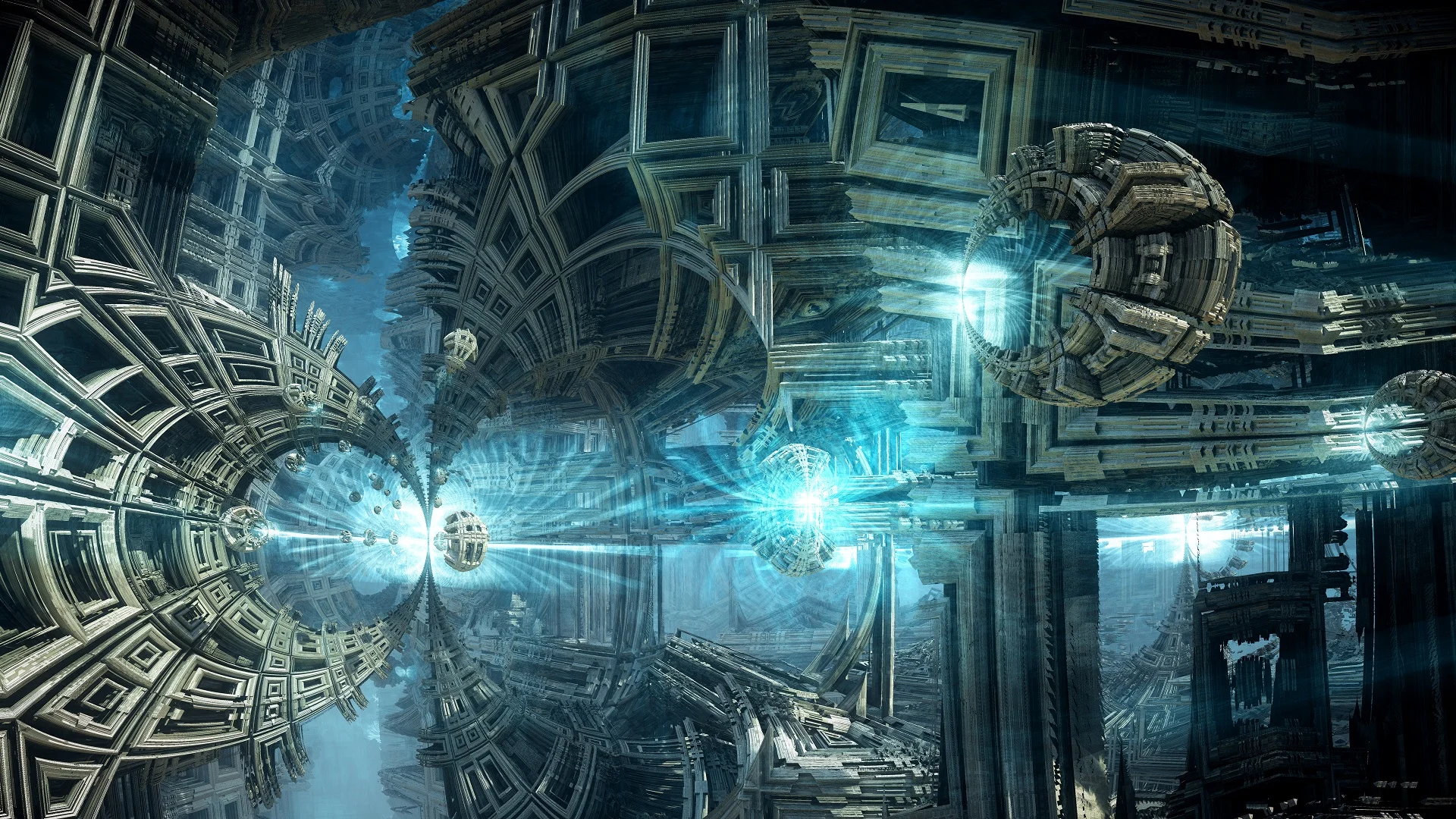
It works really well, and the true stereo adds a lot of depth. Also I used dynamic fog to create transparent layers - something that true stereo excels at and cannot be faked or converted. In this picture, the blue glowing energy lines are what I call Dynamic Fog.
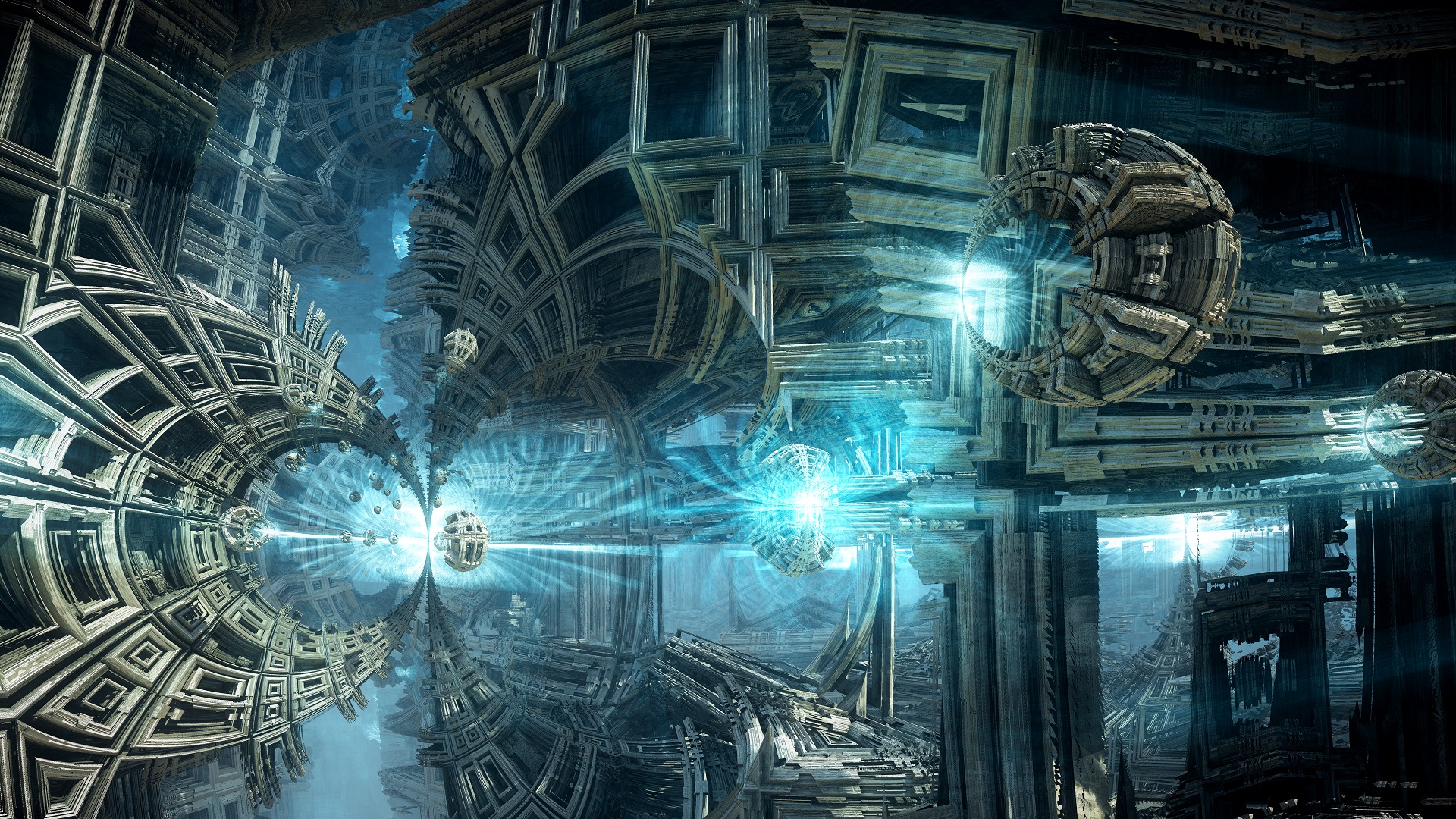
Dynamic Fog is a really cool feature of Mandelbulb3D in that it can create a volumetric effect based on the fractal formula. Some parts of the mathematical volume that aren't visible from the geometry can be made visible through the fog.
Most of the time the fog was gathering at the surface of the fractal, like fog hugging a mountain, giving usually an eerie, ghost-like, or electron microscope effect, not always something that I was looking for. Only recently I figured out how to control the location where the fog gathers, and even animate it. (In the 3D navigator, under Drivers, the 'Dyn Fog on its' and 'R Bailout' sliders) Although in this example the fog has overstepping artifacts and doesn't look as good as I hoped it did in 3D, I still believe there's a tremendous coolness to it.
Alice
In a fractal world, you can zoom in infinitely. In order to keep the very large and the very small manageable, MB3D keeps scaling everything all the time, depending on how close you are to an object. This is necessary for fractals, as you want to be able to get closer to the surface while expanding the detail.
Although I haven't used the effect much in this particular animation, and it sort of just happens, I can imagine how cool it would be to use it more pronounced; and have a fractal the size of a dollhouse just one meter in front of you scale to the size of a city. We would feel like Alice as she shrinks in order to fit through the little door in that famous book.
As I write this, the stereoscopic film is rendering, and it will be a while until it's done. Also I hope that there aren't too many overstepping artifacts, as this formula isn't very stable. I imagine that this works well for other types of immersive films though, as you don't constantly feel the idea you're missing out on what's happening behind you. Just sit back and enjoy the ride.
Ice Cave rendering and VR
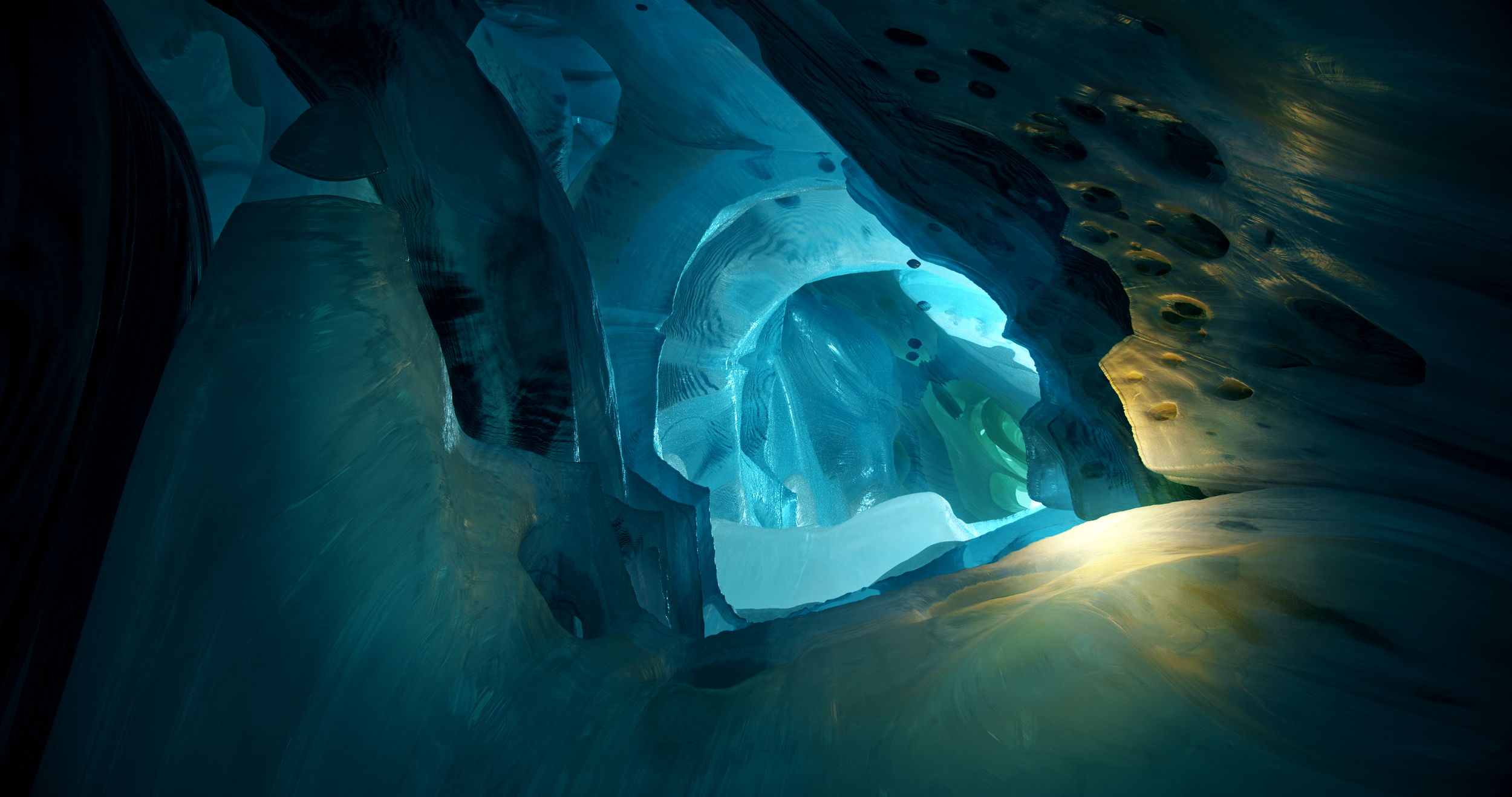
I'm currently doing a couple of 'Ice Cave' renders, and an animation is in the making. I'm not sure if it's going to be any good, because rendering refractive materials is not only extremely slow, but also prone to a lot of unwanted artifacts. But let's put the problems aside for a moment.
I'm going to use the Ice Cave examples to explain something about fractals that I've been thinking about for a while. I'll try to not to get too technical, and anybody with a mild interest in rendering or computer graphics should be able to follow it.
I'm currently doing a couple of 'Ice Cave' renders, and an animation is in the making. I'm not sure if it's going to be any good, because rendering refractive materials is not only extremely slow, but also prone to a lot of unwanted artifacts. But let's put the problems aside for a moment.
I'm going to use the Ice Cave examples to explain something about fractals that I've been thinking about for a while. I'll try to not to get too technical, and anybody with a mild interest in rendering or computer graphics should be able to follow it.
In CG, there's usually a difference between the shape of the object, and its texture. The shape is modeled in some software like digital clay, and then (after the object has been UV unwrapped) the texture is painted on. Now I'm oversimplifying this - in actual fact programs like Z-brush with their abilities to export high-res displacement maps make this distinction a little more fuzzy, but it's still pretty much true.
Take the example of a log of wood. The overall shape is being sculpted, and then a wood texture is applied. In real life though, shape and texture aren't distinct at all. The wood texture consists of little strands of material that make up the whole. To appreciate this connection, consider how the direction of the wood splinters indicate the direction of the tree as a whole.
Unfortunately, I'm not able to model a photo-realistic tree in Mandelbulb3d. But if I was, I wouldn't need to texture it, since the texture would emerge by the sheer fact that in stead of being a solid object, the fractal piece of wood would consist of thousand little wood splinters, giving the appearance of wood. Although usually you only see the outer layer, most fractals are infinitely complex layered objects like onions.

You can see this sub-surface property well in the Ice Cave example. This particular Mandelbulb formula is smooth and round, but it has detail in its surface, as well as holes. This is perfect for the scattering of light in a realistic way inside an object. I'd say I really like the (painterly) texture of this image, but there is no texture. There's only form.
I'm not saying that Mandelbulb3D is the best software for creating realistic ice or sub-surface materials (it isn't), but if this technique would somehow be improved in the future, the processes of modeling and texturing could change completely. In stead of recreating the appearance of a natural object, you would digitally recreate the process that created it. This is already feasible with simple objects like crystal, rock or ice. It would be harder to do for plants and extremely hard to do for animals and humans. But it would unlock an entirely new (semi-photorealistic) realm to render and explore.

I'm sure that some steps have been taken into this direction by clever programmers, and if you know about some cool tool that does this, please let me know in the comments.
VR
I'm considering rendering a VR version of the Ice Caves, although I'd have to think about where the hell I'm going to find enough render power to make that happen. VR is an extremely awesome way to experience fractals, and if you haven't tried it I really recommend trying to get your hand on one of the many VR devices that are coming out this year. There is a great team working on a cross-platform app that you can install on any of the devices (IOS, Android, Oculus, Vive, GearVR) in order to download and watch all my work in the best possible resolution. You should hear more about this when it will release.
Mandelbulb Maniacs and the Future of Fractal Art
Slowly but surely it seems that my work, and the work of other great fractal artists around the world, is being noticed by a broader audience and also appreciated as a more mature art form.
Not just online, but also offline these works are being recognized and praised. Keep an eye on my Events page that I'll try to update frequently with events and festivals my work will show in one way or another.
Slowly but surely it seems that my work, and the work of other great fractal artists around the world, is being noticed by a broader audience and also appreciated as a more mature art form. I won't go so far as to say it's popular - as I believe this abstract art will still only appeal to a certain audience, but there's traction nevertheless.
The Facebook group Mandelbulb Maniacs almost has 6000 members. These are not just people creating fractals, but also a lot of people who have seen the magnificent shapes these algorithms can produce, and they want to see regular updates in their timeline. In this group some truly amazing artists reside, and I'm often very intrigued by what Dortus Gunst, Philippe Jacqueroux, Gary Webb, Barbara Russell and many others I can't possibly all mention produce on a daily basis. There are also some interesting 'trends' that seem to emerge, especially because everybody shares their parameters, which means you can learn from each other's masterpieces. It would be an understatement to say that I've learned a lot from this group.
Not just online, but also offline these works are being recognized and praised. People use it for obvious reasons as VJ material in clubs and venues, but there's also an increasing number of digital art festivals that love to showcase fractalicious art. Last year I traveled to Geneva and Montreal to create a show for the full-dome format. This immersive format really provides fractals with an extra dimension. This year it seems that there will be more opportunities to showcase to the world what's possible in the infinite world of fractals.
I'm currently working on various projects that contain fractals in one way or another, and I hope to present you soon a list of places around the world where my work can be seen. For the moment there are some events lined up In the Netherlands, but hopefully I will be able to add more worldwide events soon. Right now, I'm getting ready to go to Thailand, to meet a great artist who's working on an immersive film. I hope that we'll be able to create something inspiring together.
Keep an eye on my Events page that I'll try to update frequently with events and festivals my work will show in one way or another.
Some background on 'Our Fractal Brains'
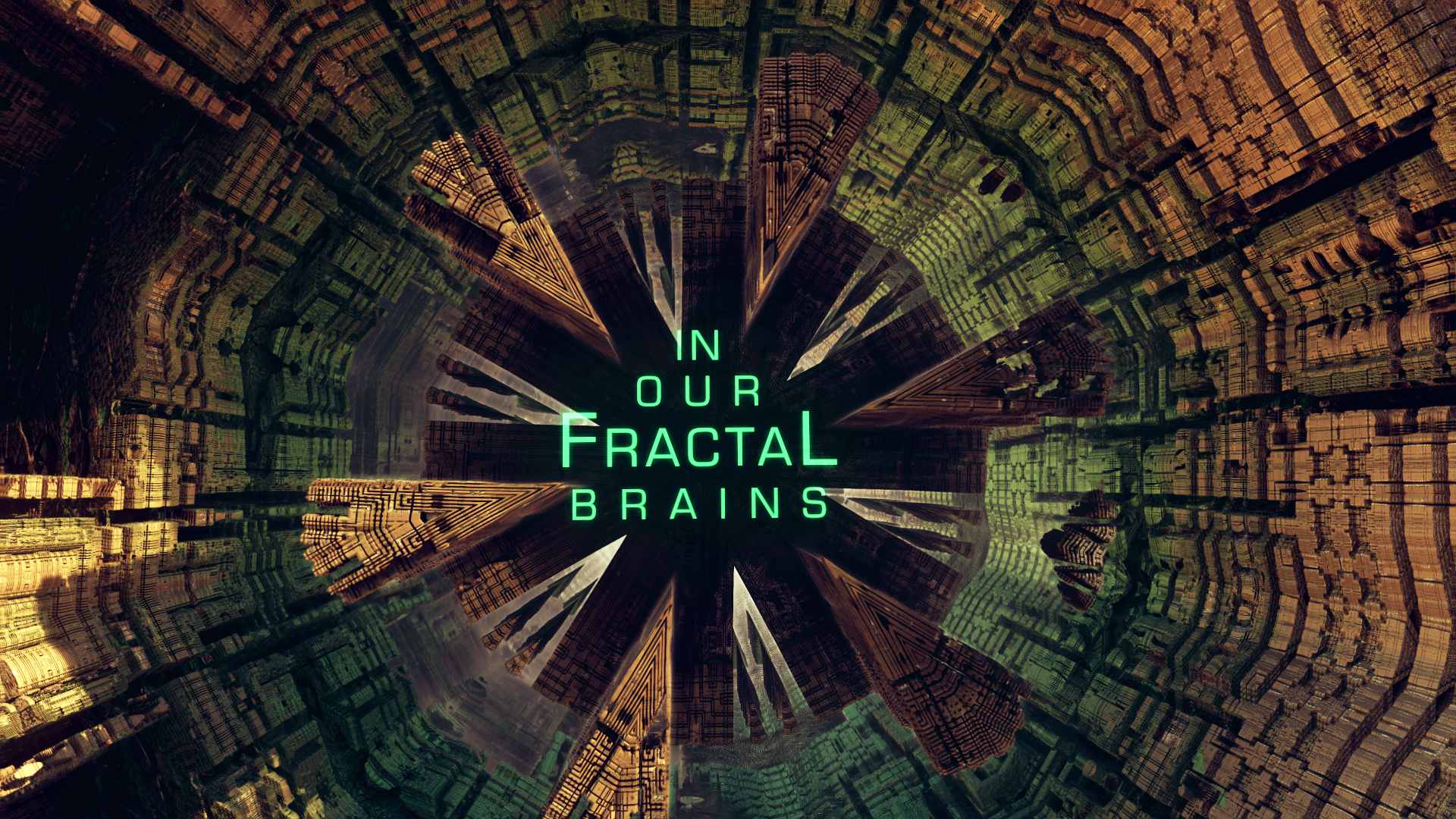
I very much enjoyed the film 'The Secret Life of Walter Mitty' by Ben Stiller. The unconventional imagination of both the lead character as well as the director resonated with me. One of the scenes that stuck was the scene where Mitty first starts to travel, to Greenland. Everywhere through the shots we see words that form sentences. I wanted to do something like that, and that's how the idea of this short film emerged.
I very much enjoyed the film 'The Secret Life of Walter Mitty' by Ben Stiller. The unconventional imagination of both the lead character as well as the director resonated with me. One of the scenes that stuck was the scene where Mitty first starts to travel, to Greenland. Everywhere through the shots we see words that form sentences. I wanted to do something like that, and that's how the idea of this short film emerged. When I discovered Patrick O'hearn's Reaching Land trough Google Play Music's recommendations, It clicked. That was the score to use for this idea.
So I set out to write something like a poem, that kind of did that thing, and started digging through the vast Fractal Soil to unearth those little gems.
The 'message' of the video could easily be misinterpreted I think. So I'd like to clarify a little. I don't actually think the brain is a fractal, or that it is endless, or infinite. I'm not a spiritual person in that sense, that thinks we're all connected or something vague like that. I do think that the brain has some fractal properties, and the way it develops in embryonic development is not unlike the emergence of shapes and forms in the fractal software.
I'm more interested in the fact that we seem to attribute 'meaning' to things, as most of us don't realize it is only in us, where that meaning resides.
Graphic design is definitely not my strongest side (understatement) but I tried to play around with fonts and styles, having learned a little from my time with Carbon Media. Machmoving occurred mostly in After Effects, although I did the glass / crystal scene in 3dsMAX. That was by the way also the first time I used Transparency in MB3D. Something postponed for that long because of its ridiculous long render times, as well as its need for triple anti-aliasing, in stead of double, as I use to.
The response has been amazing to this video, and as I write this, it has just been picked by Vimeo as a Staff Pick, of which I am immensely proud.
Spaced Out or Stretched Out- VR storytelling ideas
I've decided to share some excerpts from a piece I'm writing on VR (virtual reality) storytelling. These are thoughts and ideas that I's like to experiment with, improve upon or throw away if they don't work. If you have any additional ideas or comments about mine, I invite you to write them down in the comments section
I've decided to share some excerpts from a piece I'm writing on VR (virtual reality) storytelling. These are thoughts and ideas that I'd like to experiment with, improve upon or throw away if they don't work. If you have any additional ideas or comments about mine, I invite you to write them down in the comments section.
Discarding events
In screenwriting, one learns that scenes must turn. If, at the end of the scene nothing has changed much in respect to the beginning, the scene should be thrown away. This is at least what I learned from Robert McKee's book 'Story: Style, Structure, Substance, and the Principles of Screenwriting'. McKee proceeds to explain that scenes can turn through either action or revelation. A character can do something that changes the dynamics of the scene, or something can be revealed to him or the audience, that puts everything in a different perspective.
It would be an interesting experiment to discard the action-device and rely solely on revelation. This is useful in VR because of the following.
The nature of 360 degrees is such that you can look anywhere you want at any given time. If you want the audience to look in a specific direction you could use a bag of tricks in order to increase the likelihood that he looks in the right direction, but this creates all sorts of problems, and I suspect the viewing experience would become very forced.
Never I want the viewer to have the idea he may have missed something because he wasn't looking the right way. This is why crucial story elements should never be events - moments in time and space - that you can miss. They are either only in time - but not tied to a place, or they are in the space, but spread out over time. This will put the viewer at ease, without him worrying that he misses out.
Therefor scenes will not turn through action, but only through revelation - as events must be either time OR space, but never both. I imagine that creating a story that is forced to adhere to these principles must create something compelling and original. The following are examples of events that are spaced out or stretched out:
Imagine we're in a frozen-time scenario. Time is non-existent, only through our (pre-directed) point of view. Moving through space, we can reveal something that was previously hidden, for instance discovering a person we didn't expect to be there. We should give the viewer time to make this discovery - but when he does, the scene has turned, climaxed, etc and the story propels forward. The next example is more metaphoric (or suitable for fractals). We could be in a tunnel that feels small, confined, and end up in a large space. Here the turn could be from claustrophobic to agoraphobic. We can go from horizontal caverns (sense of being lost) to vertical (fear of falling), etc.
Events that only exist in time may be less useful, but I can imagine it to occur from time to time. If we are to use voice over, or literal dialogue, what is being said can turn a scene regardless of where you're looking. Changes in lighting or color can be obvious from all angles and have enough impact to be immediately on the leading edge of your consciousness.
On the brink of two hemispheres
If the story demands some traditional scenes, how do we show them? I've always imagined it would feel a little amateurish to put a 360 camera in the middle of a room (set?) to record some actors playing. Without editing, interesting camera angles and lenses, even without any place to put your lights - how can you shoot something beautiful?
I don't want to create something where we are 'in the middle of the action' I'd still would want to be an observer, albeit one that can observe a hell of a lot more then one that watches a screen. When faced with these issues, interesting techniques come to mind, like split screen. We could continually be at two places at once, on the brink of two hemispheres. This makes production easier, as lights and sound equipment can be placed in the blind corner, and this heightens the feeling that we are not 'actually present' - we are in the virtual world - spying on the real world.
These ideas, especially the last one, are mostly applicable to a screenplay I'm writing, in which the protagonist, a young woman, thinks she is a human - flesh and blood, but actually only exists in the virtual world. She can see the world through cameras, computers, etc. and can easily be at two places at once.
Wouldn't it be great if the audience would experience what it's like to be virtual?
Baraka
I am convinced that this cinematic language must work well in VR. The Virtual Reality goggles have been called temples before, and indeed - it's the architecture that creates presence. The same principles that places of worship have used all over the world for millennia can make VR into something transcendental.
About 23 years after its release, I recently saw the film Baraka, and was extremely impressed by what it managed to achieve. Because it was shot on 70mm IMAX film, it doesn't look dated even for a moment. Its recent sequel, Samsara is almost equally impressive, but it's Baraka that has caught my interest here.
For me, the piece achieves the setting of an emotional curve with only images and music like none other. It delivers an extremely intense climax by postponing it; a single moment that hit me like a religious experience. Since I'm an atheist, this isn't something I have on a regular basis.
The movie slowly builds with imagery from nature and culture, intensifying near the end by showing charred corpses in a funeral ritual on the river Ganges - serene, but heavy. After this scene, we see a man handling a beam that is about to hit a huge bell. The quality of the images is such that the texture can almost be felt. We want the beam to hit the bell, we want to be satisfied by the atonal strike tone - but the moment is cut. Instead, we see Masai, in Trance.
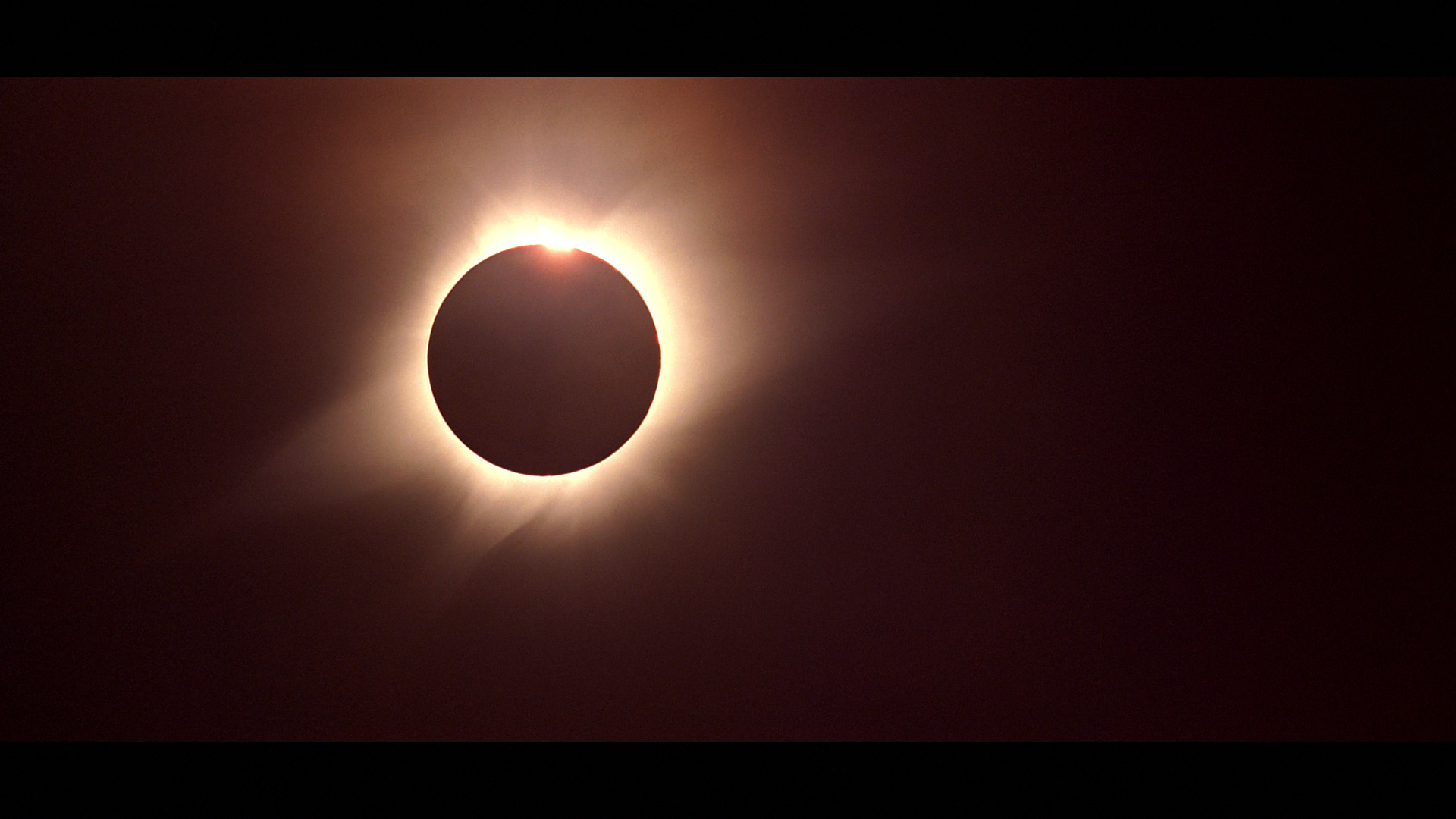
A particular shot of an eclipse has been shown before in the film; it's a perfect example of internal symbolism. An image with otherwise no meaning can start to carry meaning inside the context of the piece.
The spiritual climax delivers when the director cuts to the iconic eclipse again - together with the sound of the immense bell.
I am convinced that this cinematic language must work well in VR. The Virtual Reality goggles have been called temples before, and indeed - it's the architecture that creates presence. The same principles that places of worship have used all over the world for millennia can make VR into something transcendental.
I would really enjoy creating something like the emotional curve from Baraka, including its fantastic soundtrack, in combination with VR. I'm obviously thinking about fractals, but real footage (if shot properly) could be even more amazing.
Baraka on IMDB:
http://www.imdb.com/title/tt0103767/
Symmetry
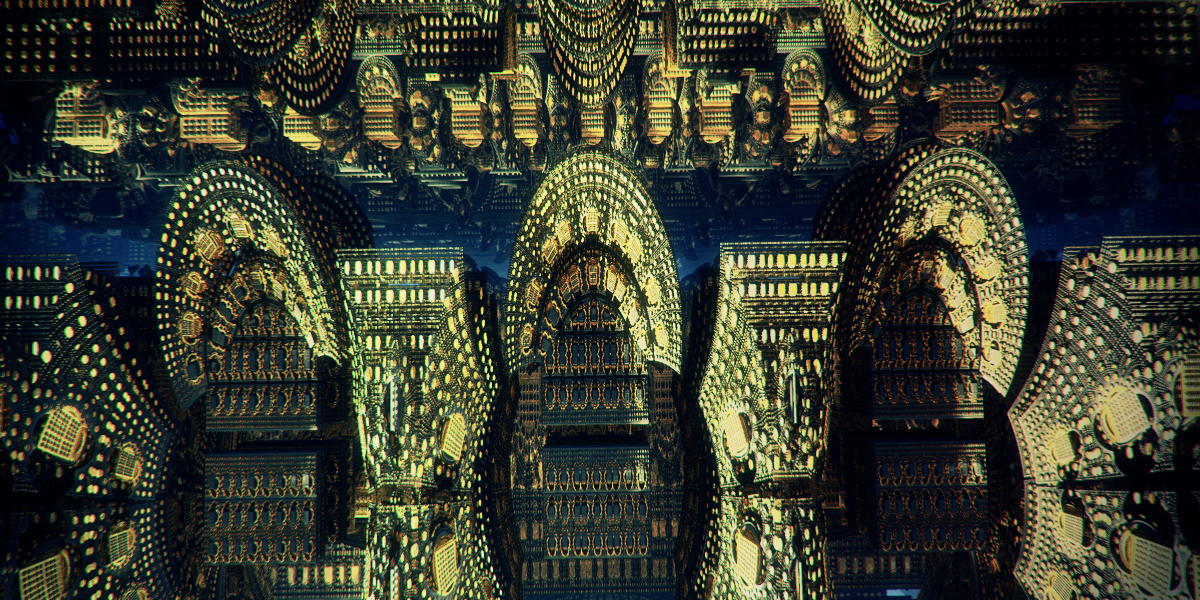
Symmetry is actually really quite interesting: It’s everywhere in nature; in the shape of a leaf to virtually every living animal - they all have a symmetry axis through the middle. Therefore, symmetry is actually a pleasing sight. Any random shape with a vertical symmetry axis has the potential to look familiar: Rorschach blobs are probably the best example of this.
This is my first blog post – and it’s about symmetry, which is something I struggle with and think about a lot when I animate. There are plenty of these types of subjects that I’d like to discuss, like four-dimensional rotations or the use of music. You will find them updated regularly in this blog and you can participate in a discussion about these matters- since there must be so many ways of looking at and dealing with these issues.
I've been thinking about discussing Symmetry in one of my tutorials before, but I've decided it was too distracting from the subject.
Symmetry is actually really quite interesting: It’s everywhere in nature; in the shape of a leaf to virtually every living animal - they all have a symmetry axis through the middle. Therefore, symmetry is actually a pleasing sight. Any random shape with a vertical symmetry axis has the potential to look familiar: Rorschach blobs are probably the best example of this. It’s also the easiest way to create ‘a face’ – like in ‘the Resolution of the Thirteen Fractal Skulls’.
If we add even more symmetry axes, we start to get a kaleidoscope, turning virtually every random pattern into a pleasing flowery shape. Fractals carry a lot of symmetry and, pleasing as this may seem, I try to avoid it at all cost. Whenever I see a vertically symmetrical picture, I can’t help but feel I’m only looking at half a picture; the other half obscured by a mirror. With kaleidoscopic images the percentage goes down.
Since almost all fractals have symmetry axes scattered around like madness, I try to find camera angles that hide this. I almost never succeed at this for 100%, but the less symmetry I see, the more confident I am having something worthwhile. It helps sell the idea that every shape is unique- even though this isn't always the case. Even when the symmetry is undeniably beautiful, like in architecture, I offset the camera to film it from an angle, like in ‘Geologic Time’.
In the immersive short, ‘the Cryogenian’ the entire journey takes place through one long symmetrical corridor. Here I used lighting to create uniqueness, but I do believe it would have been much more interesting if there was a better way to break up the symmetry.
When morphing (animating) fractals, symmetry poses yet another problem. Matter will appear from nowhere or disappear into a mirror plane. I find this a deeply disturbing feature and it distracts from the beautiful nature of the morphs. Almost every fractal short I’ve made containing morphs, seems to have this problem- most notably ‘Looking Glass’ – but there are plenty others. Sometimes I use ‘modifiers’ in Mandelbulb3D to throw off the geometry a little, mostly _helispiral or _gnarl3d, but they are slow to render and add a lot of render time.
What are your ways to fight symmetry, or how do you embrace it? Let me know your thoughts,
Julius Horsthuis