

Neural Networks interpreting Fractals
There's something intensely satisfying about peering into a machine's mind.
For me, one of the most amazing things about fractals is that at first glance they seem to resemble something from real life, but at closer inspection this appears an illusion. With the advent of Google's Deep Dream and many other Neural Networks I thought it was an interesting experiment to see how AI would interpret a fractal picture. I've done two simple tests to see where this could go.
First, I gave a couple of fractal images to Google's similar image search algorithm, to see what Google would think is on the picture.
So I uploaded this image of a pure fractal:

What would Google 'think' is on this picture? Some similar images came up, not surprisingly most where buildings, churches and such:

With DeepArt you can transform any image into a 'style' using a base picture and a style picture. I used the fractal image as the base image, and the church as a style image to render this:

Here are some other examples, all made from a base image and a style image based on its 'similar images' result:


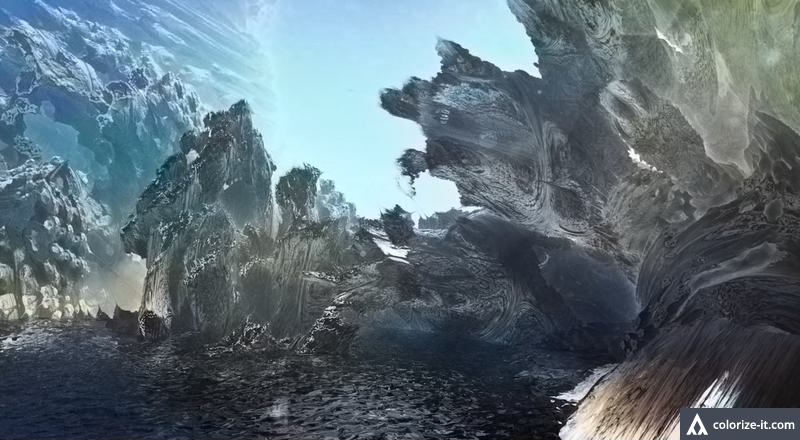
Another algorithm that uses deep learning colors in black and white pictures. Its algorithm has learned the best way to do this based on thousands of real images, so it can determine the difference between a sky which is supposed to be blue and a tree that is green.
Feeding it fractals in order to see what it would 'think' it needed to color it gave some interesting results. I made sure each image was black and white when I gave it to the algorithm. Most just got back completely sepia, which gave it still a beautiful, old look. Here's some of the most interesting results:
All processed using demos.algorithmia.com/colorize-photos/




Although all this technology is still very young, it's absolutely apparent to me that these techniques will start to play an extremely large role in creating and interpreting art, and this is very exciting to me.
There's something intensely satisfying about peering into a machine's mind.

Ice Cave rendering and VR
I'm currently doing a couple of 'Ice Cave' renders, and an animation is in the making. I'm not sure if it's going to be any good, because rendering refractive materials is not only extremely slow, but also prone to a lot of unwanted artifacts. But let's put the problems aside for a moment.
I'm going to use the Ice Cave examples to explain something about fractals that I've been thinking about for a while. I'll try to not to get too technical, and anybody with a mild interest in rendering or computer graphics should be able to follow it.
I'm currently doing a couple of 'Ice Cave' renders, and an animation is in the making. I'm not sure if it's going to be any good, because rendering refractive materials is not only extremely slow, but also prone to a lot of unwanted artifacts. But let's put the problems aside for a moment.
I'm going to use the Ice Cave examples to explain something about fractals that I've been thinking about for a while. I'll try to not to get too technical, and anybody with a mild interest in rendering or computer graphics should be able to follow it.
In CG, there's usually a difference between the shape of the object, and its texture. The shape is modeled in some software like digital clay, and then (after the object has been UV unwrapped) the texture is painted on. Now I'm oversimplifying this - in actual fact programs like Z-brush with their abilities to export high-res displacement maps make this distinction a little more fuzzy, but it's still pretty much true.
Take the example of a log of wood. The overall shape is being sculpted, and then a wood texture is applied. In real life though, shape and texture aren't distinct at all. The wood texture consists of little strands of material that make up the whole. To appreciate this connection, consider how the direction of the wood splinters indicate the direction of the tree as a whole.
Unfortunately, I'm not able to model a photo-realistic tree in Mandelbulb3d. But if I was, I wouldn't need to texture it, since the texture would emerge by the sheer fact that in stead of being a solid object, the fractal piece of wood would consist of thousand little wood splinters, giving the appearance of wood. Although usually you only see the outer layer, most fractals are infinitely complex layered objects like onions.

You can see this sub-surface property well in the Ice Cave example. This particular Mandelbulb formula is smooth and round, but it has detail in its surface, as well as holes. This is perfect for the scattering of light in a realistic way inside an object. I'd say I really like the (painterly) texture of this image, but there is no texture. There's only form.
I'm not saying that Mandelbulb3D is the best software for creating realistic ice or sub-surface materials (it isn't), but if this technique would somehow be improved in the future, the processes of modeling and texturing could change completely. In stead of recreating the appearance of a natural object, you would digitally recreate the process that created it. This is already feasible with simple objects like crystal, rock or ice. It would be harder to do for plants and extremely hard to do for animals and humans. But it would unlock an entirely new (semi-photorealistic) realm to render and explore.

I'm sure that some steps have been taken into this direction by clever programmers, and if you know about some cool tool that does this, please let me know in the comments.
VR
I'm considering rendering a VR version of the Ice Caves, although I'd have to think about where the hell I'm going to find enough render power to make that happen. VR is an extremely awesome way to experience fractals, and if you haven't tried it I really recommend trying to get your hand on one of the many VR devices that are coming out this year. There is a great team working on a cross-platform app that you can install on any of the devices (IOS, Android, Oculus, Vive, GearVR) in order to download and watch all my work in the best possible resolution. You should hear more about this when it will release.

Mandelbulb Maniacs and the Future of Fractal Art
Slowly but surely it seems that my work, and the work of other great fractal artists around the world, is being noticed by a broader audience and also appreciated as a more mature art form.
Not just online, but also offline these works are being recognized and praised. Keep an eye on my Events page that I'll try to update frequently with events and festivals my work will show in one way or another.
Slowly but surely it seems that my work, and the work of other great fractal artists around the world, is being noticed by a broader audience and also appreciated as a more mature art form. I won't go so far as to say it's popular - as I believe this abstract art will still only appeal to a certain audience, but there's traction nevertheless.
The Facebook group Mandelbulb Maniacs almost has 6000 members. These are not just people creating fractals, but also a lot of people who have seen the magnificent shapes these algorithms can produce, and they want to see regular updates in their timeline. In this group some truly amazing artists reside, and I'm often very intrigued by what Dortus Gunst, Philippe Jacqueroux, Gary Webb, Barbara Russell and many others I can't possibly all mention produce on a daily basis. There are also some interesting 'trends' that seem to emerge, especially because everybody shares their parameters, which means you can learn from each other's masterpieces. It would be an understatement to say that I've learned a lot from this group.
Not just online, but also offline these works are being recognized and praised. People use it for obvious reasons as VJ material in clubs and venues, but there's also an increasing number of digital art festivals that love to showcase fractalicious art. Last year I traveled to Geneva and Montreal to create a show for the full-dome format. This immersive format really provides fractals with an extra dimension. This year it seems that there will be more opportunities to showcase to the world what's possible in the infinite world of fractals.
I'm currently working on various projects that contain fractals in one way or another, and I hope to present you soon a list of places around the world where my work can be seen. For the moment there are some events lined up In the Netherlands, but hopefully I will be able to add more worldwide events soon. Right now, I'm getting ready to go to Thailand, to meet a great artist who's working on an immersive film. I hope that we'll be able to create something inspiring together.
Keep an eye on my Events page that I'll try to update frequently with events and festivals my work will show in one way or another.