
Hardware and Rendering for Mandelbulb3D
I often get asked questions about how long it took to render the animation, or what kind of computer I have. I often forgo answering, partly because it's not an easy question to answer. But in this post I will try and answer them as best I can.
I often get asked questions about how long it took to render the animation, or what kind of computer I have. I often forgo answering, partly because it's not an easy question to answer. But in this post I will try and answer them as best I can.
How long does a typical render take? Well, I render on multiple machines (render farm), and the machines don't all have the same specs. Also, I don't always render the entire animation in one continuous session. I can only use the render farm when no 'real' work is rendering, so I have to manage the renders in all the down-time. This hopping on and off and machines with various specs make it hard to put a number on render time. Typically, my animations render between 5 and 30 minutes per frame, and I usually render about 2500 frames for a fly-through animation. The animations that are divided in 'scenes' usually have about 100 frames per scene, so that's usually less then a continuous fly-through.
Remember that I create in-between frames in After Effects. So the 100 frames that I render get multiplied to 500 using frame interpolation. This practice saves an incredible amount of render time.
So altogether it usually takes several days, or even weeks to render something on the farm.
So what kind of computer do I have? Well, some people assume some crazy GPU configuration, but I must stress that the current generation of Mandelbulb3D fractals do not make any use of GPU. It's CPU only, and the reason is that fractals use double precision whereas GPU only uses single precision. The coordinates are therefor not precise enough to create all the cool endless zooms in the fractal space. So GPU real-time fractals can be done, but you can only zoom in to a certain extent. I have seen some examples of this in VR - and I should think that in a few years on, something pretty amazing should be possible in real time.
But for now, it's all CPU, which means that the only thing you should be concerned about when tuning your Mandelbulb3D beast is CPU clock cycles. The more the better, more virtual cores, more physical cores. As it's multi threaded, it will pretty much consume 99% CPU an any PC. I don't know about the L1 L2 caches, but I imagine they won't make much difference. Memory is not going to be an issue. The program is 32-bit so it can't use more then 4 GB of RAM. A lot of people seem to think that more RAM will speed up the rendering, but it won't.
Perhaps somebody could find the sweet spot in the pricing of a PC with as many CPU cycles for the lowest amount of $$$, taking into account the cost of the motherboard you would need for the CPU and some cheap graphics card and RAM.
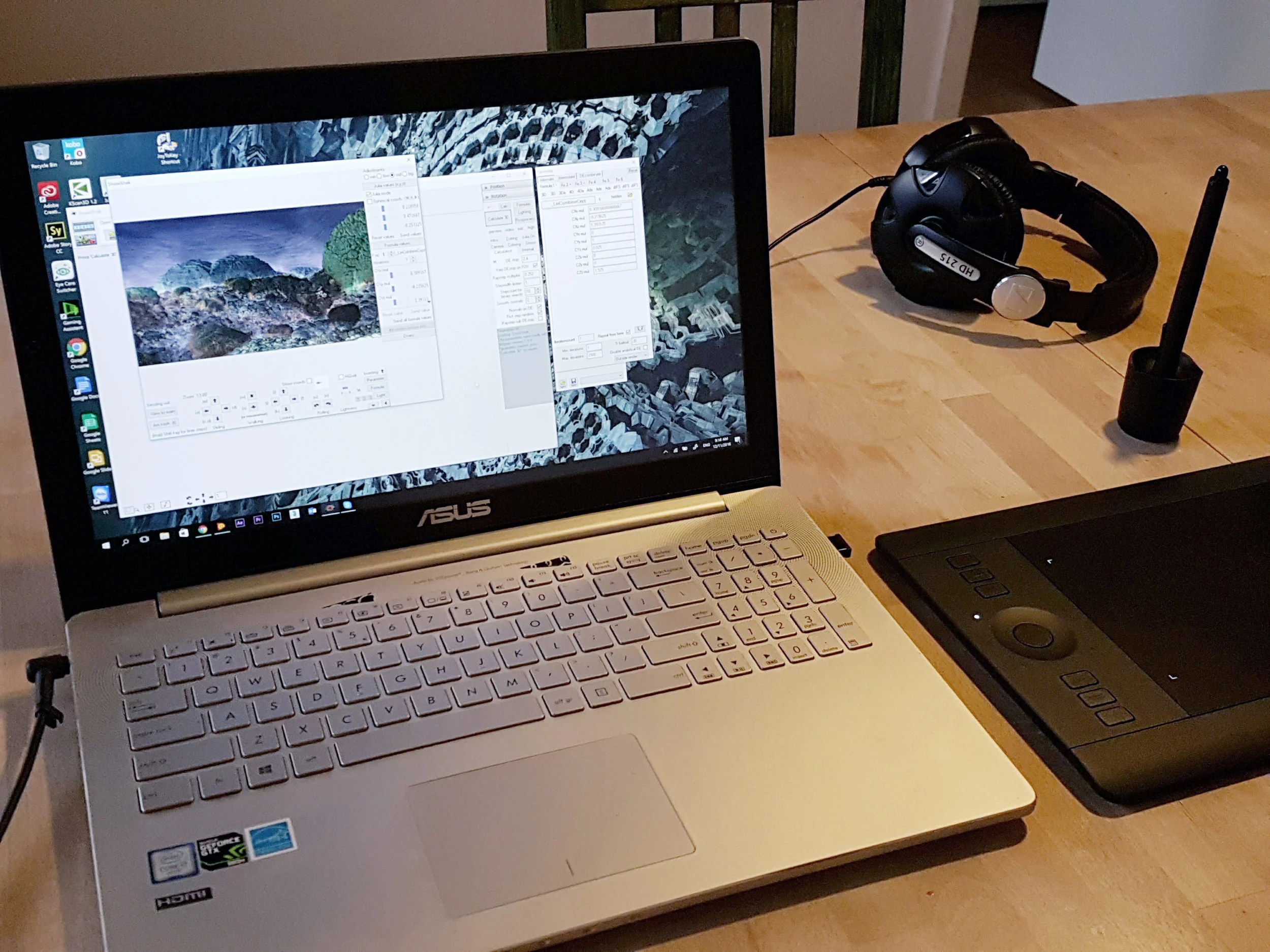
I've recently bought an ASUS Zenbook laptop, which I use for Mandelbulb3D and After Effects. I wouldn't use it to render animations, but I do create high-resolution stills on it, and I generally use it to create the fractals in MB3D in the first place.
I hope that these insights into the hardware side has proven useful for some people, looking for their own setups. And if I've made any errors, or omitted important information you think I should include, please let me know in the comments section.
Happy rendering.
Ice Cave rendering and VR
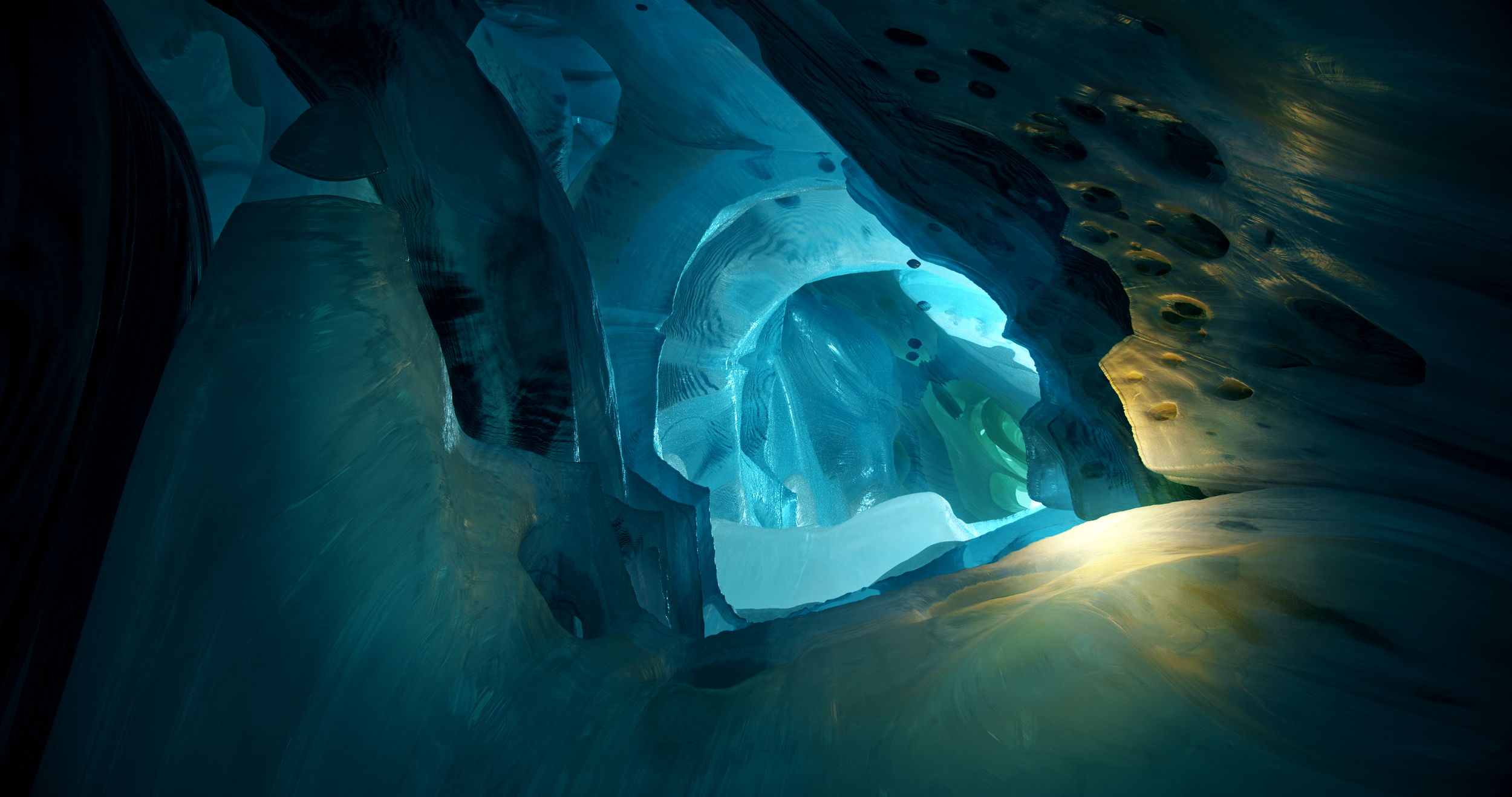
I'm currently doing a couple of 'Ice Cave' renders, and an animation is in the making. I'm not sure if it's going to be any good, because rendering refractive materials is not only extremely slow, but also prone to a lot of unwanted artifacts. But let's put the problems aside for a moment.
I'm going to use the Ice Cave examples to explain something about fractals that I've been thinking about for a while. I'll try to not to get too technical, and anybody with a mild interest in rendering or computer graphics should be able to follow it.
I'm currently doing a couple of 'Ice Cave' renders, and an animation is in the making. I'm not sure if it's going to be any good, because rendering refractive materials is not only extremely slow, but also prone to a lot of unwanted artifacts. But let's put the problems aside for a moment.
I'm going to use the Ice Cave examples to explain something about fractals that I've been thinking about for a while. I'll try to not to get too technical, and anybody with a mild interest in rendering or computer graphics should be able to follow it.
In CG, there's usually a difference between the shape of the object, and its texture. The shape is modeled in some software like digital clay, and then (after the object has been UV unwrapped) the texture is painted on. Now I'm oversimplifying this - in actual fact programs like Z-brush with their abilities to export high-res displacement maps make this distinction a little more fuzzy, but it's still pretty much true.
Take the example of a log of wood. The overall shape is being sculpted, and then a wood texture is applied. In real life though, shape and texture aren't distinct at all. The wood texture consists of little strands of material that make up the whole. To appreciate this connection, consider how the direction of the wood splinters indicate the direction of the tree as a whole.
Unfortunately, I'm not able to model a photo-realistic tree in Mandelbulb3d. But if I was, I wouldn't need to texture it, since the texture would emerge by the sheer fact that in stead of being a solid object, the fractal piece of wood would consist of thousand little wood splinters, giving the appearance of wood. Although usually you only see the outer layer, most fractals are infinitely complex layered objects like onions.

You can see this sub-surface property well in the Ice Cave example. This particular Mandelbulb formula is smooth and round, but it has detail in its surface, as well as holes. This is perfect for the scattering of light in a realistic way inside an object. I'd say I really like the (painterly) texture of this image, but there is no texture. There's only form.
I'm not saying that Mandelbulb3D is the best software for creating realistic ice or sub-surface materials (it isn't), but if this technique would somehow be improved in the future, the processes of modeling and texturing could change completely. In stead of recreating the appearance of a natural object, you would digitally recreate the process that created it. This is already feasible with simple objects like crystal, rock or ice. It would be harder to do for plants and extremely hard to do for animals and humans. But it would unlock an entirely new (semi-photorealistic) realm to render and explore.

I'm sure that some steps have been taken into this direction by clever programmers, and if you know about some cool tool that does this, please let me know in the comments.
VR
I'm considering rendering a VR version of the Ice Caves, although I'd have to think about where the hell I'm going to find enough render power to make that happen. VR is an extremely awesome way to experience fractals, and if you haven't tried it I really recommend trying to get your hand on one of the many VR devices that are coming out this year. There is a great team working on a cross-platform app that you can install on any of the devices (IOS, Android, Oculus, Vive, GearVR) in order to download and watch all my work in the best possible resolution. You should hear more about this when it will release.
Spaced Out or Stretched Out- VR storytelling ideas
I've decided to share some excerpts from a piece I'm writing on VR (virtual reality) storytelling. These are thoughts and ideas that I's like to experiment with, improve upon or throw away if they don't work. If you have any additional ideas or comments about mine, I invite you to write them down in the comments section
I've decided to share some excerpts from a piece I'm writing on VR (virtual reality) storytelling. These are thoughts and ideas that I'd like to experiment with, improve upon or throw away if they don't work. If you have any additional ideas or comments about mine, I invite you to write them down in the comments section.
Discarding events
In screenwriting, one learns that scenes must turn. If, at the end of the scene nothing has changed much in respect to the beginning, the scene should be thrown away. This is at least what I learned from Robert McKee's book 'Story: Style, Structure, Substance, and the Principles of Screenwriting'. McKee proceeds to explain that scenes can turn through either action or revelation. A character can do something that changes the dynamics of the scene, or something can be revealed to him or the audience, that puts everything in a different perspective.
It would be an interesting experiment to discard the action-device and rely solely on revelation. This is useful in VR because of the following.
The nature of 360 degrees is such that you can look anywhere you want at any given time. If you want the audience to look in a specific direction you could use a bag of tricks in order to increase the likelihood that he looks in the right direction, but this creates all sorts of problems, and I suspect the viewing experience would become very forced.
Never I want the viewer to have the idea he may have missed something because he wasn't looking the right way. This is why crucial story elements should never be events - moments in time and space - that you can miss. They are either only in time - but not tied to a place, or they are in the space, but spread out over time. This will put the viewer at ease, without him worrying that he misses out.
Therefor scenes will not turn through action, but only through revelation - as events must be either time OR space, but never both. I imagine that creating a story that is forced to adhere to these principles must create something compelling and original. The following are examples of events that are spaced out or stretched out:
Imagine we're in a frozen-time scenario. Time is non-existent, only through our (pre-directed) point of view. Moving through space, we can reveal something that was previously hidden, for instance discovering a person we didn't expect to be there. We should give the viewer time to make this discovery - but when he does, the scene has turned, climaxed, etc and the story propels forward. The next example is more metaphoric (or suitable for fractals). We could be in a tunnel that feels small, confined, and end up in a large space. Here the turn could be from claustrophobic to agoraphobic. We can go from horizontal caverns (sense of being lost) to vertical (fear of falling), etc.
Events that only exist in time may be less useful, but I can imagine it to occur from time to time. If we are to use voice over, or literal dialogue, what is being said can turn a scene regardless of where you're looking. Changes in lighting or color can be obvious from all angles and have enough impact to be immediately on the leading edge of your consciousness.
On the brink of two hemispheres
If the story demands some traditional scenes, how do we show them? I've always imagined it would feel a little amateurish to put a 360 camera in the middle of a room (set?) to record some actors playing. Without editing, interesting camera angles and lenses, even without any place to put your lights - how can you shoot something beautiful?
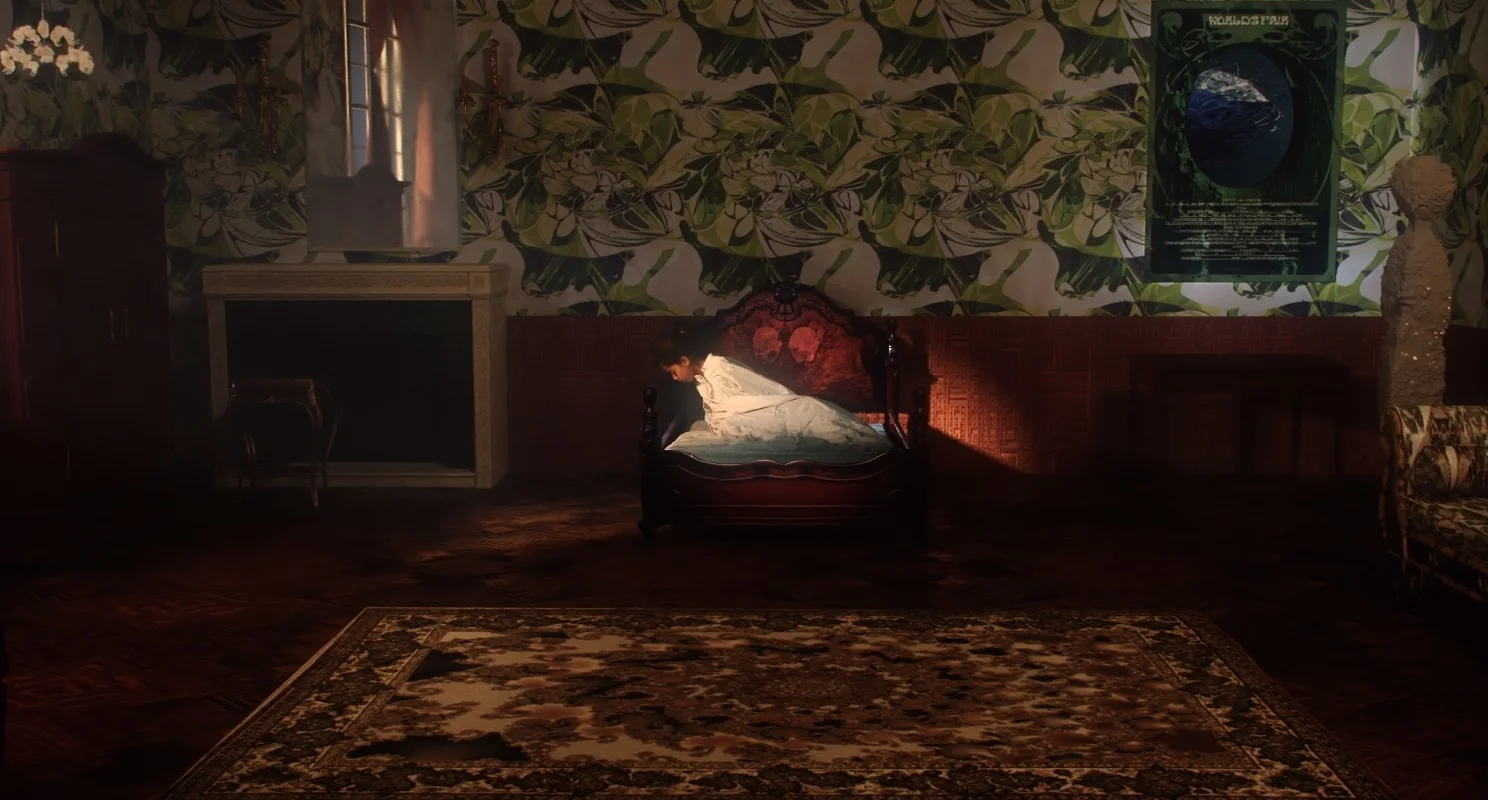
I don't want to create something where we are 'in the middle of the action' I'd still would want to be an observer, albeit one that can observe a hell of a lot more then one that watches a screen. When faced with these issues, interesting techniques come to mind, like split screen. We could continually be at two places at once, on the brink of two hemispheres. This makes production easier, as lights and sound equipment can be placed in the blind corner, and this heightens the feeling that we are not 'actually present' - we are in the virtual world - spying on the real world.
These ideas, especially the last one, are mostly applicable to a screenplay I'm writing, in which the protagonist, a young woman, thinks she is a human - flesh and blood, but actually only exists in the virtual world. She can see the world through cameras, computers, etc. and can easily be at two places at once.
Wouldn't it be great if the audience would experience what it's like to be virtual?
Baraka
I am convinced that this cinematic language must work well in VR. The Virtual Reality goggles have been called temples before, and indeed - it's the architecture that creates presence. The same principles that places of worship have used all over the world for millennia can make VR into something transcendental.
About 23 years after its release, I recently saw the film Baraka, and was extremely impressed by what it managed to achieve. Because it was shot on 70mm IMAX film, it doesn't look dated even for a moment. Its recent sequel, Samsara is almost equally impressive, but it's Baraka that has caught my interest here.
For me, the piece achieves the setting of an emotional curve with only images and music like none other. It delivers an extremely intense climax by postponing it; a single moment that hit me like a religious experience. Since I'm an atheist, this isn't something I have on a regular basis.
The movie slowly builds with imagery from nature and culture, intensifying near the end by showing charred corpses in a funeral ritual on the river Ganges - serene, but heavy. After this scene, we see a man handling a beam that is about to hit a huge bell. The quality of the images is such that the texture can almost be felt. We want the beam to hit the bell, we want to be satisfied by the atonal strike tone - but the moment is cut. Instead, we see Masai, in Trance.
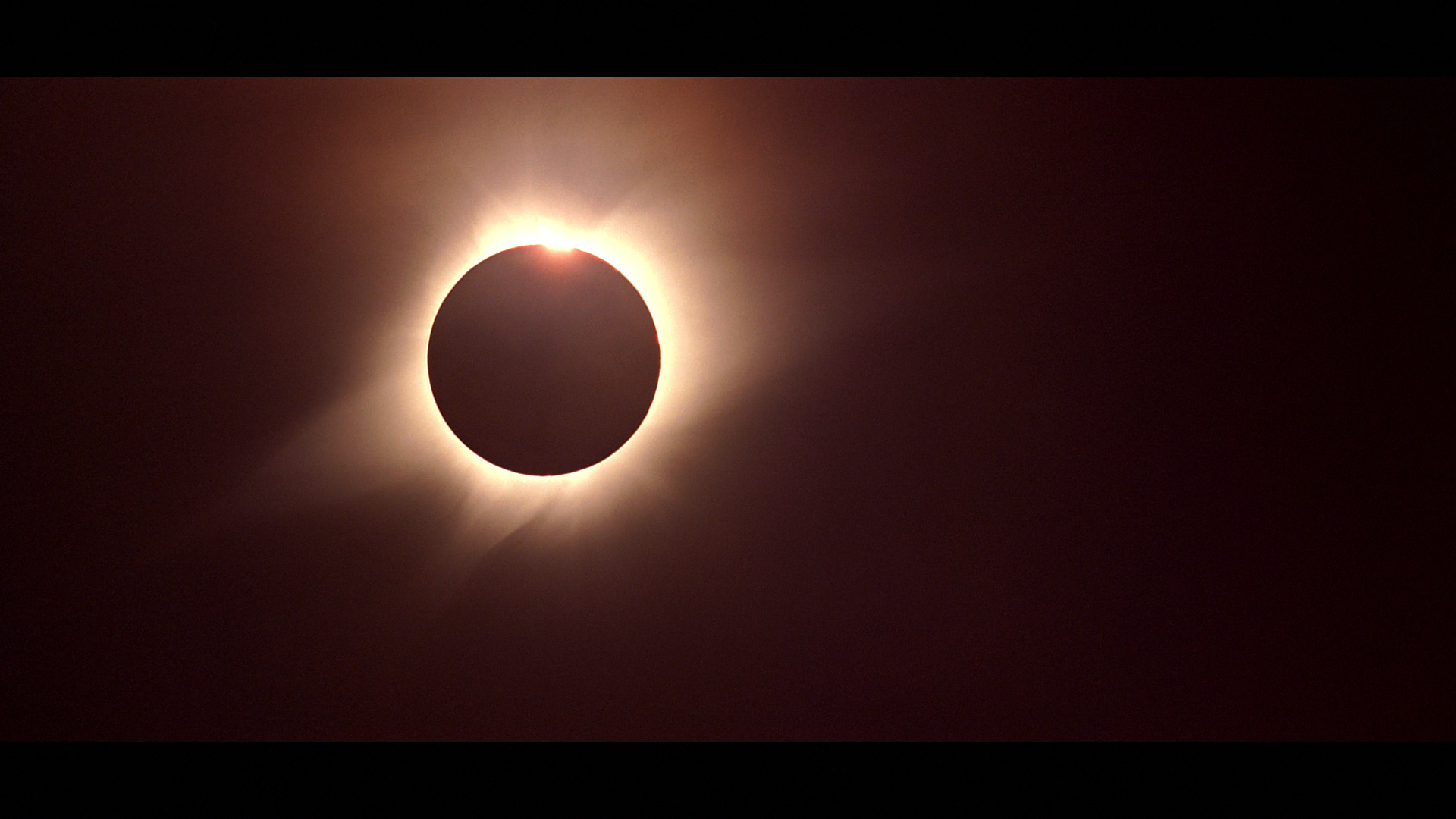
A particular shot of an eclipse has been shown before in the film; it's a perfect example of internal symbolism. An image with otherwise no meaning can start to carry meaning inside the context of the piece.
The spiritual climax delivers when the director cuts to the iconic eclipse again - together with the sound of the immense bell.
I am convinced that this cinematic language must work well in VR. The Virtual Reality goggles have been called temples before, and indeed - it's the architecture that creates presence. The same principles that places of worship have used all over the world for millennia can make VR into something transcendental.
I would really enjoy creating something like the emotional curve from Baraka, including its fantastic soundtrack, in combination with VR. I'm obviously thinking about fractals, but real footage (if shot properly) could be even more amazing.
Baraka on IMDB:
http://www.imdb.com/title/tt0103767/